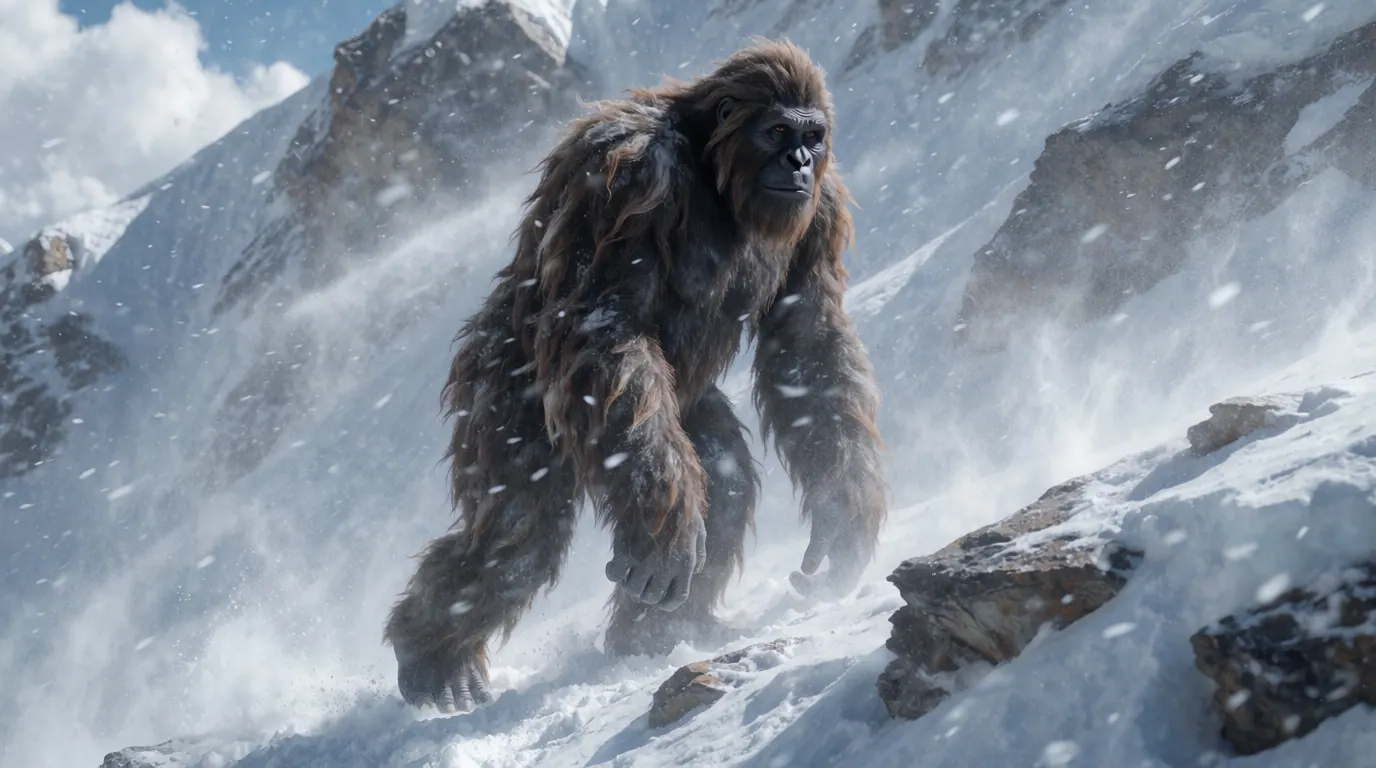
AI identification plate (In habitat) of Yeti
AI ILLUSTRATION FOR REFERENCE ONLY

Yeti

Abominable Snowman · Meh-teh (Sherpa wild-man strand) · Metoh-kangmi (filthy snowman, 1921 press rendering) · Dzu-teh (cattle-bear / large bear strand in some tellings) · Mici (regional wild-man name in some summaries)
UNRESOLVED

Mainstream consensus: Himalayan oral traditions and many Western expedition-era footprint and relic claims are documented, but DNA and museum analysis tie famous “Yeti” samples to bears and other known animals; no verified unknown hominid specimen exists.

Share this page
Short answer

The Yeti is a shaggy, ape-like “wild man” of Himalayan folklore, famous in the West as the “abominable snowman” after 1920s Everest reports. Eric Shipton’s 1951 footprint photos and later relic hunts kept expeditions coming, but DNA tests on famous samples matched bears. Mainstream science treats the label as legend plus misidentified tracks and animals, not a confirmed hominid species.

Overview

The Yeti is the shaggy wild man of Himalayan folklore - known in the West as the “Abominable Snowman” after 1920s Everest press - and a global cryptid brand built on footprints, monastery relics, and expedition photography. Sherpa and Tibetan strands are not one monster: meh-teh points toward a man-like wild figure, dzu-teh toward cattle-raiding bears, and smaller forest beings appear under other names.

Mainstream science now pairs that folklore with hard lab results. Peer-reviewed DNA on hairs, bones, and skins labeled “Yeti” repeatedly matches Himalayan and Tibetan bears. Tracks remain interesting photographs; they are not a holotype.

Compare Florida’s smell-branded swamp ape in Skunk Ape and other regional wild-man brands such as Jersey Devil.

Origin of the legend

British Everest reconnaissance in 1921 carried Sherpa talk of tracks and “metoh-kangmi” into English; Henry Newman’s “Abominable Snowman” headline fixed the nickname. Eric Shipton and Michael Ward’s November 1951 Menlung Glacier photos - a boot beside a ~13-inch print - became the most reproduced Yeti image after The Times published them.

Edmund Hillary’s 1960 World Book expedition tested famous relics such as the Pangboche hand and Khumjung “scalp,” concluding they were assembled from known animals. Bryan Sykes’s 2014 Proceedings of the Royal Society B hair survey and Charlotte Lindqvist’s 2017 follow-up on Himalayan museum samples closed more loops on bears. Tourism and festival culture nonetheless keep dark-furred biped art in Kathmandu shops and Western theme parks - often as a white cartoon that traditional descriptions rarely require.

Similar beings

North American Sasquatch lore shares the shaggy biped idea but not Himalayan oral taxonomy. Skunk Ape relocates the ape to swamps. Mongolian Death Worm shows how Central Asian expedition literature can export another unverified desert being. Bears standing in deep snow remain the primary scientific lookalike for track lore.

In popular culture

From Monsters, Inc. to Disney’s Expedition Everest, white-fur merchandise outruns Sherpa color language. Documentaries still chase footprints; the viral afterlife is entertainment layered on top of bear DNA papers.

Overview
Western “Yeti” images usually describe a towering biped with thick dark or reddish-brown fur, a conical or ape-like head, and outsized footprints in snow. Sherpa and Tibetan strands are not one uniform monster: some names point to a man-like wild figure (meh-teh), others to very large bears (dzu-teh) or smaller forest beings (teh-lma). Treat the ID guide as a folklore composite built from oral tradition plus expedition-era press, not a verified field species.
Height & build
Expedition summaries often place the classic meh-teh near 6–10 feet, broad-shouldered and heavy, walking upright. Some Sherpa tellings describe smaller forest figures under human height. Posture is bipedal in footprint lore; bear misidentification readings emphasize hulking quadruped anatomy when the animal stands.
Head & face
Ape-like or conical skull with a dark furred face is the usual Western cryptid rendering. Neck is sometimes described as short or indistinct under fur. Unlike grey-alien lore, faces are animal, not human celebrity features.
Eyes
Small dark eyes in a deep furred face; no consistent glow or oversized alien-eye reports in the core Himalayan file. Eyeshine at night is occasionally folded into bear or unknown-animal sightings at camp.
Skin / covering
Long shaggy fur in dark brown, reddish-brown, or blackish tones; snow-matted in high-pass stories. Pop-culture white fur is a later cartoon and merchandise look, not the default Sherpa meh-teh description.
Limbs
Long arms relative to torso in many illustrations; bipedal track lore emphasizes heel-to-toe prints far larger than human boots, sometimes with a opposed big toe or ambiguous toe count in disputed cast debates.
Movement & sound
Long-striding bipedal walk in track lore; whistling or high-pitched calls appear in some oral accounts. Most “live” reports are distant silhouettes or heard-but-not-seen, not sustained close observation.
Lookalikes
Himalayan brown bear, Tibetan blue bear, langurs or other primates at distance; human climbers in gear; hoax wooden foot devices; North American Bigfoot / skunk-ape lore imported by later books; white-fur cartoon Yeti from film and theme-park art.
Witness consistency
Mountain habitat, large prints, and shaggy biped silhouette recur across Western expedition literature. Size, color, and whether the being is spirit, bear, or hominid shift between Sherpa strands and tourist retellings.

Documented encounters and accounts

Published contact, sighting, and related accounts summarized from named sources. Links let you read the originals; AnomalyWiki does not verify these claims.

Claims vs mainstream

The claim

Eric Shipton’s 1951 footprint photographs prove an unknown hominid walks the Himalaya.

Mainstream view

The photos document large anomalous-looking prints in snow; experts have argued bear tracks distorted by melt, overlapping steps, or unknown but mundane causes. Photos are evidence of tracks, not of species identity without corroborating biology.

The claim

Pangboche hand and Khumjung monastery “Yeti scalp” relics were parts of an unknown primate.

Mainstream view

Investigators including Edmund Hillary’s team concluded the famous relics were assembled from bear and antelope parts; museum and lab summaries treat them as ritual or tourist objects, not zoological type specimens.

The claim

DNA studies still leave room for a hidden ape-man population.

Mainstream view

Peer-reviewed hair and bone studies (Sykes 2014; Lindqvist 2017 and follow-ups) consistently match samples to regional bears; no unknown primate genome has been validated from “Yeti” material submitted to major labs.

The claim

The white furry “Yeti” of cartoons is the traditional Himalayan description.

Mainstream view

White fur is a modern pop-culture design (film, toys, theme parks). Sherpa meh-teh and expedition-era Western accounts more often describe dark or reddish-brown shaggy fur.

Timeline

  1. 1832Naturalist B. H. Hodgson publishes a Nepal journal letter describing “wild men” covered in dark hair; later analysts suggest langur misidentification, but the note is an early English- language datapoint for Himalayan wild-man talk. Source: Hodgson, Asiatic Researches (1832); later cryptozoology historiography
  2. 1921Howard-Bury Everest reconnaissance team records Sherpa reports of tracks and “metch-kangmi”; press coverage via Henry Newman popularizes “Abominable Snowman” in English. Source: Howard-Bury, Alpine Journal (1922); Britannica / expedition histories
  3. 1951Eric Shipton and Michael Ward photograph large bipedal footprints on the Menlung Glacier during a reconnaissance near Everest, reigniting global Yeti interest. Source: Shipton mountaineering accounts; Royal Geographical Society expedition literature
  4. 1957–1959Tom Slick funds Himalayan searches; Peter Byrne and others pursue relics including material from Pangboche monastery. Source: Cryptozoology histories; period journalism on Slick expeditions
  5. 1960Edmund Hillary and Marlin Perkins lead a World Book Encyclopedia expedition that examines Pangboche “Yeti hand” and Khumjung scalp; team reports animal parts, not unknown primate remains. Source: Hillary accounts; contemporary press summaries
  6. 2014Bryan Sykes and colleagues publish DNA results on alleged Yeti hairs; most match regional bears, with one sample suggesting ancient polar bear–brown bear hybrid ancestry in interpretation. Source: Sykes et al., Proc. R. Soc. B (2014)
  7. 2017Charlotte Lindqvist’s team re-analyzes purported Yeti samples from museums and collections; all align with Himalayan or Tibetan bears. Source: Lindqvist et al., Proc. R. Soc. B (2017)

FAQ

Is the Yeti real?

Himalayan oral traditions are real cultural history, and many footprints and relics were photographed or collected, but peer-reviewed DNA on famous samples matches regional bears. No verified unknown hominid specimen exists.

What did Eric Shipton photograph in 1951?

Large, clear footprints on the Menlung Glacier, shown beside a boot for scale. The photos prove tracks existed; they do not by themselves identify a species.

What did DNA studies find?

Bryan Sykes's 2014 hair survey and Charlotte Lindqvist's 2017 bone and tissue study tied purported Yeti samples to Asian bears (and one dog), not to an unknown ape-man.

Are Yeti and Bigfoot the same?

Both are shaggy biped legends, but they grow from different regions and story cycles. Himalayan names such as meh-teh and dzu-teh are not Pacific Northwest Sasquatch lore.

Why is it called the Abominable Snowman?

A 1921 London press rendering of Sherpa "metoh-kangmi" (often glossed filthy snowman) after the British Everest reconnaissance; the nickname stuck harder than the original terms.