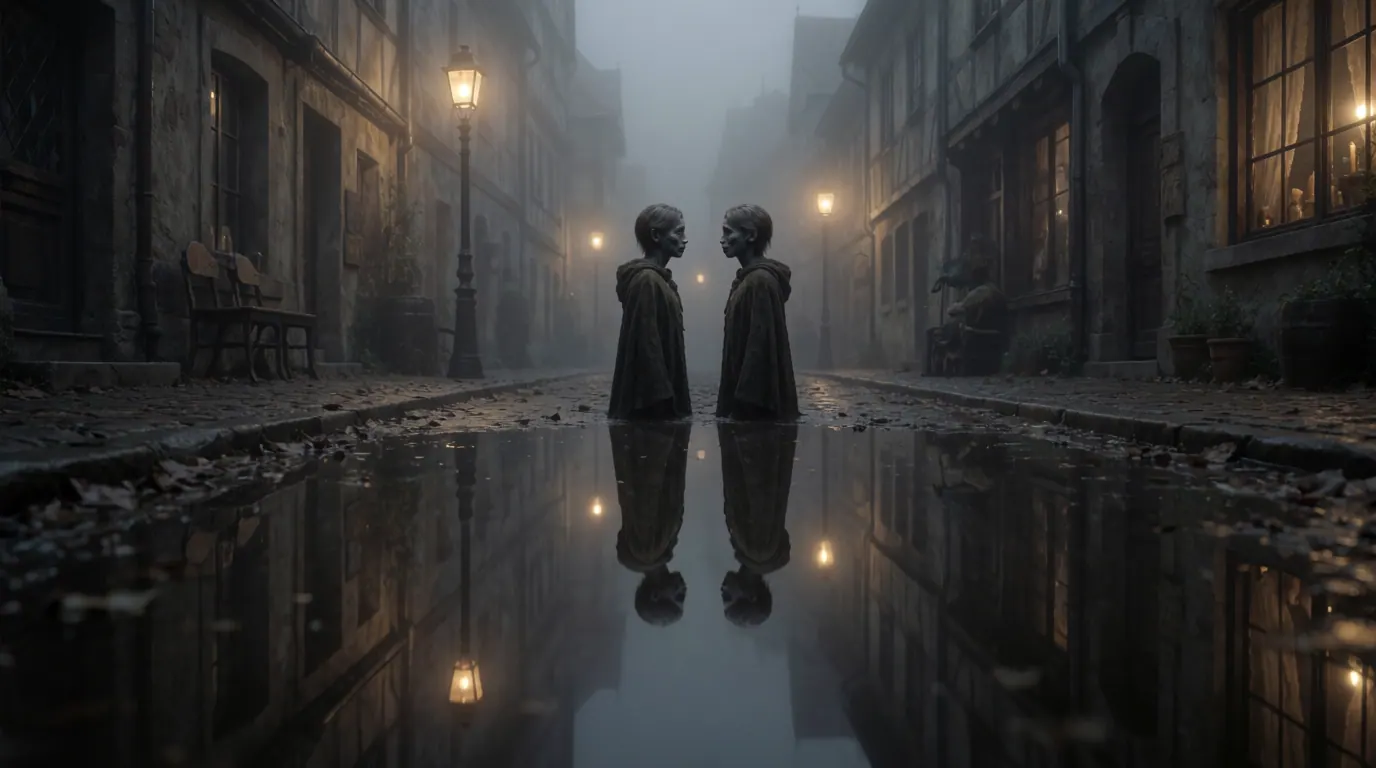
AI identification plate (In habitat) of Doppelgänger
AI ILLUSTRATION FOR REFERENCE ONLY

Doppelgänger

Doppelganger · Doppelgänger · Fetch (related double motif) · Vardøger (related precursor)
FOLKLORE

Mainstream consensus: Doppelgängers are folklore and literary motifs; psychology and neuroscience explain some "seeing oneself" reports through misperception, dream states, and clinical conditions - without confirming a supernatural second body.

Share this page
Short answer

A doppelgänger is someone's exact double - an omen of crisis in Germanic folklore and a recurring motif in Romantic literature. Goethe, Shelley, and later psychology borrowed the shiver of seeing yourself where you should not be. Mainstream views treat doubles as narrative and perceptual phenomena, not a second body walking around.

Overview

A doppelgänger is the exact double of a living person - same face, wrong place. Germanic folklore treats the sight as an omen of illness, crisis, or death. Romantic writers seized the shiver: Goethe's autobiographical traditions, Shelley's eerie double anecdotes, and later Gothic novels made the duplicate a symbol of split self and doomed recognition. Modern psychology and neuroscience add explanations for some experiences - misrecognition, sleep-related hallucination, or the unsettling sense of a presence - without requiring a second physical body on the street.

The German compound literally points to a "double goer." Related motifs appear across cultures (fetch, vardøger, bilocation saints), but the German label dominates English paranormal search. Mainstream consensus: culturally real as story and sometimes as weird perception; not verified as a roaming spare human.

Origin of the legend

Double omens predate the popular German term. Nineteenth-century collections such as Catherine Crowe's The Night-Side of Nature gathered bilocation and double tales for Victorian readers. The Emilie Sagée schoolteacher story - pupils claiming to see their teacher in two places - became a staple anecdote in psychical literature. Otto Rank and later psychoanalytic writers turned the double into a theory of narcissism and mortality fear.

Internet paranormal culture sometimes merges doppelgängers with shadow people or Hat Man encounters. Those are silhouette-fear types; doppelgängers specifically copy a known person's face. Black-eyed children share threshold dread without the identity copy.

Similar beings

Fetches in Irish lore, Norse vardøger precursors, and cinematic "evil twin" plots neighbor the motif. Shapeshifter traditions such as selkie stories change skin rather than duplicate a living neighbor. Keep banshee death-omen lore adjacent but distinct: sound and kinship versus visual double.

In popular culture

From Dostoevsky's The Double to Jordan Peele's Us and endless thriller twins, the doppelgänger thrives as identity horror. True-crime podcasts misuse the word for look-alike suspects. Social media "I saw myself" posts recycle the omen without nineteenth-century framing. The motif stays sticky because everyone understands the wrongness of meeting your own face.

Overview
A doppelgänger is a living double of a person - identical face and clothes - traditionally an omen. Visually it is uncanny because it is too exact, not because it is monstrous.
Height & build
Matches the person duplicated; same gait in mirror-like scenes.
Head & face
Identical face; sometimes subtly wrong expression or delayed mimicry.
Eyes
Human eyes; vacant, knowing, or empty-of-affect in horror retellings.
Skin / covering
Human skin tone matching the original.
Limbs
Human proportions; mirror-symmetric staging common in art.
Movement & sound
Mirrors the original or acts independently; silent approach in omen stories.
Lookalikes
Twins; impostors; reflections; digital deepfakes (modern analogy).
Witness consistency
Exact likeness defines the type; whether the double speaks or attacks varies by author.

Documented encounters and accounts

Published contact, sighting, and related accounts summarized from named sources. Links let you read the originals; AnomalyWiki does not verify these claims.

Claims vs mainstream

The claim

Seeing your double always predicts death within days.

Mainstream view

Omen belief is culturally real as story; mortality correlation is not statistically verified. Many "double" reports have mundane explanations.

The claim

Doppelgängers prove the soul can split from the body.

Mainstream view

Religious and philosophical soul doctrines differ; folklore doubles are narrative symbols, not laboratory-demonstrated bilocation.

The claim

Every lookalike stranger is a supernatural doppelgänger.

Mainstream view

Twins, cousins, impersonators, and mistaken identity explain most cases; the folklore type requires uncanny sameness plus omen framing.

Timeline

  1. 1796Jean Paul (Richter) popularizes "Doppelgänger" wording in German Romantic discourse, linking doubles to divided selfhood. Source: Literary history summaries; Jean Paul lexicon entries
  2. 1821Goethe's published account of encountering his younger self on a road after Marienbad becomes a canonical European double anecdote. Source: Goethe, Aus meinem Leben (From My Life)
  3. 1836Catherine Crowe's The Night-Side of Nature collects European ghost and double reports for English readers, spreading doppelgänger vocabulary. Source: Crowe (1836)
  4. 1914Otto Rank's Das Doppelte (The Double) analyzes the motif psychoanalytically, shifting part of the conversation from omen lore to identity psychology. Source: Rank, Das Doppelte (1914)

FAQ

What happens if you see your doppelgänger?

Germanic folklore often treats the sighting as an omen of illness or death. That is belief and story logic, not a verified forecast - many similar experiences have mundane explanations.

Is a doppelgänger the same as an evil twin?

Evil-twin plots overlap in modern TV, but classic doppelgängers stress uncanny sameness and omen, not necessarily malice or superpowers.

Can science explain doppelgänger reports?

Misidentification, fatigue, grief, and some neurological conditions can produce double perceptions; folklore and psychology offer different vocabularies for the same shiver.

Are deepfakes modern doppelgängers?

Journalists sometimes use the analogy. Digital impersonation is real technology; it does not validate supernatural doubles.