Overview
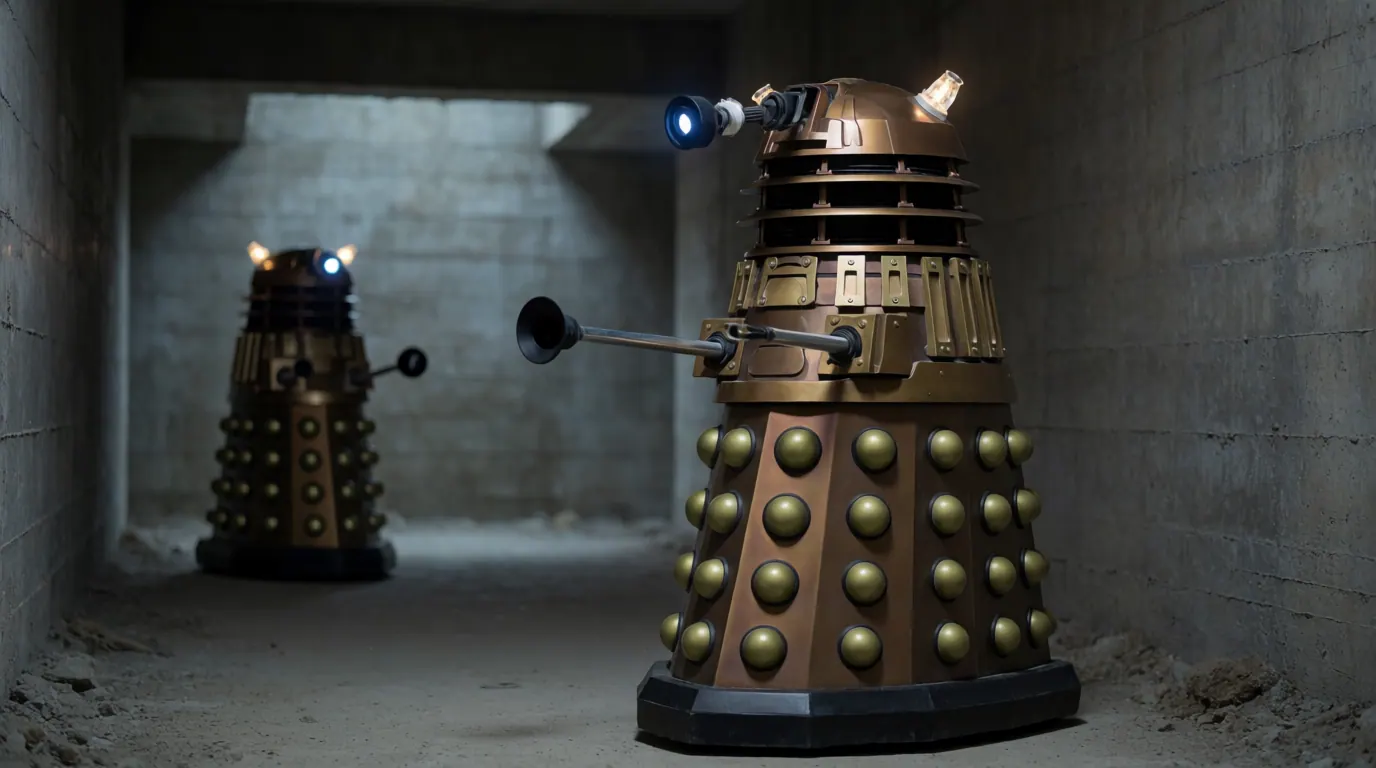
Daleks sit at the extreme end of Doctor Who's rogues' gallery: a fictional armored-mutant species whose entire identity is a travel machine rather than a body a viewer ever sees clearly. The casing itself, close to chest height on an adult human, reads instantly across six decades of British television, and that consistency is the point - audiences recognize a Dalek before they recognize almost any other robot or alien on screen. Inside the bronze, gray, or (in commander variants) black-and-gold shell sits a shriveled, tentacled mutant that the show almost never shows directly, which keeps the pepper-pot silhouette doing all identification work.
Claimed abilities in the fiction include a directed-energy weapon fired from the gun-arm socket, a plunger-style manipulator arm for manual tasks, and, from the 2005 revival onward, hovering flight that replaced the classic glide-on-wheels movement. Expanded-media stories add empire-scale warfare and mass-conversion plots that turn captured populations into new Dalek hosts, though those details shift from writer to writer rather than following one fixed manual.
The species' home world is Skaro, a planet reduced to toxic wasteland by a thousand-year war between the Kaled and Thal peoples in the in-universe backstory introduced in 1975. Aliases are sparse by design: "Dalek" is the only name the franchise uses consistently, with "Kaled mutant" occasionally applied to the organic creature hidden inside the casing once later scripts started discussing biology at all. That narrow naming is itself a franchise choice; Terry Nation wanted one unforgettable word, not a taxonomy.
Canon status is straightforward by franchise standards: the BBC treats the television episodes as the backbone, with novels, audio dramas, and comics filling in gaps without always agreeing on fine details like exact empire size or the number of Dalek-Thal wars. Readers comparing Daleks with other fictional aliens on this site will notice a pattern common across franchise entries - a stable, merchandisable silhouette built once and defended fiercely by its studio, layered over decades of writers reinterpreting the same core idea for new audiences. Doctor Who has now run across parts of six different decades, and the Daleks have outlasted every actor who has played the Doctor during that run, a durability matched by few other television villains anywhere in the world.
Origin of the legend
Doctor Who's producers almost did not get Terry Nation's monster at all. The BBC's own in-house story editors reportedly doubted a script about mutants hidden in metal shells, and Nation himself was between jobs, writing the serial partly to pay bills while his agent shopped other projects. Designer Raymond Cusick, a staff artist rather than a specialist creature-effects designer, inherited the assignment after Ridley Scott, the BBC designer originally slated for the job and later famous for directing Alien, became unavailable due to scheduling conflicts. Cusick's brief was unusually tight: build something an actor could operate while seated, on a budget that ruled out walking legs or elaborate animatronics.
His solution borrowed from everyday objects as much as from science fiction. Cusick has described starting from the image of a man sitting in a chair, then working outward to hide the operator's body beneath a skirted base that could glide rather than walk, solving the budget problem and creating an uncanny, non-human motion in the same stroke. The skirt's ribbed hemispheres and the dome's rotating eyestalk gave Dalek operators limited but workable sightlines, while a ring-modulated voice effect, applied in post-production by the BBC Radiophonic Workshop, finished the effect with a harsh, inhuman rasp that voice actors Peter Hawkins and David Graham delivered live during the original 1963 broadcasts.
The serial's impact was immediate and, by BBC standards of the era, almost unprecedented. Ratings climbed through the seven-week run, newspapers covered children hiding behind the sofa, and toy manufacturers rushed Dalek merchandise onto British shelves within months, a phenomenon the press nicknamed Dalekmania. That commercial explosion created a strange asymmetry behind the scenes: Terry Nation, as the creature's credited creator, negotiated separate merchandising rights that made him wealthy, while Cusick, as a salaried BBC staff designer, received no royalties for the design that made the toys sellable in the first place, a point Cusick spoke about publicly for decades afterward.
For eleven years, the show gave no account of what the Daleks actually were beneath the casing or how they came to exist. That changed only in 1975's "Genesis of the Daleks," which retroactively built the species' creation story around Kaled scientist Davros and the ruinous war on Skaro, turning a successful monster-of-the-week design into a species with an origin myth, a moral argument, and a recurring creator-villain that later stories would return to again and again.
Similar beings
Daleks sit at one extreme of a spectrum this encyclopedia tracks across fictional alien species: creatures built entirely around an instantly recognizable industrial silhouette rather than a face. The closest comparison on this site is the Klingons, Star Trek's warrior humanoids, and the contrast is instructive. Klingons are flesh-and-blood actors in prosthetic makeup, designed so their honor culture, politics, and facial expressiveness could carry entire episodes of dialogue-driven drama. Daleks are the opposite design choice: a species whose body is deliberately hidden, whose personality comes through a distorted electronic voice and a single repeated word, and whose storytelling function is pure threat rather than nuanced culture. Both approaches have proven durable for decades, which says as much about what television villains need as it does about either specific species.
The Xenomorph of the Alien franchise offers a different kind of contrast, another non-humanoid threat, but one built around body horror and a parasitic life cycle rather than robotic armor and genocidal ideology. Where a Dalek's danger is explicit and verbal, announcing its intent to exterminate before firing, the xenomorph's danger is silent and biological, closer to a nightmare about infection than a nightmare about fascism. Readers interested in how different science-fiction traditions encode fear into alien design will find the two entries useful opposite numbers.
The Yautja of the Predator franchise and the Na'vi of Avatar round out this site's current fictional-alien cluster, and both make for useful comparisons in different directions. Yautja share the Daleks' taste for ritualized, codified combat, but channel it through a masked individual hunter rather than a faceless collective empire. Na'vi sit almost at the opposite pole from Daleks entirely, a species defined by organic connection to its home ecosystem rather than mechanized conquest of others, which makes the pairing a useful reminder that "alien" in franchise fiction covers an enormous design range.
Beyond this site's fiction cluster, UFO-lore humanoids like Nordic Aliens and Greys make a sharper category distinction worth stating plainly: those pages describe testimony-based folklore with claimed witnesses, dates, and locations, graded for evidence quality. Daleks have none of that apparatus because they need none; they are a scripted character with a credited writer, a credited designer, and a legal owner in the BBC. Confusing the two categories, treating a Terry Nation script as equivalent to an abduction account, misunderstands what each page is actually documenting.
In popular culture
Few British television props have escaped their original show as completely as the Dalek. Within a year of the 1963 debut, Dalekmania had produced toy ray-guns, bubble-gum cards, annuals, comic strips, and a novelty pop single, "I'm Gonna Spend My Christmas with a Dalek," released in 1964, that made the BBC's pepper-pot villain a fixture of British Christmas culture decades before streaming turned franchise merchandise into a year-round industry. Two Peter Cushing feature films, Dr. Who and the Daleks (1965) and Daleks' Invasion Earth 2150 A.D. (1966), brought the creatures to color cinema screens while the television show itself was still shot in black and white, giving a full generation of children two competing mental images of the same villain.
The word "Exterminate," delivered through the Daleks' ring-modulated voice, has drifted well outside Doctor Who fandom into general British usage as shorthand for ruthless, repetitive aggression, the kind of crossover only a handful of television catchphrases ever achieve. Political cartoonists, satirists, and advertising copywriters have borrowed the line for decades, usually without needing to explain the reference to a British audience. The 2005 revival leaned into that recognition deliberately, giving the newly bronze-casinged Dalek its own standalone episode before reintroducing it to a wider pop-culture conversation that had grown up without new television Doctor Who to anchor it for sixteen years.
Fan culture has layered its own traditions on top of the official merchandise. Propmakers build screen-accurate replica casings for conventions, cosplay events regularly field dozens of working Dalek costumes, and the long-running in-joke about Daleks being unable to climb stairs survives in web memes even though the show itself debunked it on screen back in 1988. The BBC's own Doctor Who Experience exhibition in Cardiff, open through much of the 2010s, built entire walk-through sets around the species, underscoring how central the design remains to the franchise's public identity even as storylines, actors playing the Doctor, and production teams have turned over many times since 1963.
That staying power is unusual among science-fiction villains precisely because the Daleks have no human face for audiences to attach to a specific era or actor. A viewer who has never watched a full episode can usually still recognize the silhouette, repeat the catchphrase, and place the species correctly as Doctor Who's signature monster, a level of brand recognition most fictional alien species, including several covered elsewhere on this site, never come close to matching.