Overview
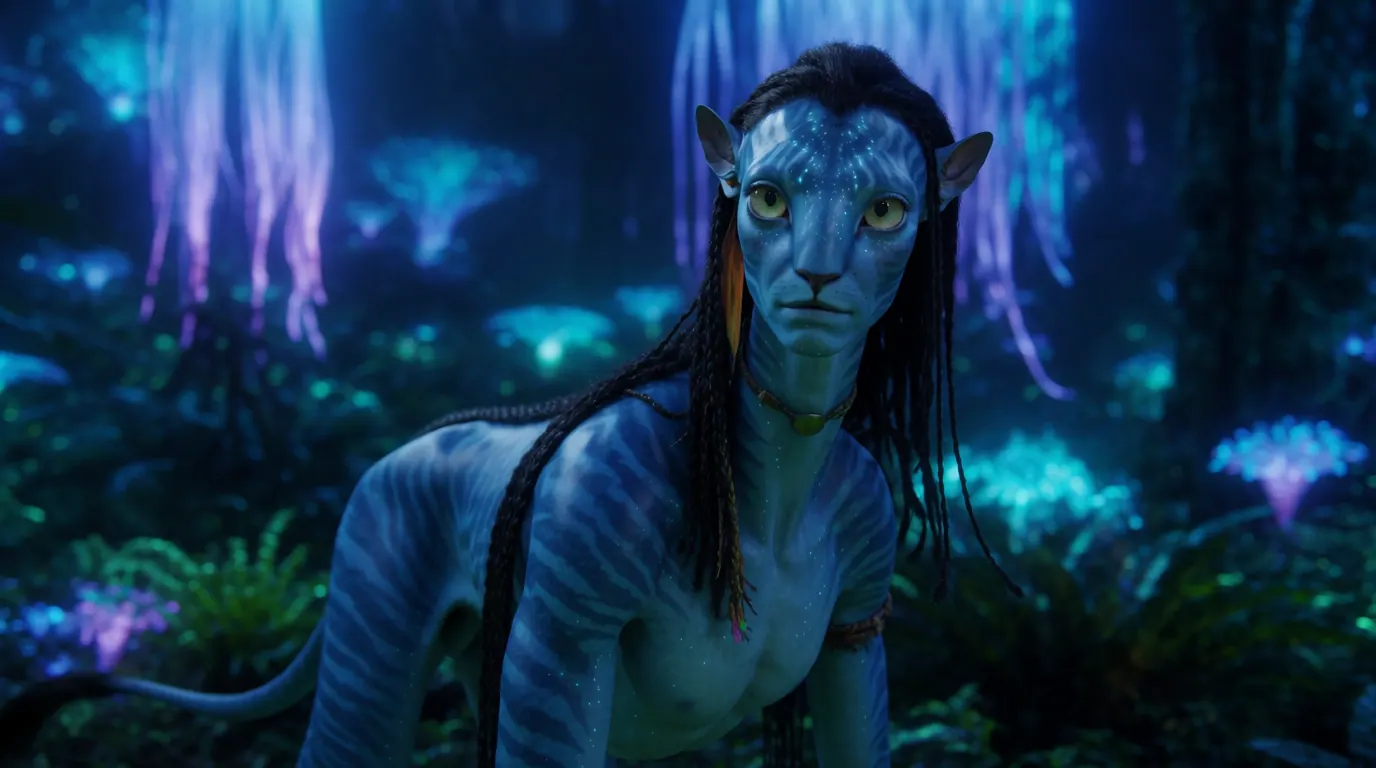
The Na'vi are the indigenous humanoid species of Pandora, the fictional moon at the center of James Cameron's Avatar franchise, standing roughly ten feet tall with blue-hued skin, large amber eyes adapted for Pandora's low light, and a prehensile neural queue growing from the base of the skull that the films use as both a cultural marker and a literal biological interface. That queue is the species' single most distinctive trait: Na'vi characters use it to form a neural bond called tsaheylu with Pandora's native wildlife, from riding beasts to the planet's networked root systems, a design choice that lets the films dramatize an entire ecosystem's interconnectedness through a single recurring gesture rather than exposition.
Claimed physical traits include heightened strength and reflexes relative to humans, a tail used for balance, and ears and nostrils built for a sensory range the films depict as considerably sharper than human hearing and smell. Culturally, the Na'vi organize into clans tied to specific biomes, the forest-dwelling Omaticaya introduced in the first film and the ocean-dwelling Metkayina added in 2022's sequel, each with its own rituals, physical adaptations, and relationship to Pandora's shared neural network, Eywa, which the films present as something between a planetary consciousness and a literal biological internet connecting every living thing on the moon.
The species' homeworld, Pandora, orbits a fictional gas giant Cameron's production team named Polyphemus, itself part of the fictional Alpha Centauri A system in the films' setting, a detail the franchise treats consistently even though no such moon or gas giant exists in real astronomical catalogs of the actual Alpha Centauri system. Aliases are minimal in the fiction: "Na'vi" is the species' own name for itself, used consistently by both Na'vi characters and the human colonizers the plot centers on.
Canon status is tightly controlled by the studio: 20th Century Fox, and later Disney following its 2019 acquisition of Fox's film assets, treats the released films as the sole backbone of Avatar continuity, with linguist Paul Frommer's published Na'vi dictionary serving as the authoritative language reference for an expanding fan and academic community. Readers comparing the Na'vi with other fictional species on this site will notice a pattern distinct from the humanoid aliens elsewhere in the fictional-aliens cluster: rather than being built around combat or menace, Na'vi design serves an ecological and environmentalist storytelling purpose, making the species' entire narrative function different from warrior cultures like the Klingons or predatory threats like the Xenomorph.
Origin of the legend
James Cameron drafted an early treatment for what became Avatar in 1994, years before the director's other major projects of that decade reached theaters, but shelved active production for roughly a decade. Cameron has said in interviews collected across the film's press materials that he judged the visual-effects and performance-capture technology of the mid-1990s incapable of rendering a convincing ten-foot blue alien species whose faces needed to carry real emotional weight across a feature-length film, rather than functioning as a brief effects showcase.
Creature designer Jordu Schell picked up the assignment once Cameron's production restarted in the mid-2000s, sculpting a series of maquettes that explored different proportions and facial structures before the team settled on the final Na'vi look balancing feline and human reference points. Cameron simultaneously commissioned linguist Paul Frommer, a University of Southern California professor, to build a complete constructed language for the species from the ground up, an unusually heavy linguistic investment for a studio blockbuster that reflected the production's broader commitment to worldbuilding depth over quick effects shortcuts.
The 2009 release paired that groundwork with genuinely new filmmaking technology: Cameron's team developed enhanced performance-capture rigs and stereoscopic 3D camera systems specifically to render Pandora's bioluminescent forests and the Na'vi themselves as fully realized digital performances rather than static creature effects. The film's commercial success, becoming the highest-grossing release of its era according to major box-office trackers, validated the decade-long development timeline and prompted both a long-running sequel franchise and a dedicated theme-park land built around Pandora's ecosystem.
Later films expanded the species' documented cultural range considerably. "Avatar: The Way of Water," released in December 2022, introduced the Metkayina, an ocean-dwelling Na'vi clan with physical adaptations including paddle-like tails and improved underwater breath control, demonstrating that the production team continued treating Na'vi biology and culture as an expanding, internally consistent system rather than a single fixed design locked in by the first film.
That commitment to internal consistency extended to the production's approach to performance itself. Cameron insisted on full-body performance capture for the Na'vi cast rather than simpler facial-replacement techniques common elsewhere in visual-effects filmmaking at the time, reasoning that an actor's complete physical performance, not just facial expression, needed to translate into the final digital character for audiences to accept a ten-foot blue alien as an emotionally real screen presence. That technical choice required actors to train extensively in movement and dialect work specific to Na'vi culture, with some cast members reportedly spending months learning Frommer's constructed language well enough to deliver dialogue with correct rhythm and pronunciation rather than simply reciting phonetic transcriptions handed to them on set.
Similar beings
The Na'vi occupy a distinct niche among this encyclopedia's fictional-alien entries: a species defined by ecological harmony rather than conflict, menace, or conquest. The sharpest contrast on this site is the Klingons of Star Trek, whose entire cultural identity centers on honor through combat and political rivalry; where Klingon storytelling explores empire, war, and diplomacy, Na'vi storytelling explores a species' relationship to its home biosphere and the threat posed by outside extraction and colonization, a near-opposite thematic register despite both being humanoid warrior-capable cultures when the plot calls for it.
The Daleks of Doctor Who and the Xenomorph of the Alien franchise sit even further from Na'vi design logic, both functioning as pure antagonist forces with no ecological or cultural nuance built into their core concept. Readers interested in how differently science fiction can imagine "alien" will find the Na'vi a useful counterweight to those entries: a species the audience is meant to root for and identify with, rather than fear.
The Yautja of the Predator franchise offer a more interesting partial comparison, since both species share a reverence for their home environment's ecosystem and a code of honorable conduct, but the Yautja express that reverence through solitary hunting ritual rather than the Na'vi's collective, networked spirituality centered on Eywa. The difference illustrates how two franchises can build superficially similar "noble warrior" alien concepts that function in almost opposite narrative roles once examined closely.
Beyond this site's fiction cluster, the category line between Na'vi and UFO-lore humanoids like Nordic Aliens deserves stating plainly, since surface descriptions (tall, humanoid, otherworldly) can superficially sound similar. Nordic Alien pages describe testimony-based contactee claims with named witnesses and dated encounters, graded for evidence quality; Na'vi pages describe a credited director's scripted film franchise with a known production history, and the two should never be read as documenting the same kind of material.
The distinction is worth making explicit rather than assuming readers will infer it: a contactee claim typically names a specific person, a specific date, and a specific location where contact allegedly occurred, details this site's UFO-lore pages weigh against available corroborating evidence. A Na'vi page instead traces back to a credited screenwriter and director, a visual-effects studio, and a release date on a theatrical calendar. Both kinds of pages describe tall blue or otherwise unusual humanoid figures, but only one category asks readers to weigh witness credibility, while the other simply documents a studio's creative and production choices.
In popular culture
Avatar's 2009 release reshaped the commercial calculus of blockbuster filmmaking almost overnight, with its box-office performance prompting a wave of studio investment in 3D theatrical releases and performance-capture technology across the industry for years afterward, even as many of those imitators failed to match the original's technical polish. Disney's California Adventure park built an entire themed land, Pandora - The World of Avatar, around the franchise's bioluminescent forest aesthetic, giving visitors physical, walkable versions of the floating mountains and glowing flora the films rendered digitally, a rare case of a fictional alien ecosystem becoming a literal tourist destination.
Linguist Paul Frommer's constructed Na'vi language has developed its own modest but genuine fan community, with online dictionaries, grammar guides, and language-learning forums maintained by enthusiasts years after the first film's release, a smaller-scale echo of the much larger Klingon-language community but notable for how quickly it formed around a single film franchise. The species' blue skin tone and neural-queue design have also become recognizable shorthand in broader pop culture for "benevolent alien" imagery, distinct from the more threatening silhouettes associated with grey aliens or franchise monsters.
Environmental and indigenous-rights commentators have engaged with Avatar's Na'vi storyline as a parable about resource extraction and colonization, a reading Cameron has acknowledged as intentional in press interviews surrounding the first film's release. That thematic weight has kept the franchise part of ongoing conversations about environmentalism in popular media, well beyond the usual box-office and merchandising discussion that follows most blockbuster science-fiction releases.
The franchise's continued expansion, with "Avatar: The Way of Water" in 2022 and further sequels announced for the following years, has kept the Na'vi culturally present far longer than most single-decade movie franchises manage, helped considerably by the fact that each new installment has introduced genuinely new Na'vi cultural variation, like the ocean-dwelling Metkayina clan, rather than simply repeating the first film's forest setting and visual palette.
Merchandising and licensed media built around the Na'vi have leaned heavily on the species' ecological imagery rather than the combat-oriented toy lines typical of other blockbuster science-fiction franchises, with Disney's Pandora theme-park attraction emphasizing guided boat tours and bioluminescent night displays over the ride-based thrill attractions more common at competing parks. That choice reflects the franchise's broader marketing strategy: selling audiences on Pandora as a place to experience rather than purely a battlefield to refight, a positioning distinct from how Star Wars or Star Trek typically market their own fictional universes to theme-park visitors and merchandise buyers alike.