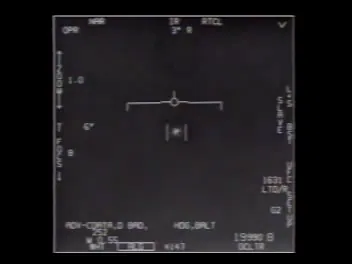
An infrared frame from the 2015 Navy ATFLIR "Go Fast" video, officially released by the Department of Defense in April 2020, showing the small thermal object low over the ocean.
U.S. DEPARTMENT OF DEFENSE / PUBLIC DOMAIN

Go Fast UAP

GOFAST video · Go Fast UFO
UNRESOLVED

Mainstream consensus: The Department of Defense officially released and authenticated the Go Fast video in April 2020 as genuine Navy footage without characterizing the object's nature. Independent analyst Mick West has argued through frame-by-frame parallax analysis that the object's true speed may be far slower than its apparent on-screen speed suggests, a kinematics debate that remains publicly unresolved.

Share this page
Short answer

The Go Fast video is 2015 Navy infrared footage of a small object skimming low over the ocean, officially released by the Department of Defense in April 2020 with the Gimbal and Tic Tac clips. Analyst Mick West argues parallax from a distant, slower object can make its on-screen speed look far more extreme than its true velocity.

"Go Fast" is a name pilots gave the object in the moment, reacting to what their screen showed them - and that same screen is exactly what later analysts argue can make a modest true speed look extraordinary. The case is less about whether the video is real, which the Pentagon settled in 2020, and more about whether "fast" means what it sounds like.

A low pass over open ocean

During a 2015 training mission over the Atlantic, a Navy F/A-18 crew picked up a small, round thermal object skimming low over the water on an ATFLIR targeting pod. The released audio captures real-time pilot reaction to how quickly the object appeared to cross their display - the moment that gave the clip its lasting nickname well before any official statement addressed it.

Official release, open question

Like its companion clips, Go Fast first reached the public through To The Stars Academy in 2017 and circulated for years before the Department of Defense officially declassified and released it in April 2020 alongside Gimbal and the Tic Tac footage. The Pentagon's statement confirmed the video's authenticity without offering any characterization of the object's nature, origin, or true performance.

The parallax counter-argument

Independent analyst Mick West's frame-by-frame review raised a specific, testable point: without a confirmed distance and altitude for the object, its on-screen speed across the targeting pod's display could reflect ordinary parallax rather than a genuinely extreme true velocity. An object farther away and higher up than it first appears would need to travel much slower to produce the same apparent screen motion - a distinction the raw footage alone cannot settle, since the pod records angular position, not absolute range.

Weighing the footage honestly

The clearest facts here are that the video is real, government-released, and shows a genuine sensor anomaly that two different pilots on two different aircraft that year could not immediately identify. The "impossible speed" framing that attaches to the name is a separate, disputed claim that depends on distance estimates the footage itself does not provide. Readers comparing the full 2015 Navy encounter set should also look at Gimbal, recorded the same year and released in the same April 2020 batch.

Documentary photos

Rights-cleared documentary stills and serious reference images. These are not AI illustrations.

Official Department of Defense release frame, April 2020Credit: U.S. Department of Defense / public domain

Sightings and object accounts

Attributed sightings, recoveries, and object histories from named sources. Links open the originals; AnomalyWiki does not verify these claims.

Claims vs mainstream

The claim

The Go Fast object's name proves it was moving at an extreme, physics-defying velocity.

Mainstream view

Analyst Mick West and others argue the object's true distance and altitude are not confirmed in the released footage, meaning its actual groundspeed could be substantially lower than the on-screen impression created by parallax against a tracking camera.

The claim

Government release of the video confirms the object had unknown propulsion.

Mainstream view

The Department of Defense's 2020 statement authenticated the footage as genuine but explicitly declined to characterize the object's origin, nature, or propulsion method.

The claim

Pilot excitement on the radio proves the object was behaving impossibly.

Mainstream view

Genuine pilot surprise documents an unexpected visual encounter; it does not by itself establish confirmed speed or distance figures, which require separate geometric analysis of the footage.

Timeline

  1. 2015A Navy F/A-18 crew records the Go Fast object on ATFLIR infrared video during a training encounter over the Atlantic Ocean.Source: U.S. Department of Defense, April 2020 release statement
  2. 2017-12To The Stars Academy of Arts and Science first makes the Go Fast footage publicly available alongside the Gimbal and Tic Tac videos.Source: Coverage of To The Stars Academy's initial 2017 video releases
  3. 2019The Navy publicly confirms the authenticity of the leaked videos, including Go Fast, as genuine recordings of unidentified aerial phenomena.Source: Military.com, Navy confirmation of UFO video authenticity
  4. 2020-04-27The Department of Defense officially declassifies and releases the Go Fast video alongside Gimbal and the FLIR1 ("Tic Tac") clip.Source: U.S. Department of Defense, press release, April 27, 2020
  5. 2020-2021Independent analyst Mick West publishes a parallax-based analysis arguing the object's true speed and altitude may be far more modest than the "Go Fast" name implies.Source: Metabunk, Mick West's Go Fast parallax analysis

FAQ

Is the Go Fast video officially confirmed as real?

Yes. The Department of Defense authenticated and released the Go Fast video in April 2020 as genuine Navy ATFLIR footage.

Why is it called "Go Fast"?

The nickname comes from pilots' own radio chatter reacting to how quickly the object appeared to cross the targeting pod's field of view during the 2015 encounter.

Was the object actually moving extremely fast?

That is disputed. Analyst Mick West argues parallax from an object farther away and higher up than it first appears could make a far more modest true speed look extreme on screen.

Did the DoD confirm the object's origin or propulsion?

No. The Department of Defense's 2020 release confirmed the footage was genuine but explicitly did not characterize what the object was or how it moved.

When and where was Go Fast recorded?

In 2015, over the Atlantic Ocean off the U.S. East Coast, by a Navy F/A-18 crew using an ATFLIR targeting pod.

How does Go Fast relate to the Gimbal and Tic Tac videos?

All three were recorded during the same 2015-era Navy encounters and released together by the DoD in April 2020, though each documents a visually and behaviorally distinct object.