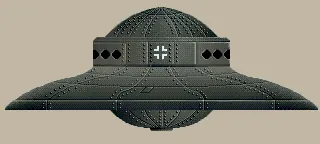
Every Haunebu diagram in circulation today is an illustration of a claim, not a photograph of a machine. That distinction gets lost fast online, where decades of repetition have let a 1990s publishing narrative read as settled wartime history - even though the paper trail runs backward from the war, not forward from it.
A myth built on an older myth
The Haunebu story does not stand on its own; it leans on an earlier, equally unverified claim that a secret "Vril Society" guided Nazi-era esoteric research. Historian Nicholas Goodrick-Clarke's "Black Sun" traced that foundational claim to postwar occult fiction rather than any documented wartime organization, which leaves Haunebu built on a premise that specialists in Nazi occultism had already identified as unsupported before the disc-program details were even added.
Where the specific name and details came from
Jan van Helsing's 1990s writing is the documented point where the Haunebu name and its detailed multi-generation program narrative entered circulation, reported on directly by Der Spiegel as part of its coverage of postwar Nazi-myth publishing in Germany. English-language conspiracy literature and researcher Peter Moon's writing carried the story to international audiences afterward, adding craft dimensions and capabilities that grew with each retelling rather than tracing to any single verifiable wartime source.
What the one genuine 1947 source actually says
The closest thing to a contemporaneous primary account is Willy Ley's essay "Pseudoscience in Naziland," published in Astounding Science Fiction in May 1947 - just two years after the war, by a German rocket engineer who had fled to the United States. Ley describes a small Berlin-based group called the "Wahrheitsgesellschaft" (Society for Truth) that spent its time "looking for Vril," a concept borrowed from an 1870s science-fiction novel. He says nothing about flying discs, secret aircraft, or any Haunebu program - the earliest real documentation of "Vril" interest in Germany describes an esoteric study group, not an aerospace project, which is a far cry from the multi-generation disc fleet later claim books describe.
What the real wartime record actually contains
Allied technical-intelligence teams spent years after 1945 cataloging genuine German advanced-aviation projects - jet engines, guided missiles, swept-wing aircraft designs - producing extensive documentation that still informs aviation history today. No file from that exhaustive postwar effort mentions a Haunebu craft, a silence that matters precisely because the Allies were not shy about documenting the German programs that did exist.
Reading the schematic honestly
The familiar Haunebu schematic reproduced across websites and documentaries is itself the primary claim artifact, not supporting evidence for one - a postwar illustration, not a captured blueprint. Readers interested in how this myth compares to its sibling claim should look at Die Glocke, which traces to a separate single unproducible 2000 source and shares the same total absence of wartime documentation.