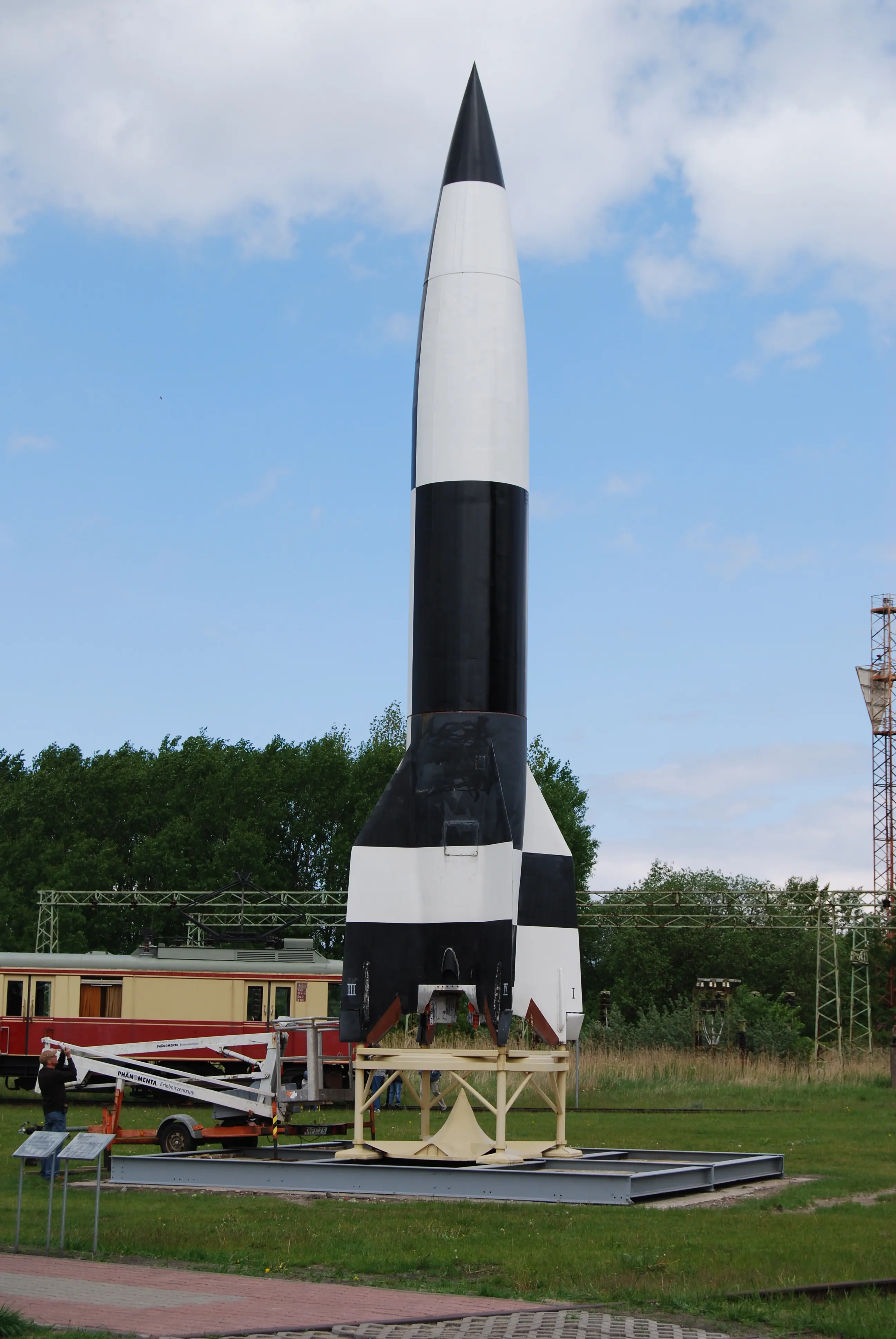
Documented A-4 / V-2 rocket on display at the Historisch-Technisches Museum Peenemünde - real wartime German hardware shown for contrast with the undocumented Die Glocke claim, which has no surviving photograph of its own.
CHMEE2 / CC BY 3.0

Die Glocke (Nazi Bell)

The Bell · Kronos device · Chronosphere
FOLKLORE

Mainstream consensus: No contemporaneous German wartime document, Allied interrogation file, or postwar exploitation report mentions Die Glocke, despite extensive Allied efforts to catalog German advanced-weapons research after 1945. Historians of Nazi wonder-weapon mythology trace the device to Witkowski's single unverifiable source and its amplification through Cook's bestselling book.

Share this page
Short answer

Die Glocke, or "the Bell," is an alleged Nazi wonder-weapon that Polish journalist Igor Witkowski described in 2000 from a reportedly unverifiable interrogation transcript, later popularized worldwide by Nick Cook's book The Hunt for Zero Point. No wartime document, patent, or Allied exploitation report has ever confirmed the device existed; historians treat it as a well-traveled postwar legend.

Compare Die Glocke to the A-4 rocket sitting under glass at Peenemünde and the gap becomes obvious. One device has production drawings, test-firing logs, captured hardware, and a dedicated museum. The other has a single Polish journalist's 2000 account of a transcript nobody else has ever read. That asymmetry, more than any specific technical claim, is why historians treat the Bell as legend rather than lost hardware.

One source, never produced

Igor Witkowski's origin story is unusually specific about its own limits: an unnamed contact let him read an interrogation document attributed to SS officer Jakob Sporrenberg, but would not let him copy it, and no later researcher has located that transcript independently. Extraordinary claims built on a single unproducible document sit in a different evidentiary category than the war's well-documented programs, where captured blueprints, production numbers, and Allied debriefs survive by the thousands.

How Nick Cook's book amplified the claim

Aviation journalist Nick Cook's 2001 bestseller The Hunt for Zero Point introduced Die Glocke to a massive English-language audience and attached specific figures - a roughly 12-foot height, a mercury-like fuel called "Xerum 525" - that do not appear in Witkowski's original Polish account. Salon's Kurt Kleiner reviewed the book the following year and argued Cook repeatedly treated ambiguous, secondhand material as settled fact, a pattern that let claim-only numbers calcify into "established" Bell lore simply through repetition across later books and documentaries.

The concrete ring that became a test rig

Claim literature frequently points to a ring-shaped concrete structure near Ludwikowice, Poland, as physical proof the Bell was tested there. Jason Colavito and other researchers who have examined the structure's design argue it matches the layout of an ordinary wartime industrial cooling tower far more closely than any propulsion test rig, and no excavation has ever recovered Bell-specific hardware from the site. A ruin that fits a mundane explanation does not need a secret-weapon one layered on top of it.

Reading the legend against the paper trail

The safest frame for any Die Glocke image is "claim art," not documentary photography, because no photograph of the device exists to caption. Readers who want the real wartime contrast should look at Peenemünde's surviving V-2 hardware: an actual wonder-weapon program that left exactly the kind of production and exploitation record the Bell conspicuously lacks. The absence of that record across eighty years of otherwise obsessive Nazi-technology research is itself the strongest evidence in this file.

Documentary photos

Rights-cleared documentary stills and serious reference images. These are not AI illustrations.

Peenemünde V-2 display: documented wartime technology with a paper trail (context only, not Die Glocke)Credit: Chmee2 / CC BY 3.0

Sightings and object accounts

Attributed sightings, recoveries, and object histories from named sources. Links open the originals; AnomalyWiki does not verify these claims.

Claims vs mainstream

The claim

Die Glocke was a real wonder-weapon recovered by Allied or Soviet forces after the war.

Mainstream view

No production record, test report, or exploitation file documenting such a recovery has ever surfaced, despite the Combined Intelligence Objectives Subcommittee's thorough cataloging of German advanced weapons.

The claim

The device proves Nazi scientists achieved antigravity or time-manipulation technology.

Mainstream view

Extraordinary propulsion or temporal-effect claims require extraordinary physical evidence; none exists beyond secondhand paraphrase of an undisclosed transcript.

The claim

Witkowski's Sporrenberg transcript is a genuine suppressed document.

Mainstream view

The transcript has never been independently located or produced for examination; historians treat an unproducible primary source as unverifiable by definition, not as confirmed fact.

The claim

The Ludwikowice concrete ring structure was built to test the Bell.

Mainstream view

Researcher Jason Colavito and others identify the structure's design as consistent with an ordinary industrial cooling tower of the period, a far more mundane and better-attested use.

Timeline

  1. 1945World War II ends; Allied teams catalog German V-2 rockets, jet aircraft, and other documented advanced weapons in extensive exploitation files, with no contemporaneous mention of a bell-shaped device. Source: Historiography of Allied technical intelligence programs
  2. 2000Igor Witkowski publishes Prawda o Wunderwaffe in Poland, introducing Die Glocke to print for the first time.Source: Witkowski, Prawda o Wunderwaffe (2000)
  3. 2001Nick Cook's The Hunt for Zero Point brings the Bell story to English-language readers, adding claim dimensions and the "Xerum 525" fuel name.Source: Cook, The Hunt for Zero Point (2001)
  4. 2002-08Salon's Kurt Kleiner reviews Cook's book and argues it strains credulity, treating ambiguous secondhand claims as settled evidence. Source: Salon, "'The Hunt for Zero Point' by Nick Cook"
  5. 2000s-2010sCable documentaries and later ancient-aliens-adjacent programming expand the Bell myth, linking it to Haunebu lore and antigravity speculation far beyond Witkowski's original account. Source: Jason Colavito, review of Nazi-wonder-weapon television coverage

FAQ

Is there a real photograph of Die Glocke?

No. Every image attached to the legend is illustrator artwork; no photograph, blueprint, or recovered component has ever been produced.

Who first described Die Glocke?

Polish journalist Igor Witkowski in his 2000 book Prawda o Wunderwaffe, citing an interrogation transcript he said he was shown but could not copy or produce.

Did Nick Cook prove the device existed?

No. His 2001 book The Hunt for Zero Point popularized Witkowski's claims and added unverified dimensions and fuel names, without new primary evidence of its own.

What is the Ludwikowice "Henge" structure often linked to the Bell?

A concrete ring ruin in Poland that claim books present as a test rig; researchers argue its design matches an ordinary wartime industrial cooling tower instead.

Why do historians doubt the Bell existed?

Allied postwar teams extensively cataloged German advanced-weapons research, and no document from that process mentions a bell-shaped device, unlike the well-documented V-2 and jet-aircraft programs.

Is Die Glocke connected to the Haunebu flying-disc legend?

Later books and documentaries link the two, but they trace to different claim lineages; the connection is a popular-media mashup rather than a shared documented source.