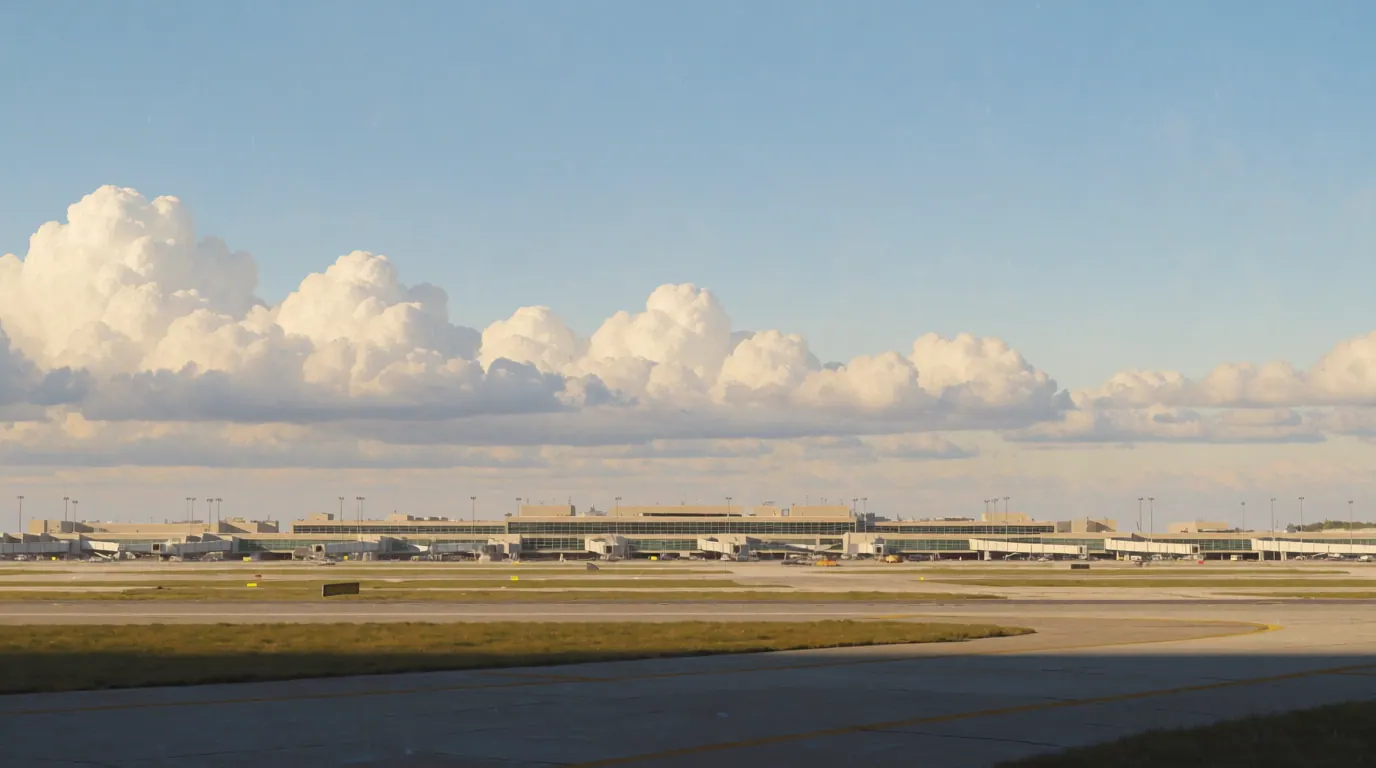
AI illustration cover for O'Hare UFO (2006)
AI ILLUSTRATION FOR REFERENCE ONLY

O'Hare UFO (2006)

O'Hare disc sighting · Chicago O'Hare UFO · Concourse C UFO
UNRESOLVED

Mainstream consensus: FAA tower logs and FOIA'd phone calls confirm a report was made and reviewed internally, which is unusual paper-trail corroboration for an airport sighting. The FAA's working theory is an optical hole-punch-cloud effect. There is no radar return, photo, or video, so the case rests on witness testimony and documentation rather than physical evidence.

Share this page
Short answer

On 7 November 2006, about a dozen United Airlines employees reported a dark, elliptical disc hovering silently over O'Hare's Concourse C before it shot straight up through the clouds. The FAA initially denied any record, then released tower logs after a Chicago Tribune FOIA request. Officials blame a hole-punch cloud illusion; witnesses say that does not match what they saw.

What happened

Late on a gray November afternoon in 2006, United Airlines ground crews at Chicago O'Hare started talking about something that did not belong in the overcast above Concourse C. Close to a dozen employees - ramp workers, pilots, supervisors - later described a dark, sharply edged elliptical object hanging motionless under the cloud deck. Witnesses said it stayed silent for roughly five minutes, then shot straight up and left a clean hole punched through the clouds.

What makes O'Hare stick in UFO case files is not a radar track or a crisp photo. It is the paperwork fight that followed. United staff called the airline and the FAA tower the same afternoon. Weeks later, when Chicago Tribune aviation writer Jon Hilkevitch began asking questions, both United and the FAA first told him they had no record of any such report. Hilkevitch's 1 January 2007 column forced a correction: FAA spokeswoman Elizabeth Isham Cory confirmed the tower had logged a call about a "flying disc," that a preliminary radar check found nothing unusual, and that the agency would not open a deeper investigation.

Freedom of Information releases and the National Aviation Reporting Center on Anomalous Phenomena (NARCAP) Case 18 report later reproduced tower phone logs and facility records that match the afternoon chatter. That paper trail is unusually solid for an airport sighting - and still does not prove a solid craft. Astronomer Mark Hammergren and other skeptics favor a hole-punch cloud optical effect: aircraft can seed ice-crystal voids that look like a circular opening when viewed from below. Believers counter that multiple trained aviation workers described a hard-edged disc before the hole appeared.

O'Hare sits in a middle zone familiar to modern UAP debates. Contemporaneous journalism and FOIA'd logs confirm that named-category witnesses reported something and that controllers wrote it down. Instruments did not hand investigators a radar paint or a video frame everyone agrees on. The case remains a study in how institutional denial, then grudging documentation, can amplify a five-minute sky anomaly into a national story.

Related phenomena

What witnesses reported

Close to a dozen United Airlines ramp workers, pilots, and supervisors said they saw a dark, elliptical object hovering motionless over Concourse C for about five minutes before it shot upward through the overcast, leaving a visible hole in the clouds. Tower ATC union specialist Craig Burzych and United spokeswoman Megan McCarthy are both quoted in contemporary reporting; astronomer Mark Hammergren later proposed a "hole-punch cloud" explanation.

Proposed explanations

  • Mainstream

    FAA spokeswoman Elizabeth Isham Cory attributed the sighting to a weather phenomenon - cold, humid conditions and airport lighting reflecting through a break in the clouds, consistent with what astronomer Mark Hammergren called a "hole-punch cloud."

    Chicago Tribune; New York Times "The Lede" (2 Jan 2007)

  • Alternative

    Aviation safety researchers at NARCAP argued that FOIA'd tower logs and three separate phone calls documented a real tracked anomaly with possible aviation-safety implications that deserved more than a weather dismissal.

    NARCAP Case 18 report (R.F. Haines et al., 2007)

  • Disputed

    Witnesses, including tower ATC specialist Craig Burzych, maintained that an opening in the clouds does not explain a sharp-edged elliptical object that stayed stationary for several minutes before accelerating straight up.

    Chicago Tribune witness quotes

Case accounts

Attributed incident and cultural accounts from named sources. Links open the originals; AnomalyWiki does not verify these claims.

Claims vs mainstream

The claim

The FAA and United covered up a flying saucer landing at O'Hare.

Mainstream view

Internal denials to reporters were real, but FOIA'd tower logs show the report was logged and reviewed, then closed as a weather phenomenon rather than hidden outright.

The claim

A dozen witnesses proves it was a solid metal craft.

Mainstream view

Multiple witnesses strengthen the report, but a preliminary radar check found nothing out of the ordinary at the time, which argues against a solid, radar-reflective object.

The claim

A hole-punch cloud fully explains the sighting.

Mainstream view

The weather theory fits the hole later visible in the clouds, but some witnesses, including a tower ATC specialist, say it does not match the sharp-edged disc shape they described.

The claim

This was just a joke by bored airport workers.

Mainstream view

Independently FOIA'd phone logs documenting three separate calls and a tower duty-log entry argue against a simple internal joke; the report was treated as a genuine operational query at the time.

Timeline

  1. 2006-11-07Around 4:15 p.m., witnesses see the object hover over Concourse C for about five minutes before it shoots upward through the clouds.Source: Chicago Tribune (Jon Hilkevitch, 1 Jan 2007)
  2. 2006-11A United ramp supervisor and other staff call the FAA tower three separate times asking if controllers saw the object; the calls are logged in the tower's daily operations record.Source: NARCAP Case 18 report (FAA FOIA records)
  3. 2006-12United spokeswoman Megan McCarthy tells Tribune reporter Jon Hilkevitch there is no record of the event in the airline's duty manager log.Source: Chicago Tribune reporting
  4. 2007-01-01The Chicago Tribune publishes Hilkevitch's "In the sky!" column, breaking the story nationally after the FAA confirms the tower call.Source: Chicago Tribune
  5. 2007-03-05NARCAP's FOIA request is fulfilled, producing the FAA's tower log entry and phone-call records.Source: NARCAP Case 18 report
  6. 2013-03-20The Chicago Tribune revisits the case, calling it one of the most famous UFO reports at the airport.Source: Chicago Tribune (Ryan Smith)

FAQ

What happened at O'Hare airport in 2006?

On 7 November 2006, close to a dozen United Airlines employees reported a dark, elliptical disc hovering silently over Concourse C for about five minutes before it shot straight up through the cloud layer.

Who saw the O'Hare UFO?

Ramp workers, pilots, and supervisors employed by United Airlines were the primary witnesses; several bystanders outside the terminal also reported seeing something unusual.

Did the FAA investigate the sighting?

The FAA initially said it had no record, then confirmed after a FOIA request that its tower logged three phone calls about the object. It did not pursue a further investigation and attributed the report to a weather effect.

What is a hole-punch cloud?

It is a roughly circular gap that can form in a cloud layer when supercooled water droplets rapidly freeze and fall, sometimes creating an optical illusion of a dark disc against the lit cloud deck. Astronomer Mark Hammergren proposed this as the O'Hare explanation.

Is there radar, photo, or video evidence?

No. A preliminary FAA radar check found nothing unusual at the time, and no photo or video from the incident has surfaced. The case rests on witness testimony and the FOIA'd tower documentation.

Why did the story only become public two months later?

United and the FAA both initially told a Chicago Tribune reporter they had no record of the event. The story broke only after the newspaper kept digging and FOIA requests surfaced the tower's internal log of the calls.