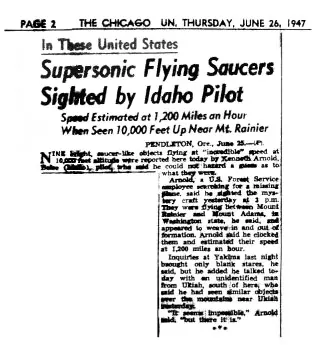
A 1947 newspaper front page reporting on the wave of "flying saucer" sightings that followed Kenneth Arnold's Mount Rainier report, documenting how the press coined and spread the term.
UPI, 1947 CHICAGO SUN MICROFILM / WIKIMEDIA COMMONS, PUBLIC DOMAIN

Flying Saucer

UFO (later general term) · Arnold objects · Mount Rainier sighting
ALLEGED SIGHTING

Mainstream consensus: The Smithsonian's National Air and Space Museum and historians of the UFO phenomenon treat Arnold's sighting as a genuine, well-documented eyewitness report that triggered a nationwide wave of similar sightings and media coverage in 1947, while noting that no physical evidence or recovered craft has ever substantiated an extraterrestrial or otherwise exotic origin for what he saw.

Share this page
Short answer

"Flying saucer" is the press nickname born from pilot Kenneth Arnold's June 24, 1947 sighting of nine fast-moving objects near Mount Rainier, which he compared to saucers skipping across water - not to the objects' shape. Wire reporters coined the phrase, and the Smithsonian credits Arnold's account with launching the modern UFO era despite no confirmed craft ever being recovered.

Kenneth Arnold spent the rest of his life correcting a misquote. He never said the nine objects he saw near Mount Rainier were shaped like saucers - he said they moved like one skipped across water. The distinction mattered to him and matters to historians, even though the phrase that stuck went the other way entirely.

What Arnold actually reported

Flying his own small plane on June 24, 1947, while helping search for a downed Marine transport, Arnold spotted nine objects traveling in a diagonal chain formation at a speed he calculated at roughly 1,200 miles per hour, using the time they took to cross between two visible mountain peaks as his stopwatch. He described their shape as crescent or boomerang-like, bright and reflective in the sunlight, closer to a flattened wing than a dinner plate.

How one simile became a shape

Reporter Bill Bequette's wire story for the East Oregonian condensed Arnold's "skip it across the water" motion description into "flying saucer" within a day of the sighting, and the phrase moved through national syndication before Arnold had any chance to clarify it further. The Smithsonian's National Air and Space Museum credits that single piece of word choice with shaping how an entire generation pictured unidentified aerial phenomena - disc-shaped, not crescent-shaped - regardless of what the original witness actually described.

A summer that multiplied the sighting

Arnold's report did not stay isolated. Within weeks, newspapers across the country carried hundreds of similar "flying saucer" accounts, the kind of rapid-cascade pattern the Smithsonian calls the "Year of the Flying Saucer." That same summer also produced the Roswell incident in New Mexico, and the two cases have been linked in popular retellings ever since, even though they involve separate witnesses, separate locations, and separate original claims.

Reading the case today

Arnold's sighting remains a well-documented eyewitness report with some contemporaneous ground-witness corroboration, not as proof of an exotic craft; no physical object or debris from the event has ever surfaced. The case's real legacy is linguistic as much as evidential - it gave the twentieth century a household term for the unexplained, built from a pilot's passing comparison that the press turned into visual shorthand for seventy-five years of UFO reporting that followed.

Documentary photos

Rights-cleared documentary stills and serious reference images. These are not AI illustrations.

Press coverage from the summer the term "flying saucer" entered everyday languageCredit: UPI, 1947 Chicago Sun microfilm / Wikimedia Commons, public domain

Sightings and object accounts

Attributed sightings, recoveries, and object histories from named sources. Links open the originals; AnomalyWiki does not verify these claims.

Claims vs mainstream

The claim

Arnold's sighting proves flying saucers were disc-shaped alien spacecraft.

Mainstream view

Arnold himself described the objects as crescent- or boomerang-shaped, not disc-shaped; the "saucer" label came from his description of their skipping motion, a distinction historians note is routinely lost in retellings.

The claim

The press immediately understood and faithfully reported what Arnold described.

Mainstream view

Reporter Bill Bequette's wire story condensed Arnold's motion simile into a shape-based nickname, permanently altering the public's mental image of the case from the outset.

The claim

Arnold's report was an isolated, unverifiable claim with no other witnesses.

Mainstream view

Multiple independent ground-based observers near Mount Rainier reported seeing unusual aerial objects the same day, providing some contemporaneous corroboration even though full consensus on shape and count was never reached.

Timeline

  1. 1947-06-24Kenneth Arnold reports seeing nine fast-moving crescent-shaped objects near Mount Rainier while flying his own plane searching for a downed Marine transport.Source: Smithsonian National Air and Space Museum, "1947: The Year of the Flying Saucer"
  2. 1947-06-25East Oregonian reporter Bill Bequette's wire story coins the term "flying saucer" based on Arnold's skipping-saucer motion description.Source: History.com, "Pilot Kenneth Arnold sees unidentified flying objects near Mount Rainier"
  3. 1947-07Hundreds of similar "flying saucer" sightings are reported across the United States in the weeks following Arnold's account, launching what the Smithsonian calls the "Year of the Flying Saucer."Source: Smithsonian National Air and Space Museum, "1947: The Year of the Flying Saucer"
  4. 1947-07The Roswell incident occurs in New Mexico the same summer, becoming permanently linked with Arnold's sighting in later UFO popular history.Source: History.com, "Pilot Kenneth Arnold sees unidentified flying objects near Mount Rainier"

FAQ

Who coined the term "flying saucer"?

Press coverage, specifically reporter Bill Bequette's wire story, coined it from Kenneth Arnold's description of the objects' motion - not their shape - after his June 1947 sighting.

Did Kenneth Arnold say the objects were shaped like saucers?

No. Arnold described them as crescent- or boomerang-shaped and said they moved "like a saucer if you skip it across the water," a simile about motion that the press turned into a shape-based nickname.

How fast did Arnold estimate the objects were moving?

He calculated roughly 1,200 miles per hour based on the time they took to cross between two mountain peaks he could see clearly from his cockpit.

Were there other witnesses besides Arnold?

Yes. Several independent ground-based observers near Mount Rainier reported seeing unusual aerial objects that same day, though their descriptions varied in shape and count.

Did Arnold's sighting lead to other famous UFO cases?

It triggered a nationwide wave of similar reports within weeks, and historians note it occurred the same summer as the Roswell incident, permanently linking the two in popular UFO history.

Has any physical evidence from the sighting ever been recovered?

No. The case rests entirely on Arnold's own testimony and contemporaneous witness corroboration; no object or debris was ever recovered.