Overview
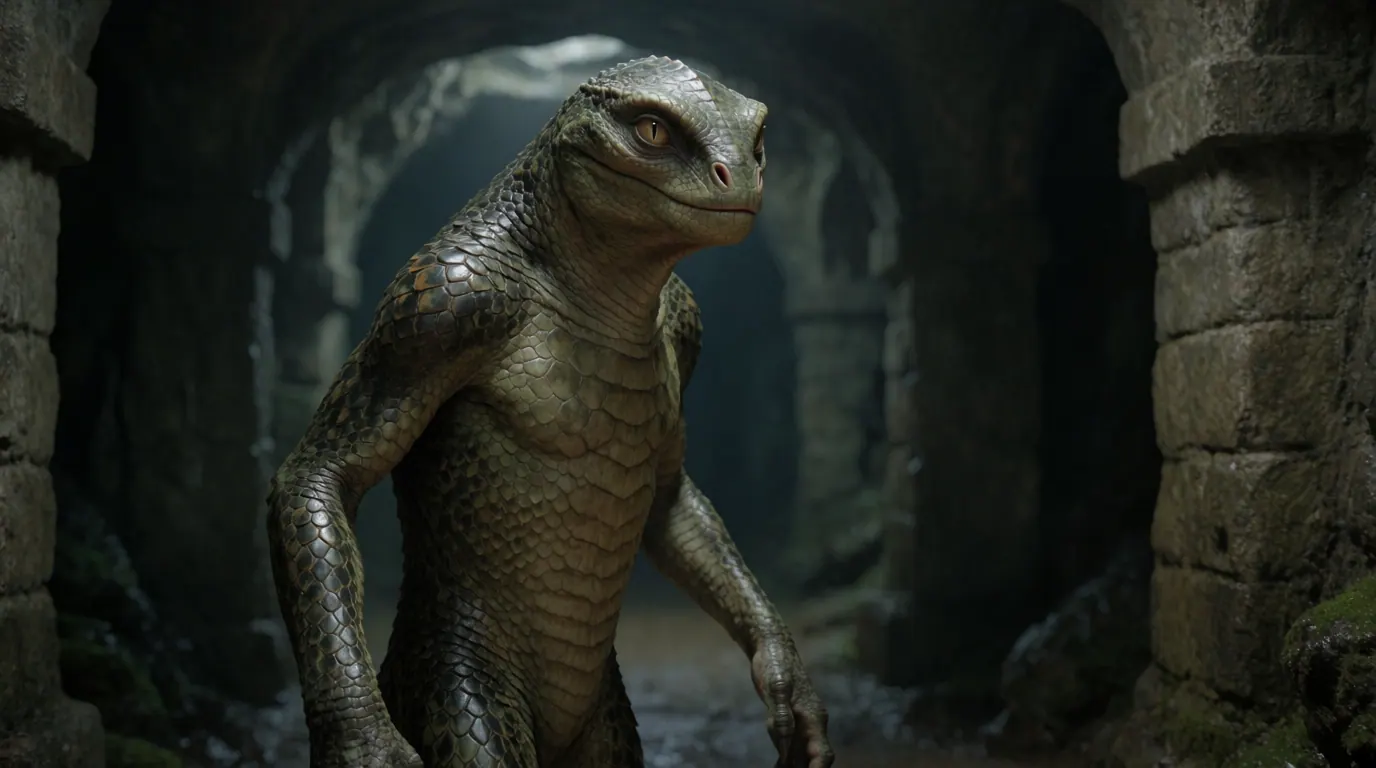
Reptilians are humanoid conspiracy-lore beings said to walk among us in human disguise while concealing a scaled "true form." Tellings put height at seven feet or more once the mask slips, and credit the type with shapeshifting, telepathy, and quiet control of governments from underground halls. Aliases circulating online include Reptoids, Lizard People, and Lizardmen. The idea is a global, internet-native folklore cluster rather than a single regional legend, though its loudest promoter, David Icke, is British, and its most-cited "field report," the Lacerta Files, claims a Swedish source. Reptilians share the Types of Aliens hub with Greys, Nordics, and the Anunnaki, the ancient Sumerian deities Icke reinterprets as the reptilian bloodline's origin point.
Origin of the legend
The reptilian elite is older than David Icke, even though his name is the one most readers remember. Historian Michael Barkun traces the shapeshifting-ruler plot to pulp author Robert E. Howard, whose 1929 story "The Shadow Kingdom" gave Weird Tales readers Serpent Men who disguise themselves as nobles and rule a kingdom from the shadows, itself drawing on Helena Blavatsky's 1888 Theosophical writing about a lost "dragon-men" civilization. NBC's 1983 miniseries V gave the look its modern visual anchor: friendly human-seeming visitors who peel back their skin to reveal scales underneath.
Icke fused these threads with ancient-astronaut writing in his 1999 book The Biggest Secret, recasting the Anunnaki of Sumerian myth, by way of Zecharia Sitchin's 1976 book The 12th Planet, as a Draco-constellation reptilian bloodline running royal houses and governments. The same year, Icke released taped interviews with Zulu sanusi Credo Mutwa under the title The Reptilian Agenda, presenting Mutwa's "Chitauri" lore as outside confirmation; scholars and sangomas interviewed since dispute that the material reflects authentic Zulu tradition. A separate, unrelated claim, the Lacerta Files, began circulating in late 1999 as a transcript of an interview with an underground reptilian woman; its own translator called it a hoax within months. Compressed video later supplied a new kind of "evidence": glitching eyes in paused clips, which fact-checkers attribute to encoding artifacts and pareidolia rather than a slipping disguise.
Similar beings
Reptilians sit closest to two other alien "race" labels in the same hub. Greys are the clinical, large-eyed abduction archetype; contactee-era Nordic aliens are the fair, benevolent counterpart; neither carries the hidden-ruler plot that defines reptilian lore. The Anunnaki entry covers the Sumerian deities Icke reinterprets as the bloodline's point of origin, while Pleiadians and Tall Whites cover adjacent "benevolent visitor" strands that some writers blend with reptilian cosmology. Little Green Men stays pure pulp-era alien design, with no shapeshifting or political-control claim attached. Fictional lizard-men from film and tabletop games supply the visual cousins, not the conspiracy content.
In popular culture
Pop culture had hidden-ruler reptiles before Icke gave them a name. NBC's V (1983) remains the visual template: amiable human-seeming visitors who tear their own skin to reveal scales. John Carpenter's They Live (1988) swapped scales for skull-faced ghouls but kept the plot that elites secretly are not human. Icke's own The Biggest Secret (1999) turned nonfiction publishing into the main delivery vehicle for the modern claim, and VICE's 2012 short documentary Conspiracy of the Lizard Illuminati introduced his theory to a younger online audience, half mockery and half genuine curiosity.