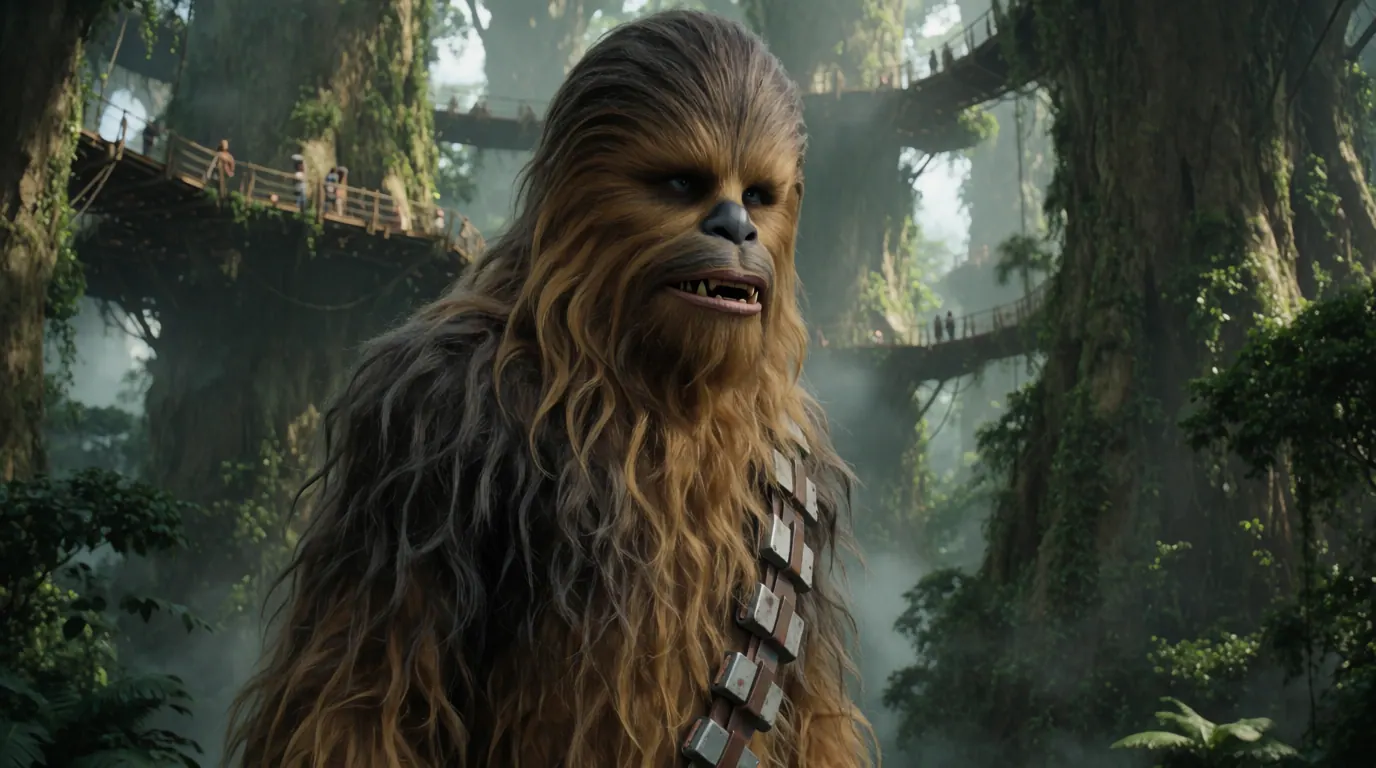
Overview
Wookiees are a towering, fur-covered humanoid species from the Star Wars galaxy, best known through Han Solo's co-pilot Chewbacca, standing roughly seven to eight feet tall with thick body hair that ranges from brown to black to, in rarer depicted individuals, nearly white. Physically, the species is built for strength: Wookiees are consistently depicted across the films as capable of tearing apart droids and overpowering multiple opponents, a trait the franchise uses both for comic relief and for genuine action-sequence stakes depending on the scene. The species' non-verbal communication, a growling, roaring vocabulary that other characters understand but human-adjacent species cannot physically replicate, was built by sound designer Ben Burtt from blended animal recordings and has stayed consistent across every Wookiee character introduced since 1977.
Claimed cultural traits include a clan-based society organized around the species' homeworld, elaborate tree-canopy cities built high in Kashyyyk's enormous wroshyr trees, and a value system that prizes personal loyalty above nearly everything else, a trait the films dramatize repeatedly through Chewbacca's decades-long devotion to Han Solo. A recurring narrative device, informally called "Wookiee rage" by fans, depicts the species as capable of a berserker-style fury once provoked past a certain threshold, though the franchise has never codified this as a strict biological rule with consistent on-screen triggers.
The species' homeworld, Kashyyyk, is a heavily forested planet the main saga films did not show on screen until the 2005 prequel conclusion "Revenge of the Sith," despite Chewbacca appearing in the franchise's very first film nearly three decades earlier. That gap meant audiences knew the character for years before seeing where he came from, a sequencing quirk unusual among major franchise species reveals. Aliases are minimal: "Wookiee" is the species' consistent name throughout the franchise, in both films and expanded media.
Canon status follows Lucasfilm's tiered system: the theatrical films and officially branded streaming series form the primary canon backbone, while older expanded-universe novels and comics were formally reclassified as "Legends" material following Disney's 2012 acquisition of Lucasfilm, a reorganization that affected Wookiee lore alongside every other corner of the franchise's extended fiction. Readers comparing Wookiees with other fictional species on this site will notice the character functions primarily as a loyal-companion archetype rather than a villain or a culture explored for its own sake, a narrative role distinct from antagonist-coded species like the Daleks or Xenomorph covered elsewhere in this fictional-aliens cluster.
Origin of the legend
George Lucas built Chewbacca partly from his own life, reportedly basing elements of the character on his Alaskan Malamute dog, Indiana, when developing early Star Wars concepts in the mid-1970s. That personal touchstone shaped the character's loyal, protective temperament well before any studio discussion of alien biology or planetary origin. Concept artist Ralph McQuarrie produced early visual designs for the character as part of his broader pre-production work establishing the look of the entire Star Wars universe, work later credited with helping convince 20th Century Fox executives the ambitious, then-unproven project was visually coherent enough to greenlight.
Makeup and creature effects artist Stuart Freeborn built the final Chewbacca costume and face sculpt, working within the practical-effects constraints of 1970s filmmaking. Casting settled on Peter Mayhew largely because of his height, just under seven feet tall, a physical requirement the production treated as essential to selling the character's towering presence opposite human-scale actors. Mayhew would go on to perform the role across the original trilogy and later return for prequel and sequel-era appearances, becoming one of the longest-running actors associated with a single Star Wars character.
Sound designer Ben Burtt, tasked with giving a mute-by-script alien a voice without resorting to conventional dialogue, blended recordings of bears, walruses, and other animals into Chewbacca's now-iconic roars and groans. That choice meant Chewbacca communicates clearly to other characters in-story while remaining genuinely non-verbal to the audience, a deliberate storytelling constraint Burtt has discussed in interviews as central to keeping the character feeling truly alien rather than simply a human in a costume.
The species' home culture remained largely unseen for decades. The 1978 CBS television special built around a Kashyyyk-set Chewbacca family reunion introduced early concepts of Wookiee home life, but the special's poor critical reception led Lucasfilm to effectively disavow it for years, pulling it from official re-release and leaving most of its worldbuilding unincorporated into later canon. It was not until the 2005 prequel trilogy conclusion that mainline films finally depicted Kashyyyk and Wookiee warriors on screen, closing a gap between the character's introduction and his homeworld's visual establishment that spanned nearly thirty years of franchise history.
Similar beings
Wookiees occupy a specific niche among this encyclopedia's fictional-alien entries: a towering, physically imposing species whose primary narrative function is loyal companionship rather than villainy, culture-building, or threat. The Yautja of the Predator franchise offer an instructive contrast in physical scale and design intent; both species read as large, strength-coded humanoids, but Yautja are solitary antagonist hunters built to generate dread, while Wookiees are consistently framed as trustworthy allies whose size signals protective capability rather than menace.
The Klingons of Star Trek make for a different kind of comparison, since both species value personal honor and loyalty heavily, but Klingon culture channels that value through an entire political empire with senators and noble houses, while Wookiee culture, as depicted across the films, stays comparatively undeveloped beyond clan structures and tree-city settlements, reflecting the species' supporting rather than central narrative role across most Star Wars media.
The Daleks and Xenomorph sit at the opposite end of the spectrum entirely, both built purely as threats with no sympathetic individual characters. Readers tracking how franchises balance "alien as ally" against "alien as menace" will find Chewbacca and his species a clear illustration of the friendly end of that spectrum, alongside the ecologically coded Na'vi, who share the Wookiees' broadly sympathetic framing despite a very different design and cultural emphasis.
Beyond this site's fiction cluster, the Wookiees' size and fur-covered silhouette occasionally draws comparison from casual readers to real-world cryptid reports like Bigfoot, a comparison worth addressing directly: Wookiees are a scripted, studio-owned film species with a credited creator and a documented production history, while cryptid pages on this site describe testimony-based sighting claims graded for evidence quality. The resemblance is purely visual coincidence, not a shared category of evidence.
That visual overlap is worth examining a little further, since it explains why the comparison keeps coming up. Both a Wookiee and a Bigfoot sighting description involve a large, bipedal, fur-covered figure glimpsed at a distance, and that shared silhouette is enough to trigger a pattern-matching instinct in casual readers scanning both kinds of pages. The difference becomes clear the moment either page is examined closely: a cryptid page documents a witness, a date, a location, and the investigation history that followed; a Wookiee page documents a screenwriter, a makeup artist, a sound designer, and a release date. Treating the two as equivalent "evidence" of anything misses what each category of page is actually built to track.
In popular culture
Chewbacca's growl, built from Ben Burtt's blended animal recordings, has become one of the most recognizable non-verbal sound effects in film history, instantly identifiable to audiences who may never have seen a full Star Wars film. The character's catchphrase-free communication style, functioning entirely through tone and context rather than words, has nonetheless generated genuine audience affection strong enough that online petitions and fan campaigns over the decades have periodically lobbied for the character to receive formal recognition, including a tongue-in-cheek push for an honorary medal referencing a perceived snub in the original 1977 film's ending ceremony.
The species' towering, fur-covered silhouette has become shorthand across broader pop culture for "gentle giant" alien design, distinct from both the menacing creature designs of films like Alien and the more overtly humanoid warrior cultures of Star Trek. Halloween costumes, convention cosplay, and merchandise built around the Wookiee silhouette remain a Star Wars licensing mainstay decades after the character's debut, helped by the design's immediate recognizability even in simplified or stylized forms.
"Solo: A Star Wars Story," released in 2018, deliberately expanded Wookiee representation beyond Chewbacca alone, depicting enslaved Wookiee laborers on Kashyyyk during a period of galactic history the main saga films had skipped over, giving the species a darker, more explicitly political dimension than most earlier appearances had explored. That expansion reflected a broader trend across 2010s and 2020s Star Wars media toward giving long-running background species more substantial individual stories rather than leaving them as scenery for human-led plots.
Academic and critical writing about Star Wars has periodically used Chewbacca as a case study in how franchise films build audience affection for non-human characters without dialogue, a storytelling challenge quite different from giving an alien species political depth through spoken exposition, the approach the Klingons and Daleks rely on instead. That durability, a character audiences have loved for decades despite literally never understanding a word he says, remains one of the more unusual achievements among this site's catalog of fictional alien species.
The species has also found a modest but steady presence in video games and animated spinoffs, with Wookiee warriors appearing as playable or supporting characters across multiple Star Wars game franchises spanning several console generations. Each new appearance has generally reinforced rather than reinvented the core traits established in 1977: towering size, overwhelming strength, and unwavering loyalty to whichever human or alien companion the story pairs them with. That consistency, rare for a franchise that has otherwise reworked large parts of its continuity multiple times since Disney's 2012 acquisition of Lucasfilm, suggests Chewbacca's basic character template proved durable enough that writers across five decades have felt little need to fundamentally alter it.