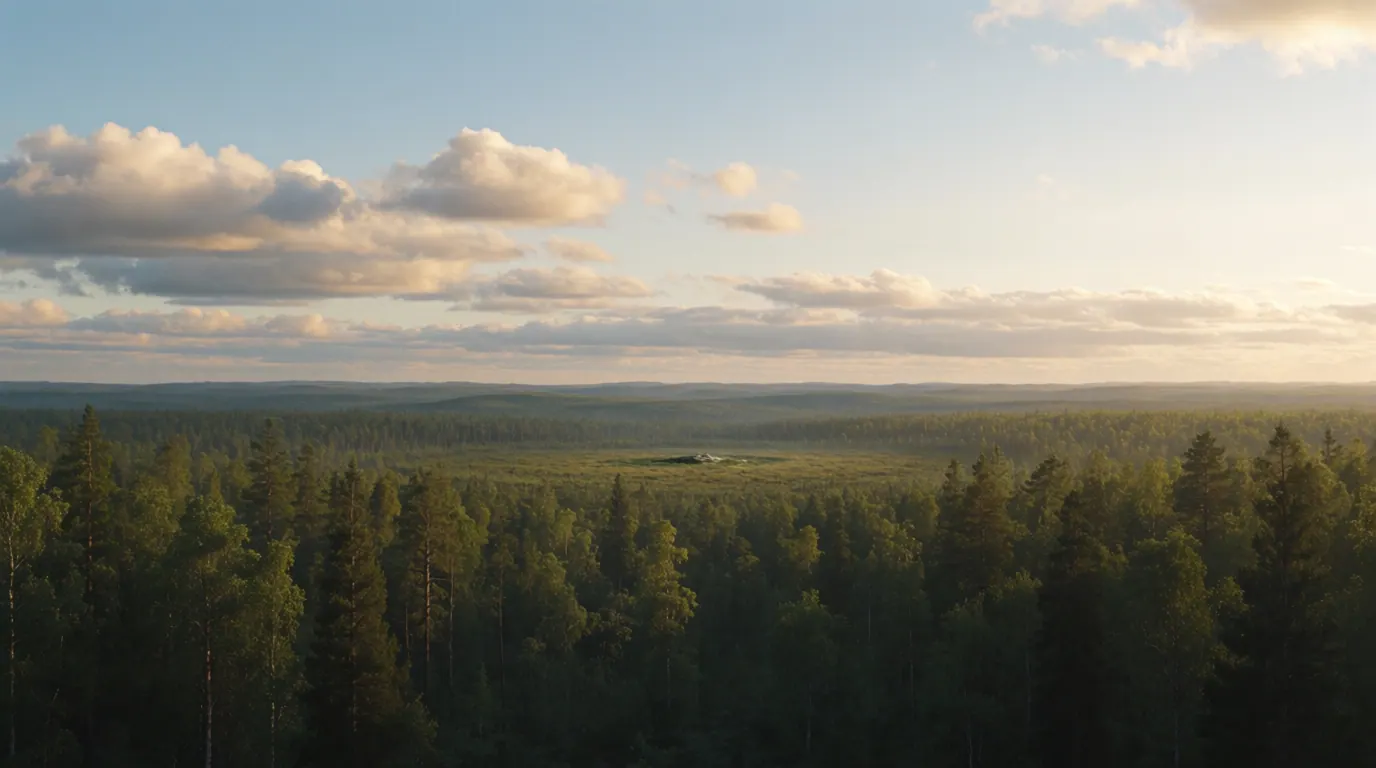
AI illustration cover for Tunguska Event
AI ILLUSTRATION FOR REFERENCE ONLY

Tunguska Event

Tunguska explosion · Tunguska blast
SCIENTIFICALLY EXPLAINED

Mainstream consensus: Tunguska is a physically documented and extensively studied event. Decades of fieldwork mapping flattened trees, recovered extraterrestrial microspherules, and modern atmospheric-disruption modeling support an airburst from a stony asteroid roughly 50-70 meters across, releasing 10-20 megatons of energy 5-10 kilometers above the ground - not a crashed craft, weapon, or supernatural cause.

Share this page
Short answer

On 30 June 1908, an airburst over Siberia flattened roughly 2,000 square kilometers of forest in a butterfly-shaped pattern without leaving an impact crater. Leonid Kulik's 1927 expedition mapped the damage decades later, and the scientific consensus now holds that a stony asteroid roughly 50-70 meters wide exploded 5-10 kilometers above the ground.

Overview

The Tunguska event is the 30 June 1908 airburst over the Podkamennaya Tunguska River region of Siberia that flattened roughly 2,000 square kilometers of forest in a radial pattern without leaving an obvious impact crater. Seismic stations and barographs across Eurasia recorded the shock; eyewitnesses hundreds of kilometers away described a fireball and a hot wind. Decades later, Leonid Kulik's Soviet expeditions photographed the "telegraph pole" forest of snapped trunks pointing away from a central zone.

Mainstream planetary science treats Tunguska as a stony asteroid or comet fragment that exploded in the atmosphere - an airburst energetic enough to fell trees but not to excavate a classic meteorite crater. Exotic twentieth-century proposals (black holes, antimatter, alien craft) lack supporting debris or physics that outcompete the airburst model. The event remains a flagship natural mystery because the blast was enormous, remote, and only slowly documented - not because it still needs a non-meteor explanation. Field geomorphology fans sometimes compare the "solved-but-still-awesome" arc to Racetrack Playa moving stones.

Expeditions, trees, and the airburst model

Kulik reached the site in the late 1920s and found butterfly-shaped devastation with trees scorched and knocked outward. Later teams hunted meteoritic iron and found microscopic spheres and peat anomalies consistent with a cosmic body, but no giant iron mass. Computer models of atmospheric entry now reproduce the energy, the lack of crater, and the tree-fall pattern for a stony body tens of meters across breaking apart several kilometers up.

Chelyabinsk's 2013 airburst gave the world a smaller modern analogue with dashcam video, strengthening public intuition for what Tunguska-scale events look like. Impact-hazard programs cite Tunguska when explaining why near-Earth asteroids matter even when they do not dig craters.

Related cosmic anomalies

  • The Bloop - another natural signal once wrapped in monster myth.
  • Oumuamua - an interstellar visitor with its own exotic-hypothesis phase.
  • Fermi Paradox - cosmic silence framing that sometimes hijacks Tunguska in fringe books.
  • Tabby's Star - photometry anomaly that likewise survived megastructure hype.
  • Wow Signal - a one-off detection with competing interpretations.
  • Natural-anomaly parallel: Racetrack Playa.

In popular culture

Tunguska fuels alternate-history novels, Tesla death-ray myths, and UFO crash retcons that place a ship under the taiga. Documentaries prefer Kulik's photographs of endless fallen larch. The lasting frame is a morning sky on fire over an empty forest that nobody surveyed for years.

What witnesses reported

Local Evenki herders and Russian settlers in the sparsely populated region reported a brilliant fireball crossing the sky, a shockwave that knocked people off their feet dozens of kilometers away, and a sound heard hundreds of kilometers distant. Soviet investigators later collected and cataloged these eyewitness accounts starting in the 1920s.

Proposed explanations

  • Mainstream

    A stony asteroid roughly 50-70 meters (164-262 feet) across entered the atmosphere at hypersonic speed and disintegrated in an airburst 5-10 kilometers above ground, releasing an estimated 10-20 megatons of energy - the scientific consensus explanation.

    Nature (1993); NASA Tunguska Workshop, Icarus special issue (2019)

  • Alternative

    The object may have been an icy comet fragment rather than a stony asteroid, a minority view debated for decades before orbital and atmospheric-disruption modeling made an asteroid the more probable candidate.

    NASA Tunguska Workshop summary (2019)

  • Disputed

    Fringe proposals - a crashed extraterrestrial craft, an antimatter event, a natural nuclear explosion, or a volcanic eruption - circulated for decades, especially in Russian popular press, but none has supporting physical evidence and all are rejected by mainstream science.

    NASA Ames Tunguska Workshop (2019)

Case accounts

Attributed incident and cultural accounts from named sources. Links open the originals; AnomalyWiki does not verify these claims.

Claims vs mainstream

The claim

Tunguska was caused by a crashed alien spacecraft, a secret weapons test, or antimatter.

Mainstream view

These fringe proposals have circulated for decades but have no supporting physical evidence; standard atmospheric-airburst physics explains the blast pattern without any exotic cause.

The claim

Since no crater or large fragments were ever found, nothing actually fell from space.

Mainstream view

Airburst asteroids explode in the atmosphere before reaching the ground, which explains the missing crater; researchers have recovered microscopic silicate and magnetite spherules of likely extraterrestrial origin from the site's soil and peat layers.

The claim

Lake Cheko is a confirmed impact crater proving a fragment reached the ground.

Mainstream view

One 2007 study proposed this, but other researchers note regional maps appear to show a lake resembling Cheko predating 1908, and most specialists still favor Kulik's original conclusion that no impact crater exists at the site.

Timeline

  1. 1908-06-30An asteroid explodes in an airburst over the Podkamennaya Tunguska River basin; local eyewitnesses report a brilliant fireball, a shockwave, and fires, and roughly 2,000 square kilometers of forest are flattened.Source: NASA, "115 Years Ago: The Tunguska Asteroid Impact Event"
  2. 1921The Soviet Academy of Sciences sends geologist Leonid Kulik on the first expedition toward the site, but the area proves too remote and inaccessible to reach.Source: NASA, "115 Years Ago: The Tunguska Asteroid Impact Event"
  3. 1927Kulik finally reaches the epicenter, finding trees still standing but stripped of bark and branches, radiating outward from a central point - clear evidence of an airburst nearly two decades after the event.Source: Kulik, Dokl. Acad. Nauk SSSR 23:399-402 (1927); cited in Nature (1993)
  4. 1929-1939Kulik leads further expeditions, searching unsuccessfully for meteorite fragments or an impact crater; later researchers attribute the circular depressions he found to seasonal permafrost freeze-thaw cycles, not impact craters.Source: Gasperini et al., Terra Nova (2007), citing Krinov (1949)
  5. 1958-1966Soviet aerial and ground surveys map a full butterfly-shaped damage zone extending 15-35 kilometers from the epicenter, and laboratory analog explosion experiments by Zotkin and Tsikulin establish that the blast was not a simple point explosion.Source: NASA Tunguska Workshop, Icarus special issue (2019)
  6. 2007Italian researchers led by Luca Gasperini propose that nearby Lake Cheko may be an impact crater from a surviving fragment, a hypothesis other geologists dispute based on regional mapping evidence.Source: Gasperini et al., "A possible impact crater for the 1908 Tunguska Event," Terra Nova (2007)
  7. 2013-02-15The Chelyabinsk meteor airburst over Russia, filmed by hundreds of dashboard cameras, gives researchers a modern comparison event and renews scientific interest in refining Tunguska's size and energy estimates.Source: NASA Tunguska Workshop, Icarus special issue (2019)
  8. 2019A NASA Ames-sponsored workshop, published as a special Icarus issue, uses validated Chelyabinsk-era computer models to revise Tunguska estimates to a stony body roughly 50-70 meters wide releasing 10-30 megatons at an altitude of 6-9 miles.Source: NASA, "Tunguska Revisited" (2019)

FAQ

What was the Tunguska event?

An asteroid airburst on 30 June 1908 that exploded over Siberia and flattened roughly 2,000 square kilometers of forest without leaving an impact crater.

Why was no crater ever found?

The object exploded in the atmosphere 5-10 kilometers above the ground rather than striking it directly, a pattern called an airburst that does not leave a crater the way a ground impact would.

How big was the object?

A 2019 NASA-sponsored workshop estimated a stony body roughly 50-70 meters (164-262 feet) across, releasing an estimated 10-30 megatons of energy.

Who first investigated the site?

Soviet geologist Leonid Kulik led the first expedition to reach the epicenter in 1927, nearly two decades after the event, and conducted further expeditions into the 1930s.

Was Tunguska caused by a comet or an asteroid?

Scientists debated both for decades; modern atmospheric-disruption modeling favors a stony asteroid, since icy comets and typical iron bodies would disrupt at the wrong altitude to match the observed blast.

Is Lake Cheko the impact crater?

A 2007 study proposed this, but other researchers dispute it using older regional maps, and most specialists still favor the conclusion that no true impact crater exists at the site.