What happened
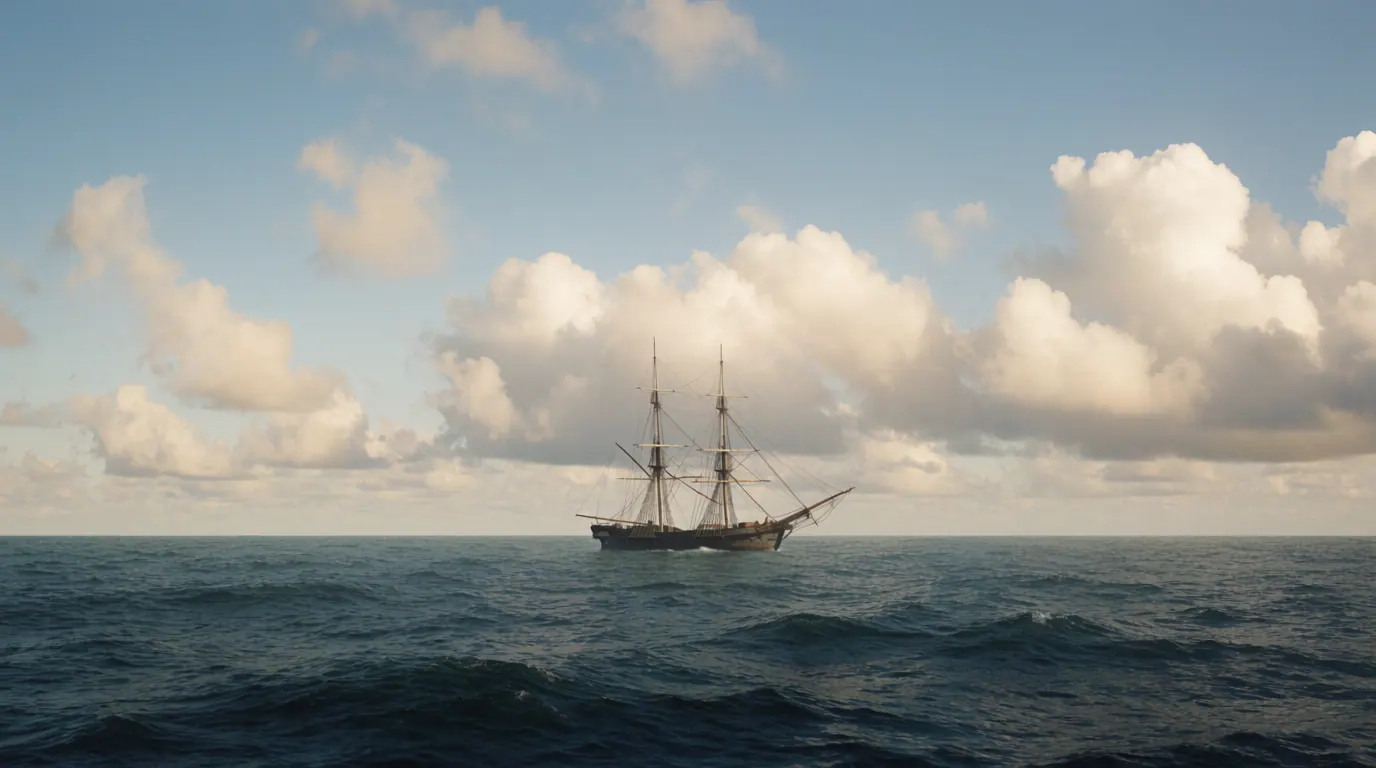
The brigantine Mary Celeste left New York on 7 November 1872 bound for Genoa, Italy, carrying 1,701 barrels of denatured alcohol. Aboard were Captain Benjamin Briggs, an experienced and well-regarded sailor, his wife Sarah, their two-year-old daughter Sophia, and seven crew. The ship's log recorded a routine crossing until its final entry on 25 November, placing the vessel near the Azores.
On 4 December 1872, the Canadian brigantine Dei Gratia, sailing roughly 400 nautical miles further east, sighted the Mary Celeste moving erratically under partial sail. Receiving no response to repeated hails, Captain David Morehouse sent First Mate Oliver Deveau and two sailors to investigate. They found the ship dishevelled but seaworthy: sails partly set and damaged, hatches displaced, charts and navigation tools scattered in the captain's cabin, and roughly three and a half feet of water in the hold, manageable with the pumps. The ship's single lifeboat was gone. The alcohol cargo was intact, and personal belongings, including Sarah Briggs's sewing machine and the family's possessions, remained undisturbed. No one aboard had left any note, and no bodies or signs of struggle were found anywhere on the ship.
Deveau and his small crew sailed the derelict to Gibraltar, arriving 13 December, a day after the Dei Gratia. The Vice Admiralty Court immediately impounded the Mary Celeste for a formal salvage inquiry, which opened on 17 December under Chief Justice Sir James Cochrane. Attorney General Frederick Solly-Flood, acting as prosecutor, became convinced the crew had murdered Briggs and his family, possibly after broaching the volatile alcohol cargo while drunk, and fled in the lifeboat. Months of testimony and physical examination of the ship, however, turned up no blood, no weapon, and no evidence supporting the theory. When the inquiry closed in February 1873, the court awarded the Dei Gratia's crew a salvage payment reduced from the usual rate, a decision widely read as reflecting lingering suspicion rather than proof of any crime.
No trace of Briggs, his family, or his crew was ever found. The most widely credited explanation among maritime historians is that Briggs, worried about a leaking pump or an explosive vapor buildup from the alcohol cargo, ordered everyone into the lifeboat as a precaution, intending to stay nearby until the danger passed; the small boat was then separated or swamped in open ocean, with all aboard lost. The case's enduring "ghost ship" reputation owes much to Arthur Conan Doyle's 1884 short story "J. Habakuk Jephson's Statement," which renamed the vessel "Marie Celeste" and invented the vivid, false detail of a ship found in perfect order with warm food still on the table, details that still circulate as if they were fact.
Related phenomena
- Dyatlov Pass Incident shows how a formal investigation can rule out foul play while still leaving the full picture incomplete for decades.
- Amelia Earhart likewise ends with an exhaustive search and no bodies ever recovered.
- D.B. Cooper pairs a documented crime with a vanishing that official investigators never fully resolved.
- Roanoke Colony shows a similarly orderly, non-violent abandonment scene centuries earlier.
- Flight 19 is another case where searchers found the vehicle's absence but no bodies.
- The Mary Celeste's open-ocean route sits well outside, but is sometimes loosely associated in pop culture with, the Bermuda Triangle legend.