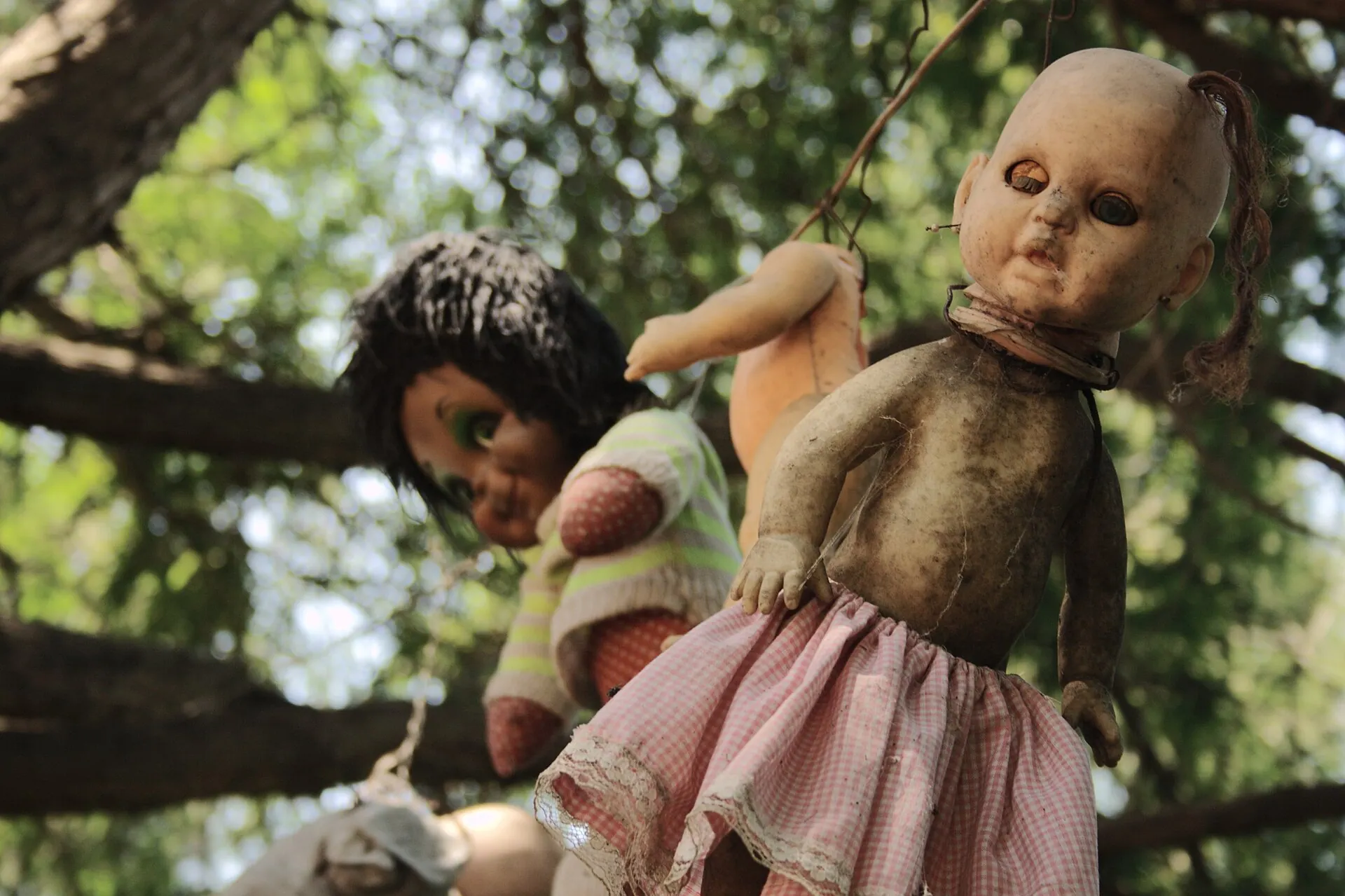
Two grimy, sun-faded dolls hanging from a tree branch on the Island of the Dolls in Xochimilco
ESPARTA PALMA / WIKIMEDIA COMMONS / CC BY 2.0

Island of the Dolls

La Isla de las Munecas · Isla de las Munecas
HISTORICAL SITE

Mainstream consensus: Santana's decades-long presence on the island and his doll collection are well documented by journalists, his surviving family, and tour operators who now maintain the site. The specific drowned-girl origin story is repeated universally in retellings but traced to oral family account rather than any contemporaneous news report, death record, or named victim; his own death is widely attributed by his nephew to natural causes or accidental drowning rather than supernatural involvement.

Share this page
Short answer

La Isla de las Munecas is a real chinampa island in Xochimilco, Mexico, where caretaker Julian Santana Barrera hung thousands of dolls for roughly 50 years after a child reportedly drowned nearby. Santana died in the same canal in 2001; locals call it an accident, while legend blames the drowned girl's spirit.

Location and access

The island sits within the Xochimilco canal network on the southern edge of Mexico City, part of a UNESCO World Heritage site built centuries ago on Aztec-era chinampas, artificial agricultural islands woven from reeds, mud, and lake sediment. There is no road access whatsoever; visitors must hire a traditional flat-bottom trajinera boat, often brightly painted and named after a woman the owner loves, from the Cuemanco or Nuevo Nativitas embarcaderos for a roughly 1.5 to 2-hour journey through the narrow, winding canals. A small entrance fee, collected directly by the Santana family who still live on and maintain the site, supports its ongoing upkeep, and the boat ride itself, passing farmers tending floating gardens and other canal-side attractions, is often as memorable to visitors as the island destination.

History and legend

Julian Santana Barrera reportedly left his family in the 1950s to live a solitary, devoutly religious life as caretaker of a small chinampa island he effectively claimed as his own, building a modest home there and cultivating vegetables to sustain himself. According to family oral history, repeated today by the Mexico City borough government's own tourism pages, he found a young girl's drowned body tangled among the water lilies in the canal near his home, with a doll floating nearby, and began hanging that doll on a tree out of guilt or respect, believing her troubled spirit lingered in the water. Santana told visitors over the following decades that hanging the dolls helped ward off bad spirits and improve his harvests, and he continued collecting discarded, damaged dolls he found washed up in canal trash, reportedly trading vegetables from his own garden with local residents for still more, eventually covering the island's trees, fences, and small structures with thousands of them in increasingly advanced states of decay.

On April 17, 2001, Santana was found dead, floating in the same canal at approximately the same spot long associated with the original drowned-girl story, a detail his nephew Anastasio Santana has repeated to journalists as an eerie, unresolved coincidence rather than proof of anything supernatural. Rather than abandoning the unsettling site, Anastasio took over as caretaker almost immediately, opening the island to a growing wave of curious tourists and carefully preserving his uncle's sprawling collection as the family's primary source of income, a role he and his relatives continue to this day, adding occasional new dolls of their own to replace ones lost to weather and decay.

Related places and beings

Readers drawn to haunted-object folklore should see Annabelle Doll for the broader worldwide tradition of possessed-doll legends this island's reputation closely echoes, right down to the shared imagery of unblinking painted eyes. Myrtles Plantation and Winchester Mystery House offer other sites where a single caretaker's decades-long personal practice, rather than any outside investigation, shaped an entire haunted reputation from the ground up. Aokigahara and Borley Rectory provide further examples of real landscapes and buildings accumulating heavy folklore around a documented or rumored death. Together these cases illustrate how grief, guilt, and deliberate isolation can quietly produce enduring, tourism-driving legends that long outlive the person who started them.

In popular culture

The Island of the Dolls has become a fixture of international "creepy places" travel lists, ghost-hunting YouTube channels, and horror-themed television documentaries exploring Latin American folklore, with its sheer visual density of decaying doll faces making it especially popular on social media and in dedicated photography features built entirely around a single unsettling location. It regularly appears alongside other globally famous haunted-object sites in year-end listicles and cable specials, and Xochimilco's own borough tourism office now actively promotes the island as a signature regional attraction, embracing rather than downplaying the eerie reputation that originally grew out of one grieving man's private ritual.

Photos and illustrations

Mix of rights-cleared documentary stills and AI illustrations (labeled).

Weathered dolls dangling from the trees of the Island of the Dolls, a Xochimilco chinampaCredit: Esparta Palma / Wikimedia Commons / CC BY 2.0
Sun-bleached dolls and doll parts fixed to a wall on the islandCredit: Px-lga / Wikimedia Commons / CC BY-SA 4.0
The island as visitors see it from the canal boats, its trees and shack strung with dollsCredit: Px-lga / Wikimedia Commons / CC BY-SA 4.0
Illustrative scene for Island of the DollsAI illustration for reference only

Visiting

loading map…

Reached only by hired trajinera (traditional flat-bottom boat) through the Xochimilco canal network from the Cuemanco or Nuevo Nativitas embarcaderos; no road access exists. A small entrance fee supports the Santana family, who still maintain the island.

Legend vs history: Verified: Julian Santana Barrera lived alone as caretaker of the chinampa island from roughly the 1950s until his death, collecting and hanging discarded dolls he found in canals and trash, reportedly trading vegetables for them with locals; he was found dead in the canal in April 2001. Legend: that a specific girl drowned at that exact spot and that her vengeful or grieving spirit possesses the dolls and caused Santana's death. No documented record or named source confirms the drowned-girl story as historical fact.

Reports and stories

Attributed reports, haunt claims, and discovery narratives from named sources. Links open the originals; AnomalyWiki does not verify these claims.

Claims vs mainstream

The claim

A specific young girl drowned at the exact spot where Julian Santana later built his home, and he found her floating body along with a doll.

Mainstream view

This origin story, repeated by nearly every tourism and media source, is attributed to Santana's own family's oral retelling; no named victim, police report, or contemporaneous newspaper account of the drowning has been independently located.

The claim

The dolls are possessed by the drowned girl's spirit and have been seen moving, whispering, or opening their eyes on their own.

Mainstream view

Visitor reports of dolls appearing to "move" or "whisper" are widely attributed by journalists and skeptics to pareidolia, wind, insects, humidity-driven decay, and the unsettling effect of hundreds of deteriorating doll faces in natural light, rather than documented movement.

The claim

Julian Santana was killed by the island's supernatural forces or by the ghost of the drowned girl as punishment or revenge.

Mainstream view

Santana's nephew, Anastasio Santana, has stated publicly that Julian likely drowned in the same spot the girl supposedly did, a detail widely reported as eerie coincidence rather than confirmed cause; natural causes or accidental drowning remain the accepted explanations.

The claim

The island has existed as a doll shrine for centuries as part of ancient local tradition.

Mainstream view

Santana began hanging dolls only in the latter half of the 20th century, a span of roughly five decades rather than a centuries-old practice, making this a modern folk shrine rather than an ancient one.

Timeline

  1. 1950sJulian Santana Barrera, reportedly fleeing his family to live a reclusive life, settles on a chinampa island in the Xochimilco canal network.Source: Atlas Obscura, "Isla de las Munecas"
  2. 1950sSantana reportedly finds a drowned girl and a doll floating nearby, and begins hanging the doll on a tree as a tribute.Source: BBC Travel, "Mexico's Island of the Dolls"
  3. 1950s-1990sSantana continues collecting dolls from canal trash and trading garden vegetables for more, hanging thousands across the island over roughly five decades.Source: Atlas Obscura, "Isla de las Munecas"
  4. 17 April 2001Santana is found dead, floating in the same canal where the girl reportedly drowned, at approximately the same spot.Source: BBC Travel, "Mexico's Island of the Dolls"
  5. 2001-presentSantana's nephew Anastasio Santana takes over caretaking the island, opening it to tourists as the family's livelihood and preserving the doll collection.Source: Atlas Obscura, "Isla de las Munecas"

FAQ

What is the Island of the Dolls?

La Isla de las Munecas is a real chinampa island in Xochimilco, Mexico, covered with thousands of discarded dolls hung by caretaker Julian Santana Barrera over roughly five decades starting in the 1950s.

Why did Julian Santana collect the dolls?

Family oral history says he began after finding a young girl's drowned body along with a doll floating nearby, hanging it as a tribute; no independent record confirms the drowning as a documented historical event.

How did Julian Santana die?

He was found dead in the same canal, at approximately the same spot associated with the drowned-girl legend, on April 17, 2001; natural causes or accidental drowning are the accepted explanations, though the coincidence fuels the island's haunted reputation.

Are the dolls really haunted?

There is no verified evidence of haunting. Reports of dolls moving or whispering are widely attributed to pareidolia, wind, insects, and the unsettling natural decay of doll faces rather than confirmed supernatural activity.

Can you visit the Island of the Dolls?

Yes, by hiring a traditional trajinera boat from the Cuemanco or Nuevo Nativitas embarcaderos in Xochimilco; there is no road access, and Santana's family still maintains the site and collects a small entrance fee.

Is the Island of the Dolls an ancient tradition?

No. Santana began hanging dolls in the 1950s, making it a modern folk shrine spanning about five decades rather than a centuries-old practice.