Location and access
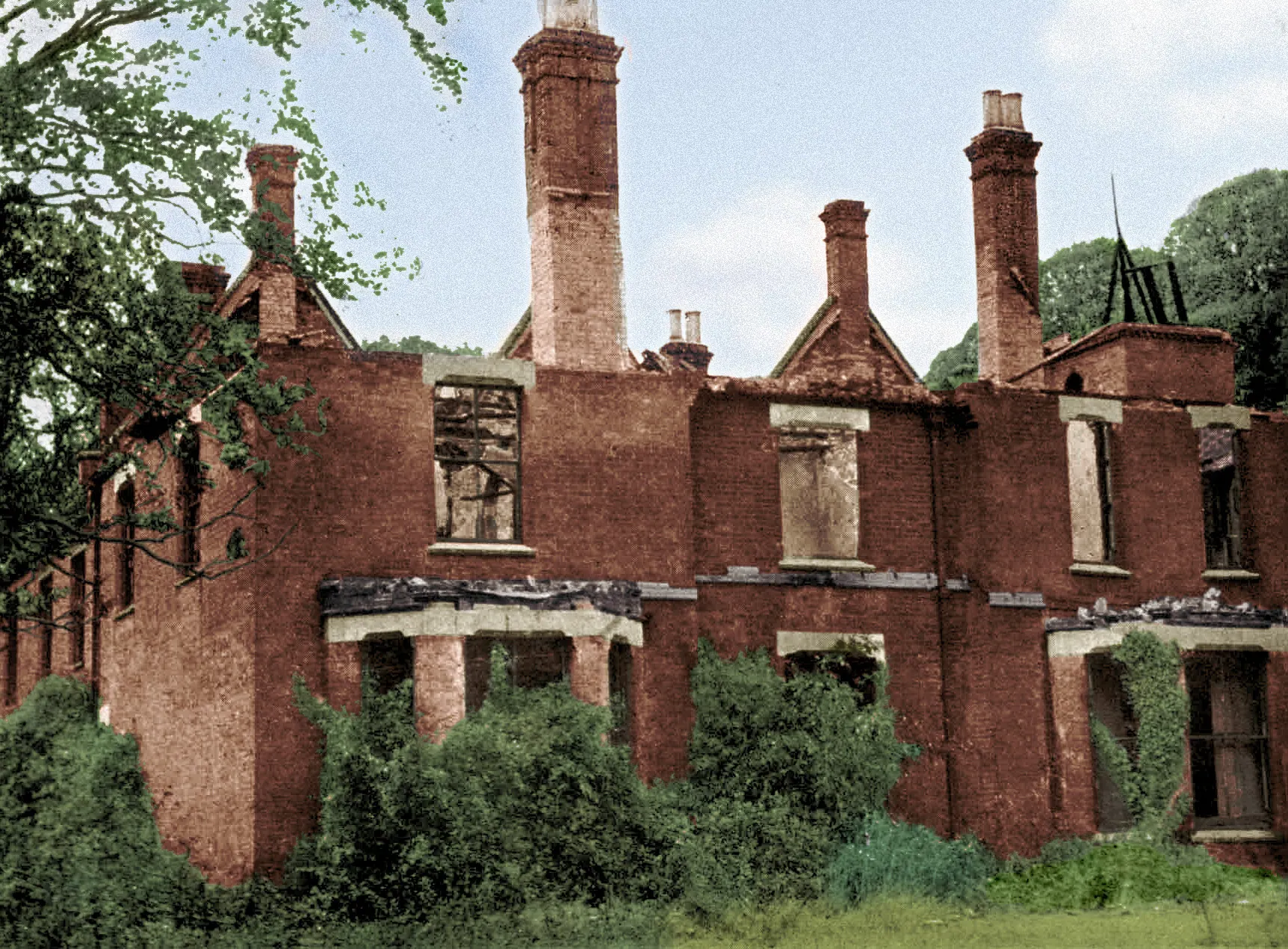
Borley is a small civil parish of just over a hundred people in rural north Essex, close to the Suffolk border and the River Stour, with Sudbury as its nearest town. The rectory itself stood opposite Borley Church, in grounds of nearly four acres, until fire and demolition erased it from the landscape by 1944.
There is nothing left to visit in the way most heritage sites mean it. The church and churchyard remain on view, and a cottage from the original stable block still stands, but the house that generated decades of headlines is simply gone. Visitors drawn by the legend today are looking at an empty field and a parish church, not a preserved haunted house.
History and legend
Rev. Henry Dawson Ellis Bull built the rectory in 1862 to house Borley's parish rector, a two-story brick house with twenty-three rooms and three staircases. For decades it was an ordinary, if large, Victorian clergy house, and local rumors of a ghostly nun circulated quietly without wider notice.
That changed in June 1929, when the Smith family, then renting the rectory, asked the Daily Mirror to put them in touch with the Society for Psychical Research. The paper sent its own reporter first, then arranged for psychical researcher Harry Price to visit. Price arrived on 12 June, and by his own account phenomena began almost immediately: thrown stones, a moving vase, and tapped-out "spirit messages." Mrs. Smith later told associates she suspected Price, an experienced stage conjurer, of producing some of it himself.
Price returned repeatedly over the following decade, renting the house himself for a year starting in 1937 and recruiting volunteer observers through newspaper advertisements. His 1940 book "The Most Haunted House in England" and 1946 follow-up "The End of Borley Rectory" turned the case into one of the most famous in psychical research, built around claimed phenomena ranging from footsteps and bell-ringing to the recurring apparition of a nun on the grounds.
The rectory's physical end came on 27 February 1939, when new owner Captain W. H. Gregson knocked over an oil lamp while unpacking boxes in the unlit hallway. The house had never been connected to gas or electricity, and the resulting fire spread quickly, badly damaging the building. An insurance investigation afterward concluded the fire had the marks of a deliberately started blaze, though no one was ever charged. Even after the fire, Cambridge lecturer Andrew J. B. Robertson organized twenty-five vigils among the ruins with student volunteers before the remains were demolished in 1944.
Price died in 1948, and the Society for Psychical Research, which had never employed him in any official capacity, commissioned three of its own members, Eric Dingwall, Kathleen Goldney, and Trevor Hall, to review his files. Their 1956 report, published as "The Haunting of Borley Rectory: A Critical Survey of the Evidence," concluded that Price had repeatedly distorted witness testimony compared with the original documents and had probably staged some phenomena himself, a damning finding from an organization that had largely supported his earlier work.
Separating fact from legend
Mainstream historians of psychical research treat Borley Rectory today as a case study in investigator contamination rather than genuine haunting. The 1956 report is unusually blunt for an SPR publication, noting discrepancies between Price's published claims and his own underlying files, and flagging the suspicious timing of several "manifestations" with Price's own visits. The real house, its construction date, and the 1939 fire are not in dispute; what collapsed under scrutiny was specifically the paranormal evidence Price built his reputation on.
Related places and beings
Borley Rectory's arc, from local rumor to press sensation to debunked investigator, closely parallels Leap Castle in Ireland, where a single owner's writing did more to build the legend than any older folklore. It also sits naturally alongside other English "most haunted" claimants such as the Tower of London and the deep tunnels of Edinburgh's vaults, each layering ghost tourism onto genuinely old buildings.
The physical disturbances Price reported, moving objects, thrown stones, and knocking sounds, place Borley firmly in poltergeist territory rather than classic apparition lore, and the case is frequently cited in broader discussions of poltergeist phenomena precisely because of how thoroughly its claimed evidence was later picked apart.
In popular culture
Borley Rectory's fame outlived the building itself by decades. Price's bestselling books kept the case in print long after demolition, and later writers, television documentaries, and ghost-story anthologies continued returning to it as a cautionary tale about investigator bias as often as a straightforward haunting story. Its reputation also helped establish the "most haunted house in [country]" framing that countless later tourist sites, including Leap Castle, would borrow for their own marketing.

