Location and access
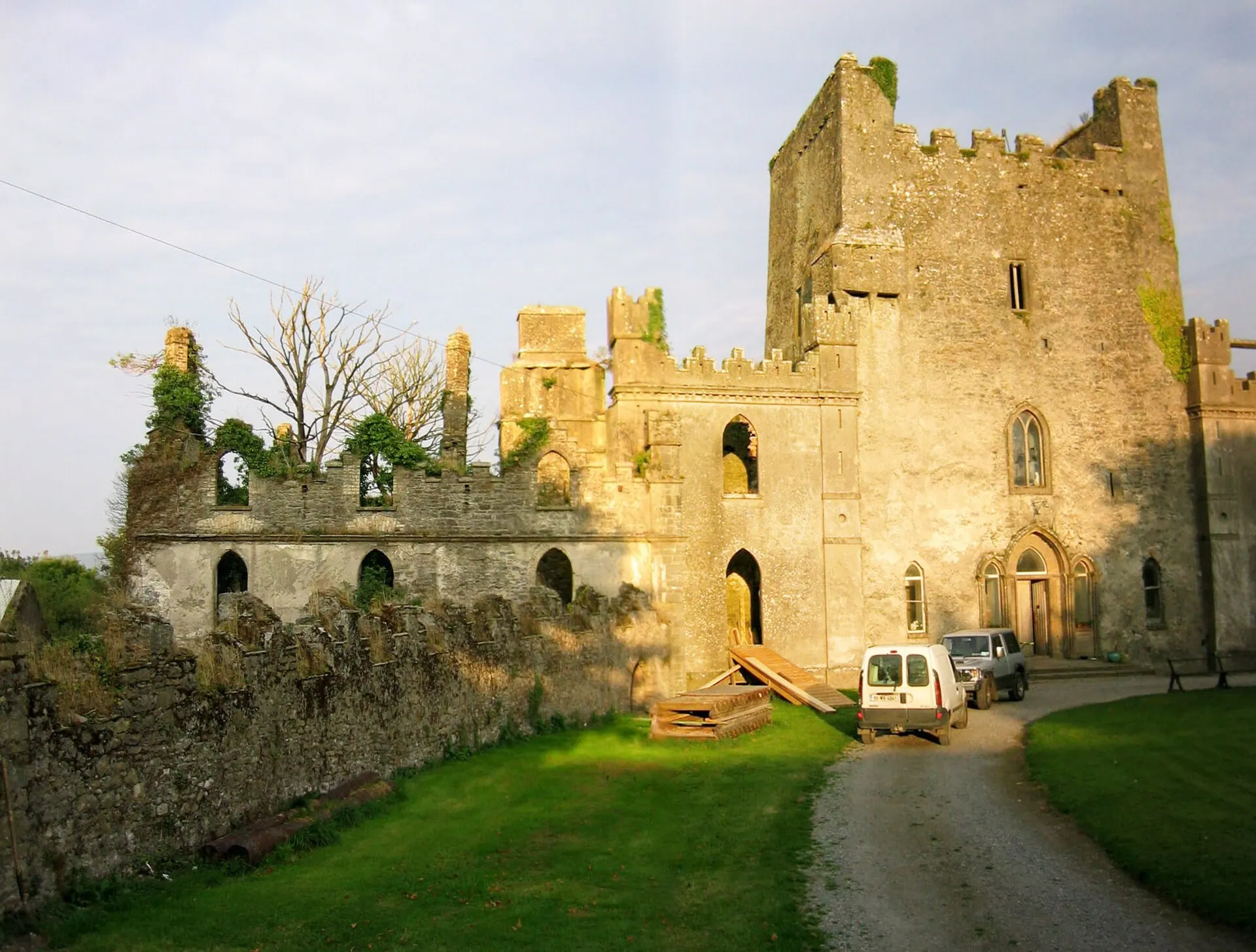
Leap Castle sits on the R421 about 6 kilometers north of Roscrea, straddling the historic border between County Offaly and County Tipperary in Ireland's midlands. The O'Bannon clan built the original tower house in the late 15th century, and the O'Carrolls later made it their principal seat, guarding one of the few passes through the Slieve Bloom Mountains, which is where the name "Leap" (from the Irish "Léim," meaning "leap") likely comes from.
Unlike the Office of Public Works sites nearby, Leap Castle is not a state monument. Musician Sean Ryan and his wife Anne Callanan-Ryan have privately owned and restored it since 1991, continuing work begun by a previous owner, Peter Bartlett, after 1974. The Ryans run guided tours by arrangement, so visiting means contacting the family directly rather than booking through a national heritage body.
History and legend
The castle's documented history is already dramatic without any ghost story. The O'Carrolls held Leap through repeated sieges, including attacks by the Earl of Kildare in 1514 and 1516, and a deliberate burning in 1558 to keep it from Elizabethan forces, who occupied it anyway. By 1642 it passed by marriage to the Darby family, who held it for nearly three centuries and added the Jacobean and Georgian wings visitors see today.
Oral tradition places the castle's bloodiest legend in 1532, after the death of chieftain Mulrooney O'Carroll touched off a succession fight among his sons. According to the story, one brother, a layman, surprised another, a priest, during Mass in the castle's upper chapel and killed him there, giving the room its lasting name: the Bloody Chapel. The tale predates any written ghost account by centuries and functions as regional O'Carroll family lore more than a verified historical record.
The castle's modern "haunted" fame is much newer and traces to one specific person. Mildred Darby, who married Jonathan Charles Darby in 1889 and moved into the castle, wrote detailed accounts of repeatedly encountering a sickening, half-decomposed presence she called "The Thing," later labeled "the Elemental" after a friend suggested the occult term. She published a fictionalized version under a pseudonym, and the castle's folklore has repeated and expanded her description ever since, including a later story that the entity awoke when three cartloads of skeletons were cleared from an old oubliette during renovations.
The Darby family's long tenure ended violently. During the Irish Civil War, on the night of 30-31 July 1922, armed raiders gave caretaker Richard Dawkins twenty minutes to get his family out before dousing the rooms in petrol and burning the castle in two successive fires. Dawkins later described the attack in an insurance claims court; the Darbys, as Anglo-Irish landowners who had raised rents to pay for earlier renovations, were an obvious target amid the period's land and political conflicts. The castle stood a roofless ruin for over fifty years until Peter Bartlett bought it in 1974, with the Ryan family continuing restoration since 1991.
Separating fact from legend
Treated as a historic site, Leap Castle holds up well: the O'Carroll and Darby ownership, the sieges, and the 1922 burning are backed by period records, newspaper coverage, and the castle's own insurance claims file. Treated as a haunted site, the record is much thinner. The Elemental has exactly one named originator, and no contemporaneous account from before Mildred Darby's writing describes anything like it. Folklorists generally read the Bloody Chapel story the same way they read other O'Carroll clan legends: plausible for the period's violence, but undocumented in any surviving court or church record from 1532 itself.
Related places and beings
Leap Castle belongs to a small cluster of European "most haunted" buildings whose fame rests heavily on one Edwardian-era narrator, a pattern it shares with England's Borley Rectory, where investigator Harry Price played a similar outsized role in shaping the legend decades later. American counterparts built on a single colorful owner's storytelling, like the Winchester Mystery House, follow a comparable arc from private eccentricity to public tourist draw.
Within Irish folklore, the Elemental sits closer to the banshee tradition than to any named cryptid: both are solitary, death-adjacent presences tied to a specific family line rather than a species with multiple independent sighting reports. Visitors sometimes conflate the two, but Darby's accounts never describe her Elemental as a wailing harbinger of death in the banshee mold; it is closer to a resident horror than a messenger.
In popular culture
Leap Castle's reputation has made it a recurring stop for international ghost-hunting television crews and paranormal tourism writers since the 1990s, and Mildred Darby's original account was republished by Windwhistle Press as "Leap Castle: The House of Horrors" with added witness testimony from later owners. The castle's name and the Elemental motif also surface regularly in roundups of the "world's most haunted" locations, usually alongside Borley Rectory and the Tower of London, cementing its place in English-language ghost-story anthologies well beyond Ireland.


