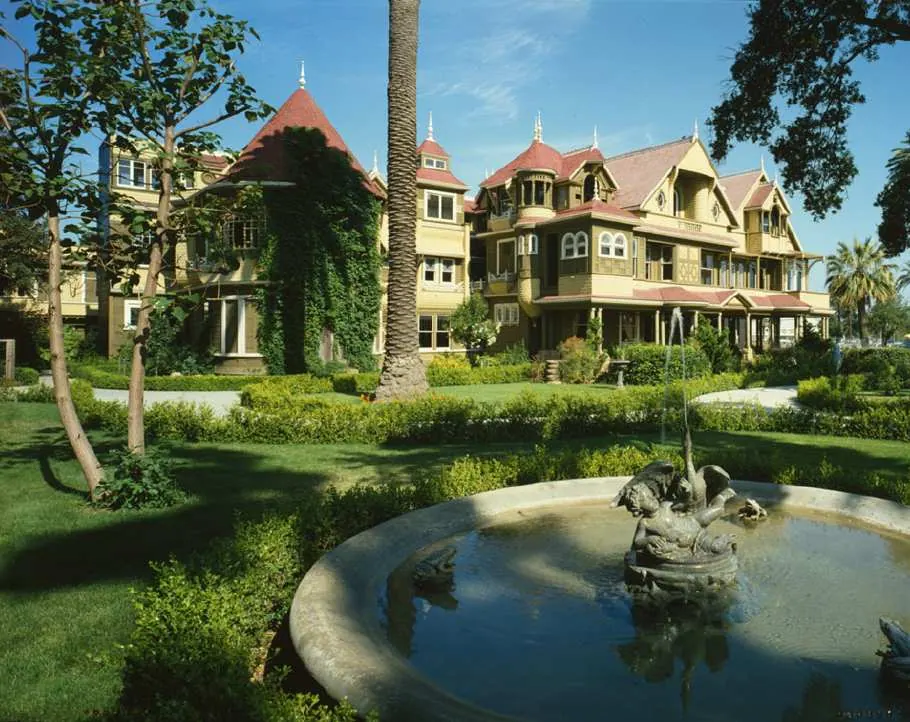
Historic American Buildings Survey photograph of the Winchester Mystery House exterior, San Jose, California.
NATIONAL PARK SERVICE, HISTORIC AMERICAN BUILDINGS SURVEY (PUBLIC DOMAIN)

Winchester Mystery House

Llanada Villa · Winchester House
HISTORICAL SITE

Mainstream consensus: The mansion, its scale, and its architectural oddities are fully documented and open to the public. The spiritualist-curse explanation for why Sarah Winchester built it rests on secondhand, undocumented stories; grief, wealth, and decades of unplanned remodeling explain the house without requiring a literal curse.

Share this page
Short answer

The Winchester Mystery House is Sarah Winchester's sprawling San Jose mansion, built in near-constant renovation from 1886 until her death in 1922, filled with staircases that dead-end at ceilings and doors opening onto blank walls. Legend blames a medium's curse-breaking orders; the house's own historians say her real motive is genuinely unknown.

Location and access

The mansion stands at 525 S. Winchester Blvd in San Jose, a stretch of farmland in 1886 that Silicon Valley has since swallowed into dense suburb. The Winchester family sold the property not long after Sarah's death, and a succession of private owners has operated it continuously as a paid attraction since 1923, making it one of the longest-running tourist houses in California. Daytime guided walks cover roughly 110 of the mansion's 160 finished rooms, weaving past the switchback staircases and cabinetry doors the house is known for, while the after-dark Flashlight and Candlelight tours unlock additional wings normally closed to daytime guests, including the Seance Room itself. Visitors are free to bring handheld EMF meters or thermometers on those evening walks, and the surrounding gardens, gift shop, and a small firearms museum round out the grounds. Because the house remains privately run rather than government-managed, hours shift seasonally; the operators post current scheduling and the flashlight-tour calendar on their own site ahead of any visit. The surrounding neighborhood retains almost none of its original rural character, so the mansion's eccentric silhouette, visible from the street, stands out sharply against the shopping centers and office parks that now line Winchester Boulevard.

History and legend

Sarah Pardee married William Wirt Winchester, heir to the Winchester Repeating Arms fortune, in 1862 in New Haven, Connecticut. The couple's only child, an infant daughter named Annie, died about six weeks after her birth in 1866, a loss family letters describe as devastating. William himself succumbed to tuberculosis in 1881, leaving Sarah a vast inheritance built on rifle royalties and, by her own later correspondence, a grief she never fully resolved. Rather than remain in New England, she moved west in 1884 and, two years later, purchased an unfinished eight-room farmhouse near San Jose, beginning what the property's current operators still call the longest continuous home renovation on record. Over the following decades she employed carpenters and craftsmen virtually without interruption, expanding the structure into a sprawling, multi-story mansion whose footprint eventually reached roughly 24,000 square feet, with somewhere near 160 finished rooms, about 2,000 doors, 10,000 windows, and dozens of stairways by the house's own count.

The spiritualist-curse story that later attached itself to this building, echoed even in the National Park Service's own National Register listing, holds that a Boston medium warned Sarah that the restless spirits of everyone ever killed by a Winchester rifle sought revenge against her family, and that only continuous, uninterrupted construction could keep them at bay. The mansion's own historians treat this version skeptically, noting plainly that no letter, diary, or contemporaneous account from Sarah herself has ever surfaced to confirm it, and that her true motivation for the decades of building remains an open question rather than settled fact. A more prosaic force shaped much of the house's famous strangeness: the 1906 San Francisco earthquake badly damaged the upper stories and a seven-story observation tower, all of which were removed afterward and never rebuilt, a likely origin for several of the staircases and corridors that now dead-end abruptly at ceilings or walls. Construction halted the instant Sarah Winchester died, on September 5, 1922, and remained frozen exactly as crews had left it when the house reopened to paying visitors the following June.

Related places and beings

Readers drawn to architecturally strange, legend-heavy American houses should see Amityville House, Myrtles Plantation, and Borley Rectory, each a case where a genuinely documented building's history gets layered with later spirit-contact folklore. Leap Castle offers an Old World architectural counterpart with its own occult reputation, while Stanley Hotel shows a different real hospitality property whose haunted branding became a deliberate part of its business model rather than an accident of history. For a very different American landscape where unexplained reports and genuine land features intertwine, Skinwalker Ranch rounds out the list. Cross-category, the poltergeist phenomenon entry covers the broader folklore of restless spirits said to influence construction, noise, and household objects, the same vocabulary tour guides still use when describing the mansion's stranger corners.

In popular culture

The mansion's reputation reaches well beyond its own gates. Walt Disney is widely said to have toured the house before designing Disneyland's own haunted attraction, reportedly deciding his version should look elegantly spooky rather than genuinely decrepit. The 2018 horror film "Winchester," starring Helen Mirren as Sarah Winchester, dramatized the spiritualist-curse legend for a wide theatrical audience, and the house regularly anchors Halloween-season listicles, paranormal-investigation cable specials, and true-crime-adjacent podcasts, many of which repeat the medium's-orders story as settled history rather than the attributed, unverified account the mansion's own archivists describe it as. Architecture students and documentary crews visit for a different reason entirely, treating the building as a case study in decades of ad hoc design decisions made without a master blueprint, a detail that rarely survives the retelling once the ghost stories take over.

Site photos

Rights-cleared documentary stills and serious reference images. These are not AI illustrations.

Winchester Mystery House exterior, Historic American Buildings Survey documentationCredit: National Park Service, Historic American Buildings Survey (public domain)
Front facade of the Winchester Mystery HouseCredit: Ben Franske / CC BY-SA

Visiting

loading map…

Privately owned tourist attraction at 525 S. Winchester Blvd, San Jose. Open daily for guided daytime tours; seasonal flashlight and candlelight night tours run select dates. Listed on the National Register of Historic Places (ref. 74000559). Check winchestermysteryhouse.com for current hours and ticket rules before visiting.

Legend vs history: Verified: Sarah Winchester bought an eight-room farmhouse in 1886 and expanded it into a 160-room, 24,000-square-foot mansion over 36 years, construction stopping only at her 1922 death. Legend: that a medium ordered her to build nonstop, day and night, without a master plan, to appease spirits killed by Winchester rifles. The house's own historians call that motive unconfirmed, not an established fact.

Reports and stories

Attributed reports, haunt claims, and discovery narratives from named sources. Links open the originals; AnomalyWiki does not verify these claims.

Claims vs mainstream

The claim

Sarah Winchester was ordered by a Boston medium to move west and build a house for vengeful spirits nonstop, 24 hours a day, or she herself would die.

Mainstream view

The National Park Service's own listing repeats this as a popularly "reported" story, but no contemporary medium's letter or diary entry has surfaced. House historians state her actual motivation remains unknown; continuous building more plausibly reflects grief over her husband and infant daughter's deaths plus a genuine passion for architecture.

The claim

The staircases to nowhere and doors opening onto blank walls were deliberately designed to confuse and trap vengeful ghosts inside the house.

Mainstream view

Architectural historians attribute many of these oddities to the 1906 San Francisco earthquake, which damaged upper floors and a tower that were removed and never rebuilt, combined with decades of ad hoc remodeling without a single master blueprint.

The claim

Sarah held nightly seances in a dedicated Seance Room to receive construction instructions directly from the spirit world.

Mainstream view

The house tour and company history acknowledge a Seance Room existed and that Sarah was interested in spiritualism, a popular Victorian-era practice, but there is no verified record of what, if anything, was communicated there versus later tour-guide embellishment.

The claim

The number 13 appears obsessively throughout the house (13-paned windows, 13-step staircases) as a deliberate anti-curse charm.

Mainstream view

Some 13-motifs are documented in the house's own materials, but many "13 everywhere" claims circulating online are tourism-era exaggerations layered on after Sarah's death to feed the mystery's modern brand, not confirmed period-built features.

Timeline

  1. 1862Sarah Lockwood Pardee marries William Wirt Winchester, heir to the Winchester Repeating Arms fortune.Source: National Park Service, Winchester House listing
  2. 1866Their infant daughter, Annie Pardee Winchester, dies about a month after birth.Source: National Park Service, Winchester House listing
  3. 1881William Winchester dies of tuberculosis on March 7; Sarah inherits a large fortune and, by later accounts, consults a spiritualist.Source: National Park Service, Winchester House listing
  4. 1886Sarah buys an eight-room farmhouse near San Jose and begins what the company's own history calls "the world's longest home renovation."Source: Winchester Mystery House official history page
  5. 1906The San Francisco earthquake damages the house; a seven-story tower and upper floors are removed and never rebuilt.Source: Winchester Mystery House official timeline
  6. 1922Sarah Winchester dies on September 5 at age 85; construction stops the same day, after roughly 36 years.Source: National Park Service, Winchester House listing
  7. 1923The mansion opens for public tours on June 30, with Mayme Brown as its first tour guide.Source: Winchester Mystery House official timeline
  8. 1974Listed on the National Register of Historic Places (reference number 74000559).Source: National Park Service, Winchester House listing

FAQ

What is the Winchester Mystery House?

A 160-room Victorian mansion in San Jose, California, built by rifle heiress Sarah Winchester in near-continuous renovation from 1886 to 1922, famous for staircases that dead-end at ceilings and doors that open onto blank walls.

Did a medium really tell Sarah Winchester to keep building forever?

That is the popular legend repeated by the National Park Service's own listing as a "reported" story, but no verified document confirms it. House historians say her true motive is unknown.

Why does the house have so many confusing staircases and doors?

Many oddities trace to decades of unplanned remodeling and to the 1906 San Francisco earthquake, which damaged upper floors and a tower that were torn down and never rebuilt.

Is the Winchester Mystery House actually haunted?

There is no scientific evidence of a haunting. Staff and visitors report cold spots, unexplained sounds, and photo anomalies, especially around the Seance Room, but these are attributed claims, not verified phenomena.

Can you visit the Winchester Mystery House?

Yes. It operates daily as a paid tourist attraction in San Jose, with daytime mansion tours and seasonal after-dark flashlight and candlelight tours.

How big is the house?

About 24,000 square feet across 160 rooms, with roughly 2,000 doors, 10,000 windows, 47 stairways and fireplaces, 17 chimneys, 13 bathrooms, and six kitchens by the house's own count.