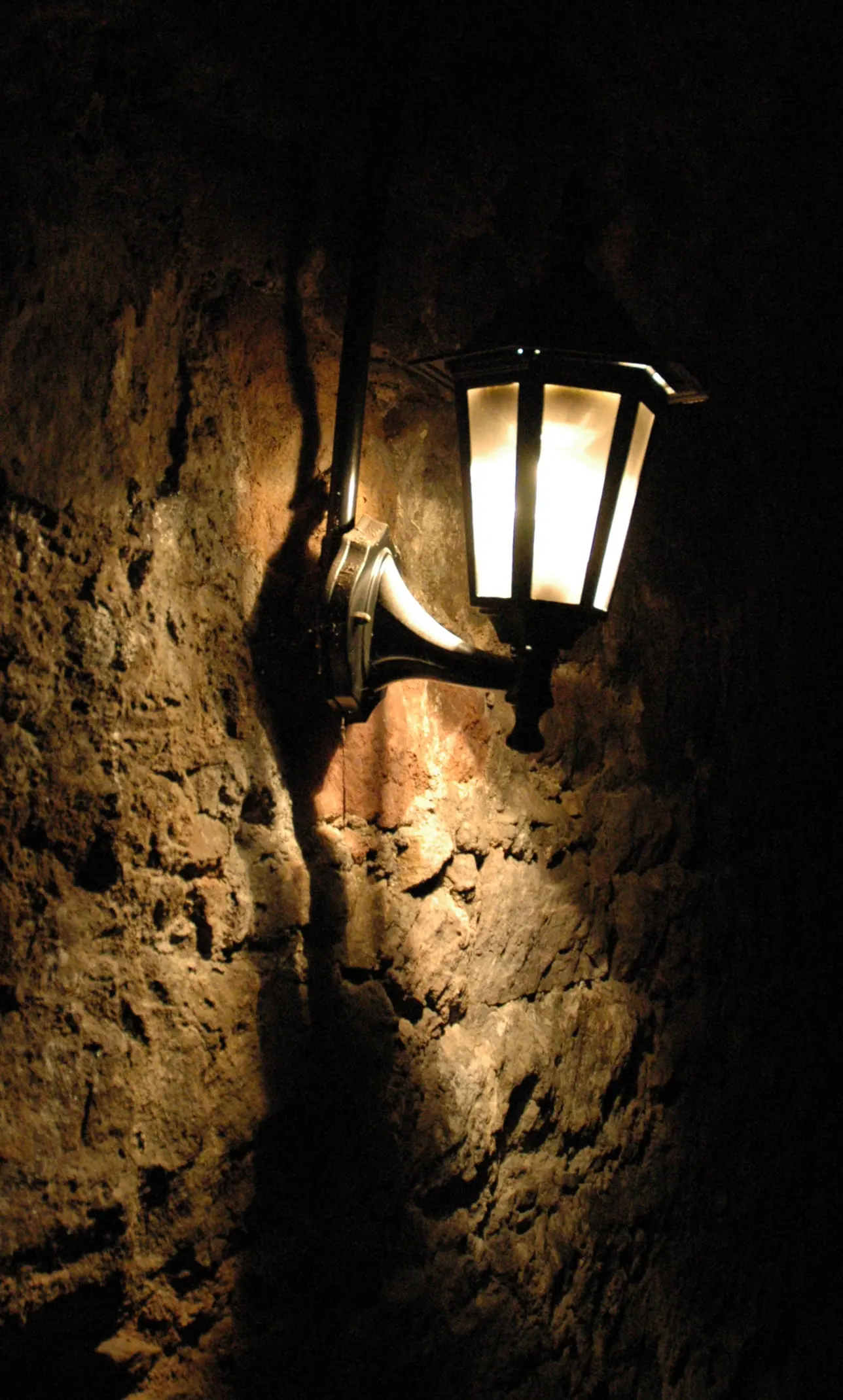
A dim stone passage in the Edinburgh vaults lit by a single wall lantern
KJETIL BJØRNSRUD / WIKIMEDIA COMMONS / CC BY 2.5

Edinburgh Vaults

South Bridge Vaults · Blair Street Underground Vaults
HISTORICAL SITE

Mainstream consensus: The vaults' construction, abandonment, slum-era occupation, and 1980s rediscovery are well-documented urban history. The haunting claims come from decades of tour-operator and visitor reports collected since the vaults reopened, not from independently verified evidence; the genuinely grim living conditions of the 19th-century poor are often cited as the real source of the space's unsettling reputation.

Share this page
Short answer

The Edinburgh Vaults are real 18th-century storage chambers beneath South Bridge, built in 1785 and rediscovered by chance in the 1980s after being sealed with rubble for a century. Ghost-tour lore centers on "Mr. Boots," a tall figure in a dirty coat; historians trace the vaults' grim reputation to genuine poverty, disease, and darkness, not confirmed hauntings.

Location and access

The vaults run beneath South Bridge in Edinburgh's Old Town, a 19-arch bridge spanning the Cowgate valley, of which only the single Cowgate arch remains visible above ground today; the rest were built over and absorbed into the tenements lining both sides of the bridge within a few years of its 1788 completion. Historic Environment Scotland formally lists the bridge itself as a Category B structure, recognizing both the visible arch and the network of vaulted chambers below. The Blair Street Underground Vaults, the main tourable section of that wider network, are accessible exclusively through guided tours operated by Mercat Tours and similar companies; there is no independent public access to the space. Tours range from straightforward historical walkthroughs to dedicated ghost-hunting experiences and seasonal overnight "Vaults Vigil" sessions in which visitors bring EMF recorders and infrared thermometers into the same chambers nineteenth-century families once called home.

History and legend

Construction of South Bridge began in 1785 under architect Alexander Laing, intended as a grand new thoroughfare connecting Edinburgh's expanding southern suburbs to the Old Town's High Street. When the bridge opened in 1788, the space beneath 18 of its 19 arches was built out into vaulted chambers rented out as storage and workshop space for the shops and tenements lining the deck above, used by cobblers, a distillery, and assorted other tradespeople. The construction, however, was poorly sealed against groundwater, and within about seven years flooding and persistent dampness drove most legitimate businesses out; locals at the time preferred to blame a supposed curse on the bridge rather than the structural defects beneath their feet. Through the nineteenth century the abandoned, damp vaults became makeshift housing for Edinburgh's poorest residents, who lived in cold, airless, disease-prone conditions before the chambers were eventually filled with rubble to discourage further illicit use and were largely forgotten for roughly a century.

The modern story of the vaults begins with Norrie Rowan, a former Scotland rugby international, who in the 1980s knocked through a wall while renovating a tenement flat and found direct access to the long-sealed network below. Rowan and his son spent years afterward clearing tonnes of rubble by hand, uncovering artifacts including oyster shells, children's toys, and medicine bottles that physically confirmed the nineteenth-century slum occupation historians had only read about in old records. Since reopening to guided tours, the vaults have built a reputation as one of Britain's most reportedly haunted sites, anchored above all by "Mr. Boots," a tall figure in a dirty blue coat said by generations of visitors to pace the darker corridors and glare silently from doorways at anyone who lingers too long.

Related places and beings

Readers interested in European sites blending real atrocity with modern ghost tourism should see Tower of London and Highgate Cemetery for other British locations where documented death and legend intertwine closely, and Paris Catacombs for a continental underground counterpart built on an even larger scale of real human remains. Leap Castle and Borley Rectory round out the United Kingdom's most tour-promoted haunted buildings, each pairing genuine historical violence with decades of accumulated ghost-story tradition. Cross-category, the Hat Man entry covers the broader folklore of tall, shadowy, hat-or-coat-wearing figures reported in dark interior spaces worldwide, a description that maps closely onto the "Mr. Boots" sightings guides still collect from vault visitors today.

In popular culture

The vaults are a fixture of Edinburgh's broader ghost-tour industry and regularly feature in UK paranormal television productions, including a widely watched international ghost-hunt segment filmed on location by popular online creators during a visit arranged through Mercat Tours. Edinburgh's wider reputation as one of the world's most haunted cities leans heavily on the vaults alongside above-ground sites like Greyfriars Kirkyard, feeding a steady stream of travel-writer "most haunted" rankings, Halloween-season listicles, and amateur paranormal-investigation podcasts that treat the Mr. Boots legend as a near-mandatory stop for any serious ghost-hunting itinerary through Scotland.

Photos and illustrations

Mix of rights-cleared documentary stills and AI illustrations (labeled).

Lantern light on rough stone in the vaults beneath the South BridgeCredit: Kjetil Bjørnsrud / Wikimedia Commons / CC BY 2.5
Brick storage bays inside the vaults, once workshops, stores, and dwellingsCredit: Kjetil Bjørnsrud / Wikimedia Commons / CC BY 2.5
Illustrative scene for Edinburgh VaultsAI illustration for reference only

Visiting

loading map…

Accessible only by guided tour, primarily through the Blair Street Underground Vaults operated by Mercat Tours and related operators. Not open for independent exploration; tours run daily and include historical, ghost-hunting, and overnight "vigil" formats seasonally.

Legend vs history: Verified: South Bridge was built from 1785 with 19 arches, 18 of which were converted into vaulted chambers used first as storage and workshops, then as slum housing for Edinburgh's poorest residents before being sealed and forgotten. Legend: that the vaults are one of the most haunted sites in Britain, with a recurring tall figure known as "Mr. Boots" or "the Watcher." These are attributed tour-guide and visitor reports, not independently verified phenomena.

Reports and stories

Attributed reports, haunt claims, and discovery narratives from named sources. Links open the originals; AnomalyWiki does not verify these claims.

Claims vs mainstream

The claim

The South Bridge Vaults were deliberately built as a secret underground "city" for smuggling and hiding bodies.

Mainstream view

Historic UK and contemporary accounts describe a mundane original purpose: the vaults were ordinary storage and workshop space for the shops built above the bridge's 19 arches, used by cobblers, distillers, and tradespeople, not a purpose-built criminal network.

The claim

A specific curse was placed on South Bridge after a local woman was promised she would be the first to cross it, but was instead the first to cross it in her coffin.

Mainstream view

This "bridge curse" story is reported as local legend by outlets like the i Paper, tied to genuine early structural problems (flooding and poor sealing) that caused businesses to abandon the vaults within a decade of opening, a practical explanation locals reinterpreted supernaturally at the time.

The claim

"Mr. Boots," a tall figure in a dirty blue coat and heavy boots, is a specific identifiable ghost who actively tries to scare visitors out of his section of the vaults.

Mainstream view

Tour operator Mercat Tours presents this as a recurring visitor-reported figure with several competing theories about who he might have been (a guard, thief, or body snatcher), explicitly framed as unverified speculation rather than a confirmed identity.

The claim

Hundreds of unexplained paranormal encounters prove supernatural activity in the vaults.

Mainstream view

Travel writers who have toured the vaults note the extreme cold, total darkness, uneven sloped floors, and claustrophobic conditions as more than sufficient to produce unsettling physical and psychological sensations without requiring a supernatural explanation.

Timeline

  1. 1785Construction begins on South Bridge, a 19-arch bridge across the Cowgate valley in Edinburgh's Old Town.Source: Historic UK, Edinburgh's South Bridge and Vaults
  2. 1788South Bridge opens; vaulted chambers beneath 18 of its arches are built out as storage and workshop space for the shops above.Source: The Scotsman, "A history of Edinburgh's hidden vaults and tunnels"
  3. 1795Businesses begin abandoning the vaults within just seven years of opening, due to flooding and poor sealing during construction.Source: i Paper, "How Edinburgh's South Bridge vaults became cursed"
  4. 19th centuryAbandoned vaults become makeshift housing for Edinburgh's poorest residents before being filled with rubble to discourage illicit use.Source: Historic UK; The Scotsman
  5. 1970Historic Environment Scotland (then the Ministry of Works) designates South Bridge a Category B listed structure, formally recognizing the surviving arch and its vaults.Source: Historic Environment Scotland, listing LB27950
  6. 1980sFormer Scotland rugby international Norrie Rowan rediscovers access to the vaults while renovating a tenement flat and spends years clearing rubble by hand.Source: The Scotsman; i Paper
  7. 1985The vaults come to wider public attention after excavation reveals the labyrinthine network of chambers, per Historic UK's account of the rediscovery.Source: Historic UK, Edinburgh's South Bridge and Vaults

FAQ

What are the Edinburgh Vaults?

Real 18th-century chambers built beneath 18 of South Bridge's 19 arches in Edinburgh's Old Town, originally used as storage and workshops, later as slum housing, then sealed and forgotten for roughly a century before being rediscovered in the 1980s.

Who rediscovered the Edinburgh Vaults?

Former Scotland rugby international Norrie Rowan found access to the vaults in the 1980s while renovating a nearby tenement flat, then spent years clearing out rubble by hand.

Who or what is Mr. Boots?

A tall figure in a dirty blue coat and heavy boots reportedly seen in the Blair Street vaults, nicknamed "Mr. Boots" or "the Watcher" by tour guides; his identity remains speculative, with theories ranging from a guard to a body snatcher.

Why do the vaults have such a dark reputation?

Beyond ghost claims, the vaults genuinely housed Edinburgh's poorest residents in cold, damp, airless conditions during the 19th century, with cholera, tuberculosis, and other diseases common, a real tragedy that predates and underlies the modern ghost tourism.

Can you visit the Edinburgh Vaults?

Yes, but only on guided tours, primarily through the Blair Street Underground Vaults run by Mercat Tours and similar operators; independent access is not available.

Is there real evidence of hauntings in the vaults?

No independently verified evidence exists. Reports of cold spots, voices, and figures are attributed visitor and guide claims, and the vaults' extreme darkness, cold, and uneven floors can themselves produce unsettling sensations.