Location and access
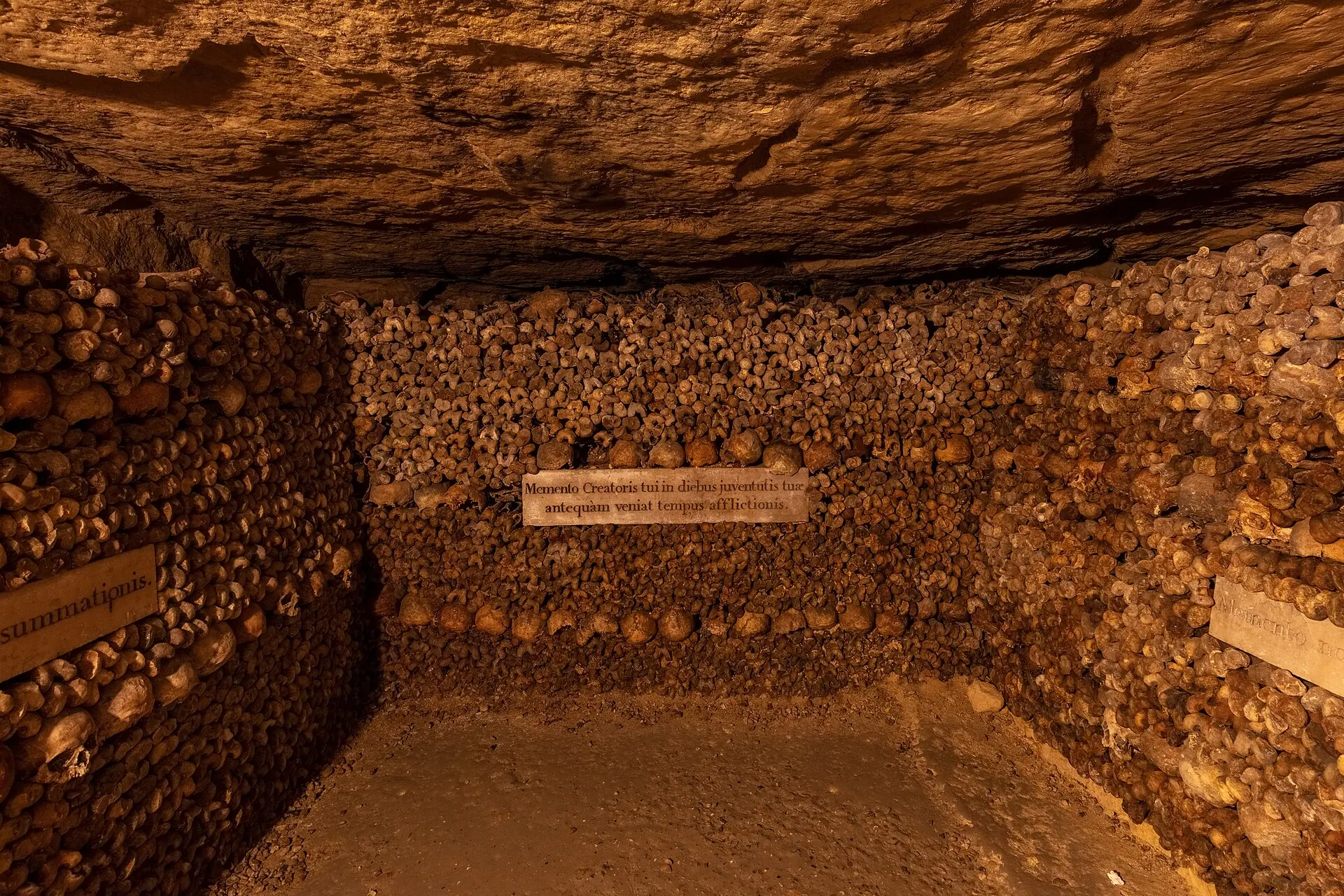
The official Catacombes de Paris museum sits at 1 Avenue du Colonel Rol-Tanguy in the 14th arrondissement, roughly 20 meters underground, the equivalent depth of a five-story building below street level. Visitors book timed tickets in advance through the museum's own website to walk the managed 1.5-kilometer circuit of 243 steps, a route that includes clearly labeled galleries explaining the ossuary's construction alongside the famous stacked-bone walls. That toured section represents only a small fraction of the roughly 800 hectares of former quarry tunnels that honeycomb the ground beneath the wider city; entering the much larger unofficial network without authorization has been illegal since 1955 and is actively patrolled by a dedicated police unit nicknamed the "cataflics," whose job is specifically to locate and eject unauthorized explorers from the restricted tunnels.
History and legend
Paris's aboveground cemeteries, especially the centuries-old Saints-Innocents burial ground beside the bustling Les Halles market, became a severe public health emergency by the mid-1700s, with roughly a tenth of the city's annual dead buried there despite the site's small footprint. In 1780, a wall collapse at Saints-Innocents sent decomposing remains bursting directly into a neighboring building's cellar, a disaster vivid enough to prompt a royal order closing the cemetery for good. Authorities settled on the abandoned Tombe-Issoire limestone quarries, already being structurally reinforced under a department Louis XVI had created in 1777 specifically to stop Paris's streets from collapsing into forgotten mine workings, as the new resting place for the displaced dead. From 1785 to 1787, laborers transferred Saints-Innocents' remains by torchlight at night, deliberately avoiding daylight to sidestep public unease and clerical objection, and the completed site was formally consecrated the "Paris Municipal Ossuary" on April 7, 1786, soon nicknamed the Catacombs in deliberate homage to their ancient Roman namesake. Further transfers continued through the Revolution and again during Baron Haussmann's sweeping 1850s renovation of Paris, with the very last bones added in 1860, and the ossuary first opened for limited public visits by appointment in 1809.
Modern catacomb folklore grows almost entirely out of the unofficial tunnel network beyond the museum's managed circuit, explored for generations by self-described "cataphiles" drawn to the thrill of mapping forbidden space beneath their own city. Their subculture has produced genuine, well-documented discoveries, most famously the 2004 police find of a fully wired illegal cinema, fully stocked bar, and workshop built deep in a restricted gallery, alongside persistent unverified legends: a widely shared "lost camera" video purporting to show a man losing his mind underground traces to a 1990s clip aired on American television with a shifting, uncorroborated origin story, while multiple maintenance staff independently describe unexplained melodic singing deep in older galleries, a phenomenon cataphiles have nicknamed "the singing from below."
Related places and beings
Readers drawn to underground, death-saturated European sites should see Edinburgh Vaults for another rediscovered subterranean network with its own ghost-tour industry, and Tower of London and Highgate Cemetery for above-ground British counterparts where documented death meets modern legend in comparable ways. Aokigahara offers a very different, forested parallel in how a real landscape can accumulate heavy folklore over time, and Alcatraz shares the Catacombs' particular mix of restricted access, institutional oversight, and persistent ghost claims layered onto genuinely grim history. Cross-category, the shadow people entry covers the broader folklore of unidentified dark figures reported in low-light spaces worldwide, matching several cataphile shadow-sighting accounts collected over the years in the unofficial tunnels.
In popular culture
The Catacombs anchor the 2014 found-footage horror film "As Above, So Below," widely believed by fans to have drawn directly on the "lost camera" legend for its premise, and the site regularly appears in true-crime-adjacent YouTube deep dives, paranormal podcasts, and "most haunted" European travel listicles aimed at adventurous tourists. The museum's own dramatic bone-wall displays, arranged in deliberately artistic patterns by the original eighteenth-century workers, make it one of the most photographed and Instagrammed dark-tourism sites in Europe today, a popularity that keeps recirculating the unofficial network's urban legends well beyond the small cataphile subculture that originally produced them, often stripping away the careful caveats those same cataphiles originally attached to their own stories.


