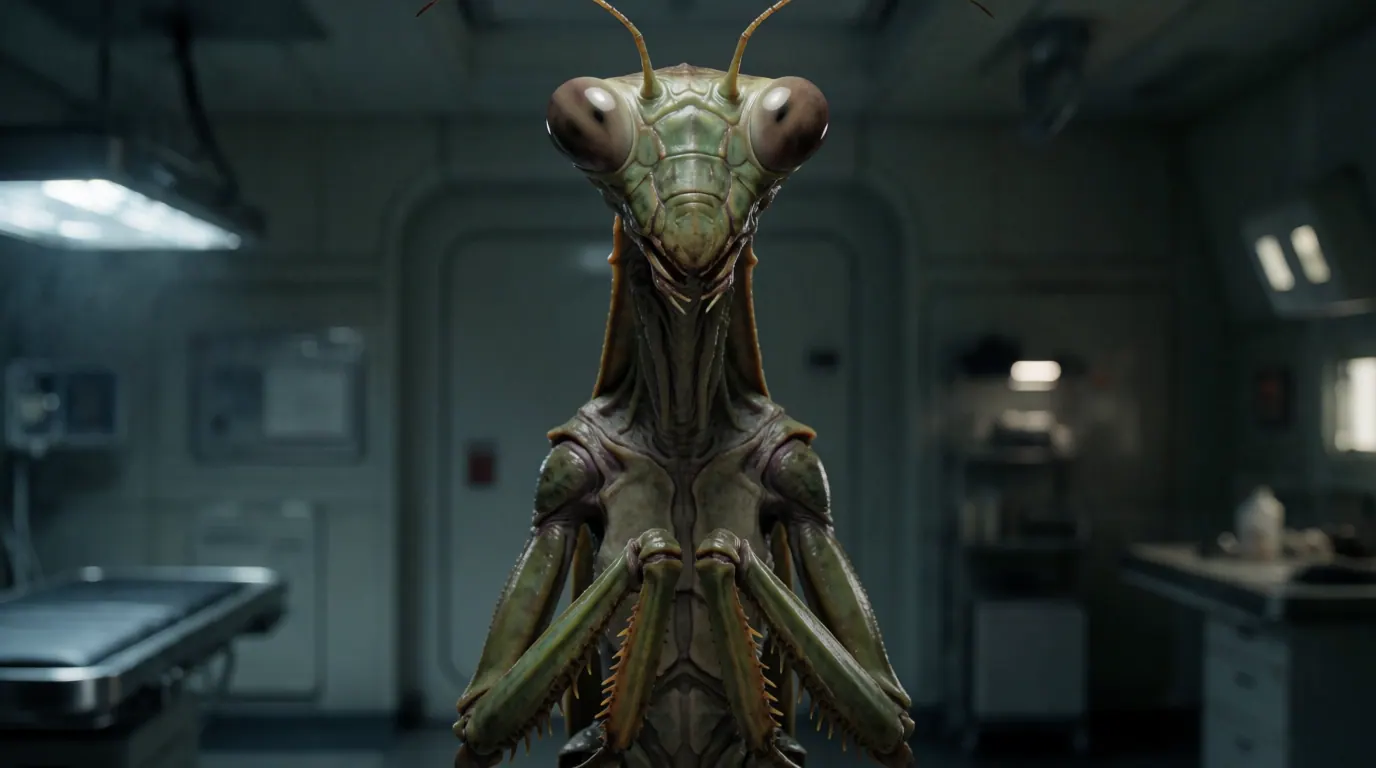
AI identification plate (In habitat) of Mantis Aliens
AI ILLUSTRATION FOR REFERENCE ONLY

Mantis Aliens

Mantids · Mantid aliens · Insectalins (Jacobs typology label) · Insectoid overseers
FOLKLORE

Mainstream consensus: No physical specimens or independent biology support human-scale mantis visitors; tall insectoid overseers persist as testimony-and-book folklore within abduction culture, analyzed alongside hypnosis, false-memory research, and media scripting - not as a verified species.

Share this page
Short answer

Mantis aliens are tall, insectoid figures in UFO abduction lore - triangular heads, folded forelimbs, and wraparound eyes - often cast as overseers beside Greys. The look spread through Karla Turner's 1990s books and David Jacobs's later "insectalin" typology. Mainstream researchers treat them as hypnotic testimony and modern folklore, not a verified species.

Overview

Mantis aliens - also called mantids or insectoids in abduction literature - are tall, bipedal figures with triangular heads, huge wraparound eyes, and folded forelimbs like a praying mantis. They appear mainly in late-twentieth-century abduction books and conference talks as overseers, surgeons, or cold intellects directing smaller Greys. The type is a niche folklore of hypnosis-centered UFO subculture, not a creature with museum bones or radar tracks.

Mainstream psychologists who study abduction claims, including research summarized by Susan Clancy in skeptical venues, treat mantid memories alongside other abduction imagery as products of sleep phenomena, false memory, and cultural scripts rather than as zoology. Believers cite named authors - Karla Turner, Budd Hopkins, David Jacobs - whose books sketch insectoid “Whites” or “insectalins” with eerie calm authority.

Origin of the legend

Karla Turner’s Into the Fringe and Taken circulate drawings and regression narratives that include mantid beings, including childhood “mother” reinterpretations retold in Hopkins’s circle. Jacobs’s later typology language about insectoid overseers gave conference audiences a hierarchical cast list: mantids above greys. Insect dread and science-fiction art already supplied the silhouette; abduction hypnosis sessions gave it testimony format.

Comparative notes in enthusiast newsletters sometimes joke that mantids are greys in chitin, highlighting how fluid the cast can be. Natural-history facts about real praying mantises explain why the body plan feels biologically stylish without proving extraterrestrial entomology. The Betty and Barney Hill 1961 template that mainstreamed modern abduction storytelling is covered at Betty and Barney Hill; mantids are a later costume change in that theater.

Similar beings

Greys share abduction-context roles with different heads. Reptilians and Nordic Aliens compete as other body-plan brands. Little Green Men are a pulp press cliché, not mantid overseers. Real terrestrial mantids are insects, not bipedal surgeons.

In popular culture

Abduction documentaries, forum art, and indie games reuse the folded-arm insectoid because it reads as alien intelligence in one silhouette. The pop version rarely cites Turner or Jacobs; it just needs the triangle head.

Overview
In late-twentieth-century abduction lore, mantis aliens are praying-mantis-like bipeds: elongated triangular heads, huge dark wraparound eyes, thin necks, and spiked forelimbs often held folded against the chest. Witnesses and authors frequently place them above Greys in a story hierarchy - calm, telepathic "supervisors" in craft interiors or exam rooms. The silhouette is a folklore identification cluster from books and regression sessions, not field biology.
Height & build
Taller and thinner than Greys in many accounts; Jacobs's "insectalin" cases often describe six feet or more with an upright insectoid posture and a slight suggestion of an abdomen under the torso. Proportions stress long limbs and a narrow frame rather than human bulk.
Head & face
Triangular mantid head dominates the silhouette; mandibles or mouth parts appear in some retellings but are not uniform. Faces read as alien and angular, with little human expressiveness in published summaries.
Eyes
Large, dark, glossy or compound-like wraparound eyes are the strongest recurring cue - often described as absorbing light or staring without blinking. Color is usually black or deep brown in print, with less variation than skin tone.
Skin / covering
Green, brown, gray-green, or pale chitin with a hard exoskeleton sheen in most abduction art and witness art (for example Turner's family drawings). Texture is insectoid and segmented rather than mammalian skin or fur.
Limbs
Two spiked or serrated forelimbs fold mantid-style; legs are thin and jointed. No wings in the core mantis-overseer cluster (unlike literal Earth mantids' wings in adulthood). Hands are sometimes described as three-fingered or clawed in forum retellings; book summaries emphasize forelimb spikes.
Movement & sound
Angular, insect-like motion; clicking or rustling sometimes claimed. Communication is overwhelmingly telepathic in published abduction narratives rather than spoken language.
Lookalikes
Greys (smoother heads, large almond eyes, no mantid triangle); Hollywood insect monsters; Earth praying mantises at the wrong scale; hybrid "insectoid Grey" fan art that blends both types. Distinguish Jacobs's robed insectalins from Turner's pale green mantid family drawings.
Witness consistency
Mantid head shape, folded arms, and overseer role recur across Turner- and Jacobs-linked strands. Height, exact color, mandibles, and clothing vary; Hopkins's early Grey-centered books are not the main origin lane for this specific silhouette.

Documented encounters and accounts

Published contact, sighting, and related accounts summarized from named sources. Links let you read the originals; AnomalyWiki does not verify these claims.

Claims vs mainstream

The claim

Mantis aliens are a confirmed extraterrestrial species supervising Grey abductors.

Mainstream view

Claims rest on self-reported and hypnotically elicited narratives in books; no specimens, instruments, or government case files verify the biology or hierarchy.

The claim

Hypnosis reliably recovers literal memories of mantid beings in craft.

Mainstream view

Psychologists studying "abductees" report fantasy proneness and suggestible memory formation under hypnosis; recovered scenes are studied as narrative, not as automatic forensic fact.

The claim

Karla Turner's family drawings prove independent corroboration of one mantid type.

Mainstream view

Drawings document what a child and investigators discussed after regression work; they are cultural evidence of the story, not proof of an external organism.

The claim

David Jacobs's insectalin table is an empirical census of real alien ranks.

Mainstream view

The table synthesizes the author's hypnosis cases into a typology; folklore scholars treat such grids as belief-world architecture, not zoological taxonomy.

Timeline

  1. 1981Budd Hopkins publishes Missing Time, helping standardize Grey-centered abduction hypnosis narratives; insectoid overseers are not the focus of that early framework. Source: Hopkins, Missing Time (1981)
  2. 1992Karla Turner's Into the Fringe appears, linking family abduction claims to mantid-like figures and childhood memory material (including experiencer art discussed in later summaries). Source: Turner, Into the Fringe (1992)
  3. 1992Whitley Strieber's novel Majestic and the CBS Intruders miniseries bring giant insectoid visitors into mainstream science-fiction and TV imagery parallel to abduction lore. Source: REALL Newsletter "Graying Mantis" (1999); popular culture records
  4. 1994Turner's Taken reports comparative patterns among eight women, including insectoid "White" beings in multiple accounts alongside Greys. Source: Turner, Taken (1994)
  5. 2015David Jacobs publishes Walking Among Us with an "insectalin" category - tall mantis-like overseers, telepathy, and robed high collars in his synthesized case set. Source: Jacobs, Walking Among Us (2015)
  6. 2000s–2010s"Mantid" spelling and overseer memes spread through abduction forums and typology listicles, often citing Turner and Jacobs as anchors. Source: Abduction subculture reception; REALL chronology summaries

FAQ

What are mantis aliens in UFO lore?

Tall bipedal insectoids with triangular heads and folded forelimbs, usually cast as overseers in late-twentieth-century abduction books rather than as lone roadside sightings.

Who popularized mantid beings?

Authors such as Karla Turner, Budd Hopkins, and David Jacobs circulated drawings and regression narratives featuring mantids or “insectalins.” The type is subcultural, not a museum specimen.

Do scientists accept mantis aliens as real?

Mainstream psychology treats abduction mantid memories as culturally shaped and often hypnosis-linked, akin to other abduction imagery, not as verified entomology.

How do mantids relate to Greys?

In many conference taxonomies, mantids outrank or direct greys during procedures. Skeptics read that hierarchy as storytelling cast lists inside the same modern myth.

Are they just praying mantises?

Real mantids are terrestrial insects. The alien version scales that body plan into a human-sized biped for abduction drama; natural history does not confirm the leap.