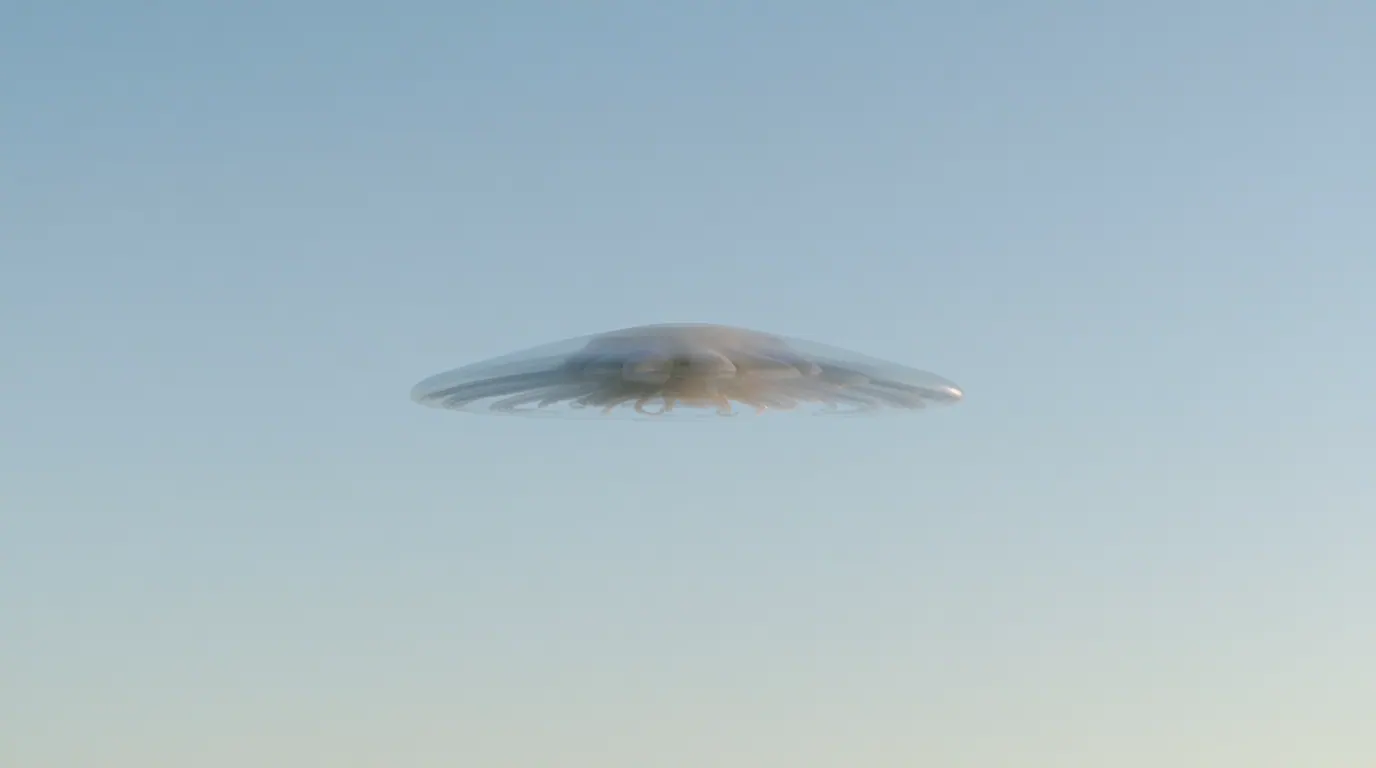
AI illustration of jellyfish UAP IR silhouette (front view) for reference only.
AI ILLUSTRATION FOR REFERENCE ONLY

Jellyfish UAP

Al Taqaddum Object · Al Taqaddam jellyfish · ATQ jellyfish UAP
SCIENTIFICALLY EXPLAINED

Mainstream consensus: AARO assesses with high confidence that the signature Al Taqaddum jellyfish clip shows no anomalous performance and is consistent with a cluster of fully and partially inflated balloons. The nickname remains a descriptive label for the IR shape, not a proven craft type.

Share this page
Short answer

The Jellyfish UAP nickname comes from infrared footage shot over Al Taqaddum Air Base, Iraq, on 23 October 2017 - a bulbous shape with dangling strands that looked alive on FLIR. AARO later assessed the clip with high confidence as a cluster of fully and partially inflated balloons drifting with the wind, not anomalous craft.

Infrared turns ordinary latex into a ghost story. Over Al Taqaddum Air Base on 23 October 2017, a force-protection aerostat's FLIR camera tracked a soft, multi-lobed shape with hanging strands for more than seventeen minutes - long enough for the jellyfish nickname to stick across UAP forums.

The Al Taqaddum recording

The sensor sat roughly 2,700 feet up. The object appeared to float above the desert base while the aerostat held station. Without metadata, slow drift can look like intelligent hover. AARO later reconstructed altitude bands on the order of 850 to 2,200 feet and speeds roughly 4 to 14 mph moving east to west with the wind - balloon weather, not Tic Tac kinematics.

AARO's balloon-cluster reading

The office's case resolution materials assess with high confidence that the clip shows no anomalous performance and matches clusters of fully and partially inflated balloons. In stretches of the video, bulbous lobes and dangling strings become visible as the cluster rotates. Fluctuating infrared returns track sensor gain changes more than glowing hull metal. Partners floated a camouflaged quadrotor idea; AARO discarded it because a powered drone should not simply ride the wind and should show motor heat the FLIR lacks.

Nickname versus craft class

Once stills escaped into public circulation, jellyfish became a reusable shape label for soft IR blobs. The official DVIDS release and AARO resolution page keep the conversation tied to one dated Iraq clip. Wonder at the eerie tentacles; keep non-human airframe claims out until better evidence than grayscale morphology appears.

In popular culture

Thumbnail culture loves the organic silhouette because it feels closer to a living craft than a hard triangle. Neighbor pages on orbs, Gimbal, and GoFast show how sensor artifacts and prosaic objects earn durable nicknames. Watch the DVIDS package before trusting a caption that skips balloons.

AARO's write-up also notes geo-location from the aerostat and weather context that make east-to-west drift look ordinary once you stop treating every IR blob as a new physics class. That is how a seventeen-minute mystery becomes a case study in sensor literacy - valuable even after the balloon verdict.

Sightings and object accounts

Attributed sightings, recoveries, and object histories from named sources. Links open the originals; AnomalyWiki does not verify these claims.

Claims vs mainstream

The claim

The jellyfish is a non-human craft with tentacle propulsion.

Mainstream view

AARO's video, metadata, weather, and line-of-sight work support a balloon cluster drifting with wind at ordinary speeds.

The claim

Seventeen minutes of FLIR proves anomalous technology.

Mainstream view

Duration alone does not equal performance. AARO finds no kinematics beyond known balloon behavior.

The claim

It must have been a camouflaged quadrotor drone.

Mainstream view

AARO and partners discarded that theory - wind drift and lack of motor heat signatures fit balloons better.

The claim

Official balloon talk is a cover story.

Mainstream view

The public DVIDS release and case resolution report show the morphology and analysis path; extraordinary craft claims need better evidence than the IR silhouette.

Timeline

  1. 2017-10-23Infrared sensor on a force-protection aerostat (~2,700 ft) over Al Taqaddum Air Base, Iraq, records ~17 minutes 30 seconds of the floating object.Source: AARO Al Taqaddum Case Resolution
  2. 2018-2024Stills and nicknames circulate in UAP communities as jellyfish craft evidence before a full public resolution package.Source: UAP community reception / later AARO materials
  3. 2025-04-29DVIDS posts the Al Taqaddum Object video package noting AARO's balloon-cluster assessment.Source: https://www.dvidshub.net/video/960331/al-taqaddum-object
  4. 2025-09-08AARO case resolution report (ref. noted in public archives) assesses high confidence balloon-cluster identification and no anomalous performance.Source: AARO UAP Case Resolution Reports

FAQ

What does AARO say the jellyfish was?

AARO assesses with high confidence that the Al Taqaddum object was consistent with a cluster of fully and partially inflated balloons and showed no anomalous performance.

When and where was the footage recorded?

On 23 October 2017, an infrared sensor on a force-protection aerostat over Al Taqaddum Air Base, Iraq, recorded about seventeen and a half minutes of the object.

Why does it look like a jellyfish?

Rounded lobes plus dangling strings in infrared create a tentacled silhouette. The nickname describes shape, not biology or confirmed craft design.

Was it a drone under camouflage netting?

AARO and partners considered that idea and rejected it - wind drift and missing motor heat signatures fit balloons better.

Does the resolution kill every jellyfish nickname online?

No. Other soft IR blobs may still be labeled jellyfish casually. The public Al Taqaddum case that AARO resolved remains the best-documented anchor for the nickname.

Where can I watch the official clip?

DVIDS hosts the Al Taqaddum Object video package alongside AARO's balloon-cluster caption.