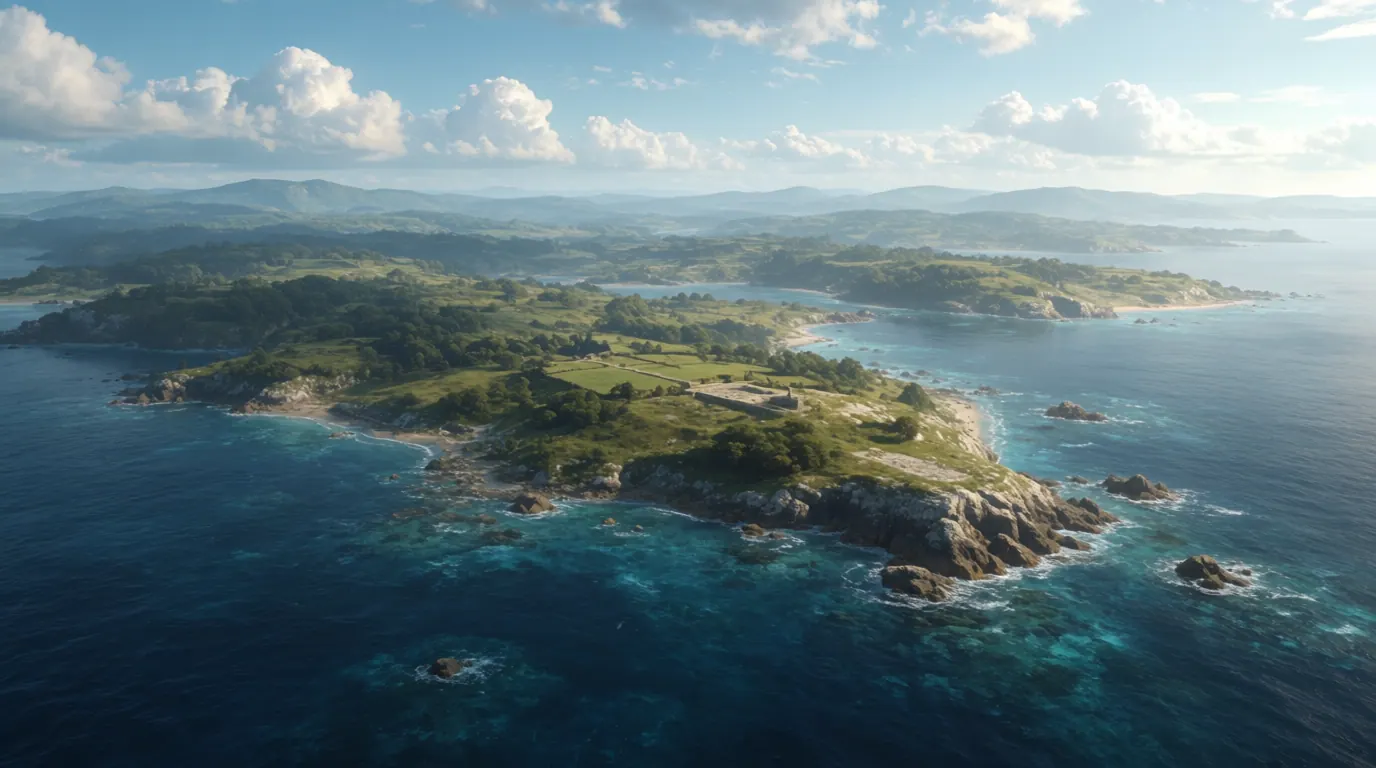
AI illustration of granite cliffs at Land's End with distant islands on the horizon for Lyonesse lore - atmospheric legend only, not a documentary photograph.
AI ILLUSTRATION FOR REFERENCE ONLY

Lyonesse

Lethowsow · Lyonnesse
LEGENDARY

Mainstream consensus: A genuine, long-standing Cornish coastal folk tradition, first set down in writing in the 15th century and absorbed into Arthurian romance soon after, without geological evidence for the sudden, large-scale flood the legend describes.

Share this page
Short answer

Lyonesse is a legendary land said to have stretched from Cornwall to the Scilly Isles before drowning in a single catastrophic flood. First mapped in a 15th-century travel itinerary, it later anchored Arthurian romance and real place-name disputes. Modern coastal geology shows no evidence of one sudden continent-scale flood event.

Mainstream view

Historians and folklorists treat Lyonesse as a Cornish folk tradition first recorded in writing in the 15th century, later absorbed into Arthurian romance as the homeland of Tristan, with no geological evidence of a sudden flood event matching the described scale.

Alternative claim

Early antiquarians Richard Carew (1602) and William Camden (1586) debated whether a real, datable catastrophic flood submerged a specific, named landmass between Cornwall and Scilly within historical memory.

Trace the Lyonesse tradition to its root and the record goes quiet remarkably fast. The earliest known mention comes from William of Worcester, an English antiquarian traveling through Cornwall around 1478-80, who notes in his itinerary a local tradition of land that once stretched from Land's End to the Isles of Scilly, scattered with churches, before the sea swallowed it whole. He gives no date for the flood and doesn't yet use the name "Lyonesse" at all - that label solidifies only later, through two antiquarians who disagreed about how seriously to take the whole thing. William Camden's 1586 Britannia records the tradition with some credibility; Richard Carew's 1602 Survey of Cornwall engages with it more skeptically but still helps fix the name in English antiquarian discourse.

What modern geology actually shows is both more interesting and less dramatic than the legend. Archaeologist Charles Thomas, and later geographer Patrick Nunn, documented genuine post-glacial sea-level rise around the Isles of Scilly - a slow, millennia-long process that really did connect the islands more fully to the Cornish mainland at various points in the deep past. That real, gradual drowning likely seeded the folk memory Worcester recorded centuries later, but it is categorically different from the legend's claim of one sudden, catastrophic flood swallowing an entire named kingdom overnight. Slow coastal retreat over thousands of years and a single historic cataclysm are not the same evidence, even though they point in the same geographic direction.

The Arthurian connection came later still and from an entirely different direction. Thomas Malory's 15th-century material already loosely associates Tristan with a land called Lyonesse, but it was Alfred, Lord Tennyson's 19th-century Idylls of the King that permanently welded the Cornish flood tradition onto Arthur's own story, staging the king's final battle with Mordred on Lyonesse's doomed shore. That graft tells readers more about Victorian romantic taste than about any 5th-century event - by the time Tennyson wrote, "Lyonesse" had already drifted from local Cornish memory into a flexible literary stage set, available for whatever catastrophe a given storyteller needed. For the structurally similar Breton flood legend, see Ys; for the Arthurian court this legend got pulled into, see Camelot.

Illustrations

AI illustrations for reference only - not documentary photographs.

Legendary Lyonesse atmosphere (AI illustration)AI illustration for reference only

Key debates and stories

Attributed discovery narratives, debates, and claim histories from named sources. Links open the originals; AnomalyWiki does not verify these claims.

Claims vs mainstream

The claim

Lyonesse was a specific, named kingdom that sank in one historically datable flood.

Mainstream view

William of Worcester's 15th-century account is the earliest written record and gives no specific date for the flood; later writers like Carew and Camden debated the claim without resolving it, and no single historical flood event matching the description has been identified.

The claim

Modern sea-level rise around Scilly directly confirms the Lyonesse legend as literal fact.

Mainstream view

Geomorphologist Charles Thomas and later researchers including Patrick Nunn documented genuine, gradual post-glacial sea-level rise around the Isles of Scilly over millennia - a slow process entirely different from the sudden, singular catastrophe described in the legend.

The claim

Lyonesse and the Breton legend of Ys describe the same real flood event.

Mainstream view

Folklorists read the structural similarity - a drowned land, a single catastrophic night - as shared Celtic flood-myth motifs rather than evidence both traditions record one historical event in two regions.

Timeline

  1. 15th century CEWilliam of Worcester's travel itinerary records the earliest known written mention of a lost land between Land's End and the Scilly Isles, said to have held numerous churches before the sea took it. Source: William of Worcester, Itineraries (travels c. 1478-80)
  2. 1586 CEAntiquarian William Camden's Britannia records and lends credibility to the tradition of a sunken land off Cornwall, helping fix it in English antiquarian discourse. Source: William Camden, Britannia (1586)
  3. 1602 CERichard Carew's Survey of Cornwall engages directly with the Lyonesse tradition, debating its plausibility and helping cement "Lyonesse" as the standard English name for the legend. Source: Richard Carew, Survey of Cornwall (1602)
  4. 19th century CEAlfred, Lord Tennyson sets the final battle between Arthur and Mordred in Lyonesse in his Idylls of the King, permanently linking the Cornish flood legend to the broader Arthurian cycle for English-language readers. Source: Alfred, Lord Tennyson, Idylls of the King (1859-1885)

FAQ

Was Lyonesse a real place?

No sudden, continent-scale flood matching the legend has been confirmed geologically. The tradition is first recorded in writing in the 15th century as Cornish folklore.

Where was Lyonesse supposed to be located?

Between Land's End, Cornwall, and the Isles of Scilly, England - a stretch of coastline said to have once been dry, church-dotted land.

Who first wrote down the Lyonesse legend?

Antiquarian William of Worcester, in travel itinerary notes from around 1478-80, without yet using the name "Lyonesse" itself.

Does sea-level rise around Scilly prove the legend true?

It shows real, gradual post-glacial sea-level change over millennia, documented by researchers like Charles Thomas and Patrick Nunn - a slow process, not the single sudden catastrophe the legend describes.

How did Lyonesse become connected to King Arthur?

Later romance writers, and especially Tennyson's 19th-century Idylls of the King, grafted the Cornish flood legend onto Arthurian tradition as Tristan's homeland and Arthur's final battlefield.

Is Lyonesse related to the Breton legend of Ys?

The two share the structural motif of a sudden drowned land, which folklorists read as common Celtic flood-myth imagery rather than evidence of one shared historical event.