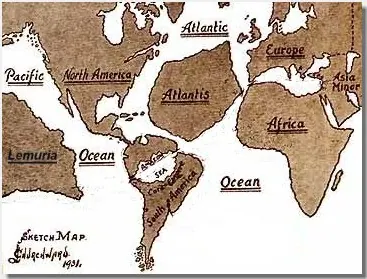
Historical public-domain map illustration associated with Lemuria lost-continent lore - documentary of the idea, not a geological survey chart.
PUBLIC DOMAIN (THEOSOPHICAL / SCOTT-ELLIOT MAP TRADITION)

Lemuria

Lemurian continent · Kumari Kandam (related Tamil legendary motif; not identical)
LEGENDARY

Mainstream consensus: Folklore / legendary overlay on an obsolete scientific hypothesis - not a verified lost continent or advanced sunken civilization.

Share this page
Short answer

Lemuria began as an 1864 biogeographic land-bridge idea to explain lemur distributions, then flowered into a Theosophical lost continent of a mythical root race. Plate tectonics removed the scientific need for a sunken landmass, yet Lemuria lore still thrives as esoteric mythology and imaginative geography.

Mainstream view

Biogeography is explained by plate tectonics, continental drift, and known island histories. No geological evidence supports a lost advanced continent called Lemuria. Theosophical and New Age Lemuria are religious-esoteric narratives, not Earth science.

Alternative claim

A vast prehistoric continent sank, leaving spiritual lineages, psychic lore, or remnant peoples (sometimes linked to Mount Shasta “Telos” stories or Tamil Kumari Kandam motifs in popular retellings).

Lemuria started as a Victorian fix for a mammal-distribution puzzle and ended as one of the most durable sunken-continent myths in esoteric literature. Zoologist Philip Lutley Sclater coined the name in 1864 for a hypothetical land that might explain why Madagascar and South Asia seemed to share certain mammal affinities. Within a generation, Helena Blavatsky and later Theosophists reused “Lemuria” for a spiritual homeland of a mythical “third root race,” complete with clairvoyant maps and deep-time chronologies that no excavation has ever matched.

Plate tectonics and modern biogeography removed the scientific need for Sclater’s bridge. Madagascar’s biota, India’s drift history, and island colonization models leave no room for a drowned advanced civilization called Lemuria. What persists is cultural: Theosophical treatises, Scott-Elliot’s illustrated continents, Mount Shasta “Telos” folklore, and popular blends that mash Lemuria together with Plato’s Atlantis, Churchward’s Mu, or Tamil Kumari Kandam motifs.

Theosophical maps are documents of a belief system - fascinating as intellectual history, useless as Earth-survey charts. Lemuria remains lore layered on an obsolete hypothesis, not a staged museum hoax and not a verified sunken empire.

Peers in this silo include Mu, Hyperborea, Atlantis theories, and Kumari Kandam. Contactee-era Theosophy-adjacent threads also surface among Nordic aliens stories.

Scott-Elliot’s illustrated continents and Blavatsky’s root-race chronology turned a zoologist’s stopgap into a spiritual epic. Mount Shasta tourism later rented the brand for underground cities. None of those chapters produce Lemurian pottery. They produce books, maps, and pilgrimage economies - which are real cultural facts about belief, not geology.

Sclater needed a bridge for lemurs; Blavatsky needed a stage for root races. Only one of those projects answered a zoology paper.

Lemuria began as a zoologist's land-bridge sketch and became an esoteric homeland. Keep the Victorian hypothesis, the Theosophical epic, and modern geology on separate shelves.

Tamil Kumari Kandam motifs sometimes share shelf space with Lemuria in popular writing. Scholars still separate the Tamil literary tradition from Sclater's zoology and Blavatsky's root races.

Documentary photos

Rights-cleared documentary stills and serious reference images. These are not AI illustrations.

Historical Lemuria map illustration (public domain; legendary cartography)Credit: Public domain (Theosophical / Scott-Elliot map tradition)

Key debates and stories

Attributed discovery narratives, debates, and claim histories from named sources. Links open the originals; AnomalyWiki does not verify these claims.

Claims vs mainstream

The claim

Lemuria was a real sunken continent that once connected Madagascar and India.

Mainstream view

Sclater’s land-bridge idea is obsolete. Madagascar’s biota is explained without a drowned Lemurian continent; plate tectonics superseded Victorian land-bridge models.

The claim

Advanced Lemurians (a Theosophical “third root race”) lived millions of years ago.

Mainstream view

Root-race chronology is esoteric doctrine from Blavatsky and later Theosophists, not archaeology or paleontology. No material culture of such a civilization exists.

The claim

Mount Shasta shelters Lemurian survivors or an underground city (Telos).

Mainstream view

Local New Age folklore and channeling claims; no geological or archaeological verification of subterranean Lemurian cities.

The claim

Lemuria and Atlantis prove a suppressed global prehistoric empire.

Mainstream view

Atlantis originates in Plato’s dialogues as a literary-political allegory; Lemuria began as a zoology hypothesis later spiritualized. Neither is verified sunk tech.

Timeline

  1. 1864Philip Lutley Sclater coins “Lemuria” as a hypothetical land explaining lemur-related mammal distributions between Madagascar and Asia. Source: Sclater, Quarterly Journal of Science (1864); history-of-science summaries
  2. 1870s–1880sErnst Haeckel and others discuss sunken southern lands in evolutionary and biogeographic debates; the name circulates beyond specialist zoology. Source: Nineteenth-century biogeography historiography
  3. 1888Helena Blavatsky’s The Secret Doctrine reframes Lemuria as home of the Third Root Race in Theosophical anthropogenesis. Source: Blavatsky, The Secret Doctrine, Vol. II (1888)
  4. 1904W. Scott-Elliot publishes The Lost Lemuria with clairvoyant-informed maps and descriptions elaborating Theosophical Lemuria (often linked to C. W. Leadbeater). Source: Scott-Elliot, The Lost Lemuria (Theosophical Publishing Society, 1904)
  5. 1960s–presentPlate tectonics becomes mainstream; scientific Lemuria land-bridge models are abandoned while New Age, Tamil-nationalist, and Mount Shasta Lemuria lore continue. Source: Modern geology textbooks; cultural histories of lost-continent myths

FAQ

Was Lemuria a real continent?

No verified geological continent named Lemuria exists. The name began as a nineteenth-century biogeographic hypothesis and later became esoteric mythology.

Who invented the name Lemuria?

Zoologist Philip Lutley Sclater coined Lemuria in 1864 in connection with Madagascar mammal distributions. Theosophists later reused the name for a spiritual lost land.

Is Lemuria the same as Atlantis or Mu?

They are distinct traditions often blended in popular books. Atlantis comes from Plato; Mu is a later Pacific lost-continent idea; Lemuria started as a science hypothesis that occult writers spiritualized.

Why do scientists reject Lemuria today?

Plate tectonics and modern biogeography explain species distributions without a sunken Lemurian continent. No archaeological culture matches Theosophical Lemurians.

What is the Mount Shasta Lemuria story?

New Age folklore claims Lemurian survivors or underground cities near Mount Shasta. These are legendary and channeling narratives, not verified archaeology.

Is Kumari Kandam the same as Lemuria?

Kumari Kandam is a Tamil legendary submerged homeland motif sometimes mapped onto Lemuria in popular writing. Scholars treat it as cultural legend, not proven geology.