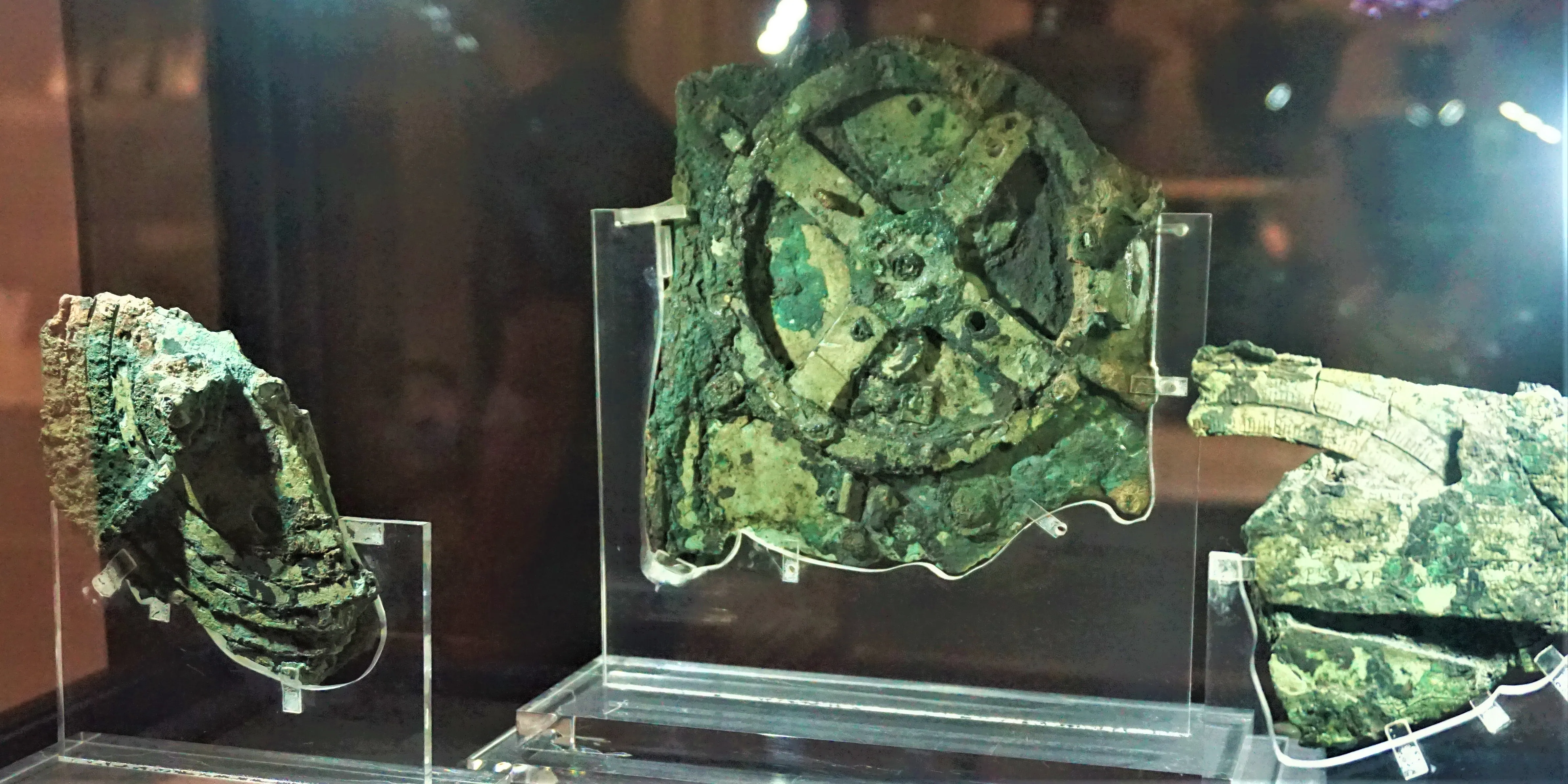
Sponge divers working a Roman-period wreck off Antikythera in 1900-1901 hauled up statues, pottery, and corroded bronze lumps that looked like scrap. Within a year, museum study in Athens showed gear teeth in the crust - the first hint that the lumps were a precision astronomical machine. Fragments at the National Archaeological Museum remain green-brown corrosion cakes with layered plates, tooth profiles, and Greek inscription traces.
Historian of science Derek de Solla Price made the device famous as an "ancient computer" in the 1970s. Later X-ray tomography by the Antikythera Mechanism Research Project, published in Nature in 2006 by Freeth and colleagues, reconstructed calendar, eclipse, and lunar-theory gear trains that fit Hellenistic astronomy rather than impossible lost tech. Letter forms and wreck context place manufacture broadly in the late Hellenistic period.
Fringe OOPArt lists still treat rarity as proof of aliens or a vanished super-science. Specialist literature answers with inscriptions, Babylonian-derived eclipse cycles, and craftsmanship continuous with known Greek mechanics - exceptional survival, not non-human origin. Reconstructions are hand-cranked geared calculators, not electronic computers.
Readers chasing other "too advanced" artifacts often land next on the Baghdad Battery electroplating claim or the Saqqara Bird flight fantasy. For a monumental site sometimes dragged into the same impossible-tech narrative, see Gobekli Tepe. Licensed museum photographs of the corroded fragments are the identification spine; polished CGI reconstructions erase the corrosion that proves the find is archaeological.
The mechanism matters because it forces a harder question than "aliens or not" - how much of Hellenistic mathematical astronomy could already be built into metal, and how much of that craft simply failed to survive outside a single wreck. That is wonder with paperwork, which is the point of keeping Antikythera out of the warehouse-myth pile.
The mechanism matters because it forces a harder question than aliens-or-not: how much Hellenistic mathematical astronomy could already be built into metal, and how much of that craft simply failed to survive outside a single wreck.