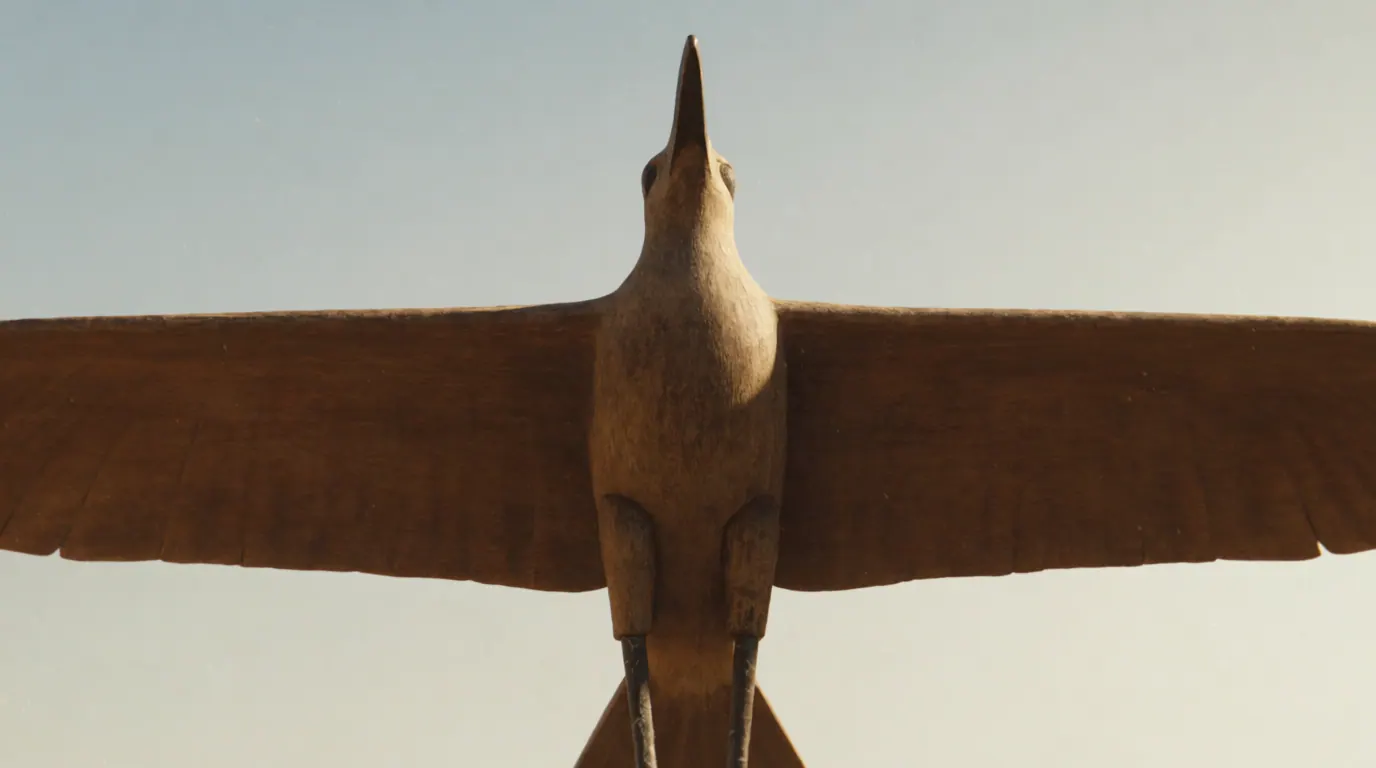
The Saqqara Bird sits in Cairo as a palm-sized sycamore falcon that modern eyes keep trying to turn into a Boeing. Excavated near Saqqara in 1898 and dated near 200 BCE, it is a real museum object with a wingspan of about eighteen centimeters. The mystery is interpretive, not about whether the wood exists.
Why the glider story took off
Khalil Messiha and later documentaries argued that the vertical tail looked like an aircraft stabilizer and that a missing horizontal piece would complete a glider. Replicas sometimes gained that extra surface before cameras rolled. That is a modern improvement loop, not tomb archaeology. Egypt already had falcon gods; it did not need secret runways to carve a bird.
What the airflow numbers say
A 2023 computational study built from a 3D scan reported a low maximum glide ratio, a center of gravity that fights pitch stability, and asymmetric lift that invites uncontrolled roll. Those results match older aeromodeller complaints that the unmodified shape is a poor flyer. Fringe captions rarely quote the polars.
Better mundane readings
Ceremonial falcon, elite child’s toy, weather vane, or masthead ornament on festival boats all fit Egyptian material culture better than a suppressed air force. Identification should lock sycamore grain, stubby wings, and museum scale - not CGI jet contrails.
OOPArt discipline for this Cairo bird
Pair the figurine with other ancient-tech lookalikes when teaching method - photograph the object, read the accession story, then test the extraordinary claim. The Saqqara Bird survives that gauntlet as wonderful woodwork, not as a flight manual. Keep museum centimeters and runway daydreams on different shelves so the falcon can stay interesting without inventing hangars.
Scale is the first honesty check
Hold the eighteen-centimeter wingspan in mind before any documentary montage of runways. A palm-sized falcon can be exquisite ceremonial work. It cannot smuggle a lost air force through a tomb shaft on vibes alone.
Keep the falcon at museum scale
Cairo’s vitrine already answers the first question: this is a small wooden bird with a measurable wingspan. Aviation documentaries that skip the centimeter scale are doing rhetoric, not aerodynamics. Leave the falcon exquisite and grounded.
Replicas are not the tomb bird
Every time a documentary adds a horizontal stabilizer to a flying copy, it is testing a modern aircraft idea, not recovering a Ptolemaic airframe. Cite the Cairo original’s dimensions before citing the improved balsa.