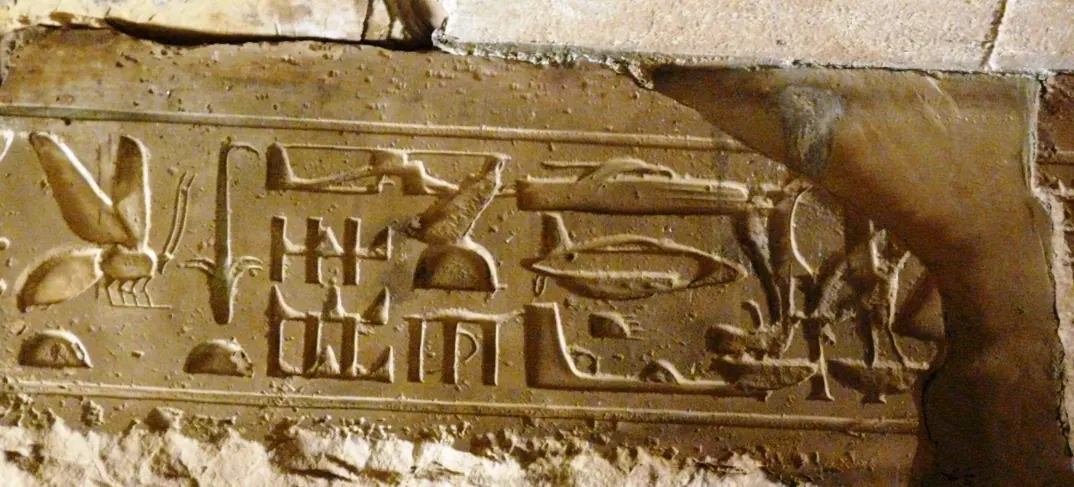
Close-up of the carved architrave in the Temple of Seti I at Abydos, Egypt, where re-carved hieroglyphs look like a helicopter, a submarine-like shape, and a glider.
OLEK95 / WIKIMEDIA COMMONS / PUBLIC DOMAIN

Helicopter Hieroglyphs

Abydos helicopter hieroglyphs · Abydos helicopter glyphs
MISIDENTIFICATION

Mainstream consensus: A well-documented case of pareidolia from genuine, well-understood palimpsest recarving; Egyptologists identified and explained the overlap long before the image went viral.

Share this page
Short answer

The "helicopter hieroglyphs" are a palimpsest on the Temple of Seti I at Abydos: workers plastered over Seti's titles and recarved Ramesses II's name on top, and the two overlapping outlines coincidentally resemble a helicopter and other vehicles. Egyptologists call it ordinary recarving, not a New Kingdom air force.

Mainstream view

Ramesses II had his father Seti I's royal titles on the architrave plastered over and recarved with his own name; where the plaster has since worn away, the two overlapping sets of hieroglyph outlines create accidental shapes that a 1990s internet image cropped and contrast-enhanced to resemble a helicopter, submarine, and other vehicles.

Alternative claim

Ancient-astronaut writers present the carving as a single, deliberate New Kingdom depiction of a helicopter and other advanced machines, implying contact with modern or alien technology.

A single stone architrave inside the Temple of Seti I at Abydos has launched a thousand ancient-astronaut thumbnails. Photographed up close and run through heavy contrast enhancement, patches of worn plaster on the beam resolve into shapes that do, genuinely, look like a helicopter, what some call a submarine, and a vehicle resembling a tank or zeppelin. For readers primed by science fiction, the image practically narrates itself: a 3,000-year-old Egyptian relief depicting 20th-century military hardware.

Egyptology solved this one before it ever went viral. In the 1930s, epigraphers Amice Calverley and Myrtle Broome spent years recording the Abydos temple wall by wall for the Egypt Exploration Society, publishing their survey through the Oriental Institute in Chicago. Their work documents, in detail, that this particular architrave carries two layers of inscription. The first belongs to Seti I, who built the temple. After his death, his son and successor Ramesses II - never shy about claiming credit - had his father's royal titles plastered over and recarved with his own name, a practice called usurpation that shows up repeatedly across New Kingdom Egypt wherever a pharaoh wanted his cartouche on a predecessor's monument.

Plaster doesn't last forever. Over centuries, patches flaked away unevenly, leaving fragments of both inscriptions visible at once in some spots. Where Seti's original glyphs and Ramesses's recarved ones overlap, the combined outlines - stripped of context, cropped tight, and contrast-boosted for a 1990s internet image - happen to trace shapes a modern eye reads as aircraft. It's the same mechanism behind seeing faces in wood grain, just applied to hieroglyphs: pareidolia helped along by selective photography.

What makes Abydos a particularly clean case study is the paper trail. Nobody needed to invent an explanation after the viral image spread; Calverley and Broome had already published the recarving in scholarly detail decades earlier. The temple itself remains one of the best-preserved New Kingdom monuments in Egypt, its real content - a sequence of chapels dedicated to Osiris, Isis, and Horus, plus the famous Abydos King List - considerably richer than one overexposed photograph of a damaged ceiling beam.

Photos and illustrations

Mix of rights-cleared documentary stills and AI illustrations (labeled).

The "helicopter" hieroglyphs on an architrave in the Temple of Seti I, Abydos, EgyptCredit: Olek95 / Wikimedia Commons / Public domain
Architrave behind the entrance of the Temple of Seti I, Abydos, EgyptCredit: Olaf Tausch / Wikimedia Commons / CC BY 3.0
Abydos temple wall atmosphere (AI illustration, not the exact panel)AI illustration for reference only

Key debates and stories

Attributed discovery narratives, debates, and claim histories from named sources. Links open the originals; AnomalyWiki does not verify these claims.

Claims vs mainstream

The claim

The carving is a single, intentional depiction of a helicopter, submarine, and tank.

Mainstream view

The shapes come from two different inscriptions - Seti I's original titles and Ramesses II's later recarving - overlapping where plaster has flaked away, not from one artist carving a vehicle.

The claim

Egyptian priests could not have recarved stone that precisely without modern tools.

Mainstream view

Recarving a predecessor's cartouches was routine practice in Egyptian temples (usurpation), documented across many New Kingdom monuments, and required no technology beyond standard stone-working tools.

The claim

No mainstream explanation existed before skeptics needed one to debunk the viral image.

Mainstream view

Calverley and Broome's epigraphic survey recorded this wall and its recarving decades before the "helicopter" cropping began circulating online in the 1990s.

Timeline

  1. c. 1290s BCESeti I's temple at Abydos is decorated with his royal titles on the architrave in question.Source: Calverley & Broome, "The Temple of King Sethos I at Abydos"
  2. c. 1279 BCE onwardRamesses II has his father's titles plastered over and his own name recarved on top of the same architrave, a common practice for successor pharaohs.Source: Calverley & Broome, "The Temple of King Sethos I at Abydos"
  3. 1933–1938Calverley and Broome publish the formal epigraphic survey of the temple, documenting the architrave and its recarving in detail.Source: Egypt Exploration Society / Oriental Institute publication series
  4. 1990sA tightly cropped, contrast-enhanced photograph of the worn plaster sections begins circulating as "proof" of a helicopter carving, launching the modern viral claim.Source: Wikipedia, "Helicopter hieroglyphs"

FAQ

What are the helicopter hieroglyphs?

A nickname for an architrave carving at the Temple of Seti I in Abydos, Egypt, where overlapping recarved inscriptions create shapes some read as a helicopter and other vehicles.

Why does the carving look like a helicopter?

Ramesses II had his father Seti I's titles plastered over and recarved with his own name; where the plaster has worn away in spots, the two inscriptions overlap into vehicle-like outlines.

Is this the only place Egyptian pharaohs recarved earlier inscriptions?

No. Recarving or "usurping" a predecessor's cartouches was common royal practice across New Kingdom Egypt, well documented on many temple walls besides this one.

When was the explanation for the "helicopter" shape published?

Egyptologists Calverley and Broome documented this wall's recarving in their 1930s epigraphic survey, decades before the viral cropped photo began circulating in the 1990s.

Do mainstream Egyptologists dispute the carving's age?

No. Both inscription layers date to the New Kingdom, roughly the 13th century BCE, with no evidence of modern tampering or anachronistic imagery.