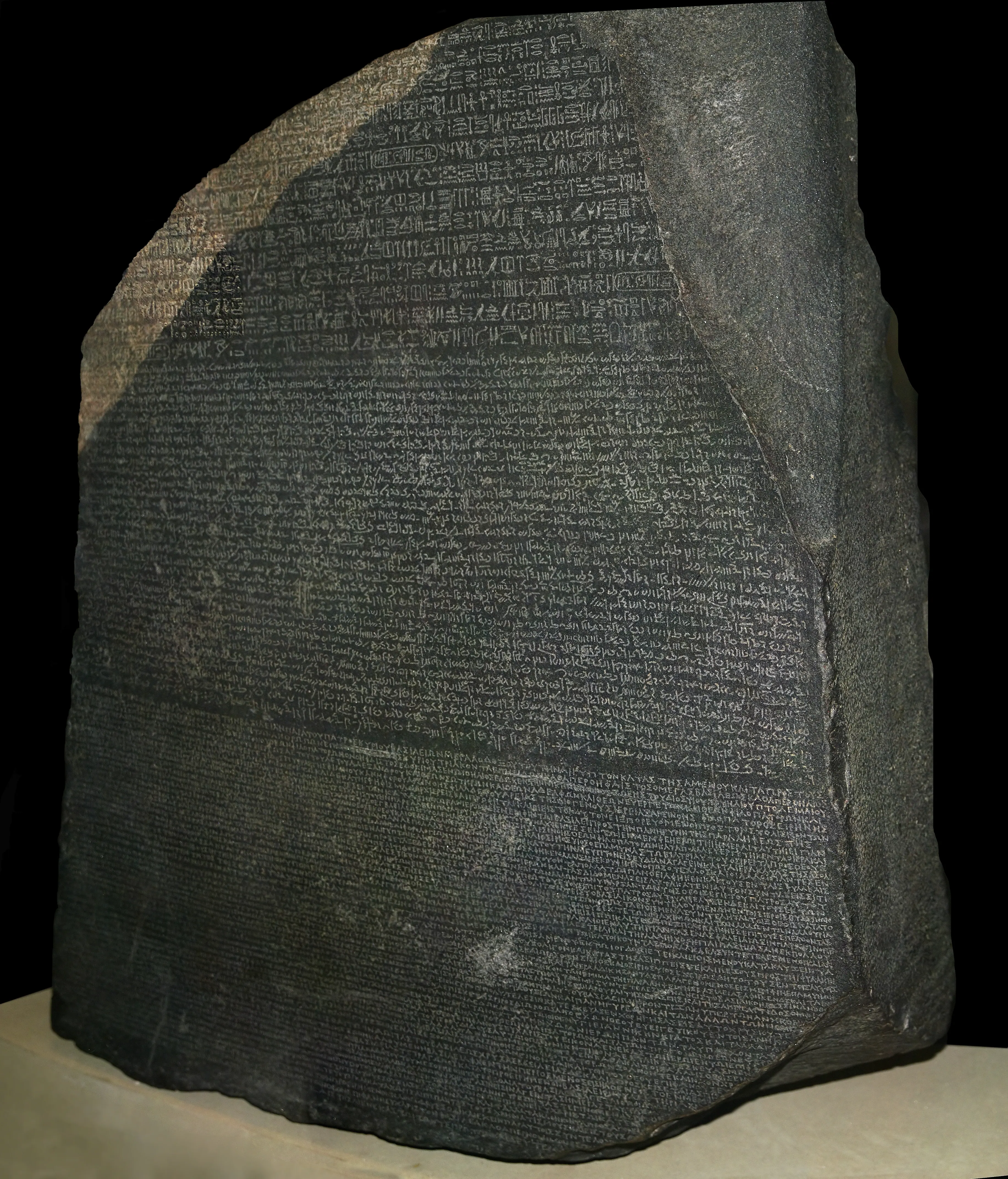
For more than a thousand years after the last people who could read them died out, Egypt's hieroglyphs sat in plain sight on temple walls and tomb ceilings - unmistakably writing, completely unreadable. That changed because of a slab of dark granodiorite that French soldiers stumbled onto in 1799 while rebuilding a fort near the town of Rosetta, now Rashid, in the Nile Delta.
What made the stone valuable wasn't its carving style or its age; it was its structure. The stele preserves the same 196 BCE priestly decree, honoring the young King Ptolemy V, written out three times in three different scripts: Egyptian hieroglyphs, the everyday Demotic script, and Greek. Scholars attached to Napoleon's Egyptian expedition recognized almost immediately what that meant - because the Greek text was perfectly legible, it offered a control against which the other two mysterious scripts could, in theory, be checked line by line.
Theory took over two decades to become method. British polymath Thomas Young made real headway in the 1810s, correctly identifying that some hieroglyphic signs functioned phonetically rather than purely as pictures, and that royal names enclosed in oval cartouches were a reliable anchor point across scripts. The decisive breakthrough came from French scholar Jean-François Champollion, who extended Young's phonetic insight across a wider set of inscriptions and announced in 1822 that hieroglyphic writing combined phonetic signs with ideographic ones in a coherent, decodable system - not the purely symbolic, mystical picture-language earlier European scholars had assumed.
The stone itself changed hands amid the era's upheavals: ceded to Britain under the 1801 Capitulation of Alexandria after France's military defeat in Egypt, it has sat in the British Museum since 1802, one of the most visited objects in the building. Its real legacy, though, isn't the slab itself but what it opened: three thousand years of Egyptian religious texts, administrative records, royal inscriptions, and private letters, all unreadable the day before Champollion's announcement and steadily legible ever since - a decipherment so foundational that Egyptology as a discipline essentially starts from this single bilingual decree.
