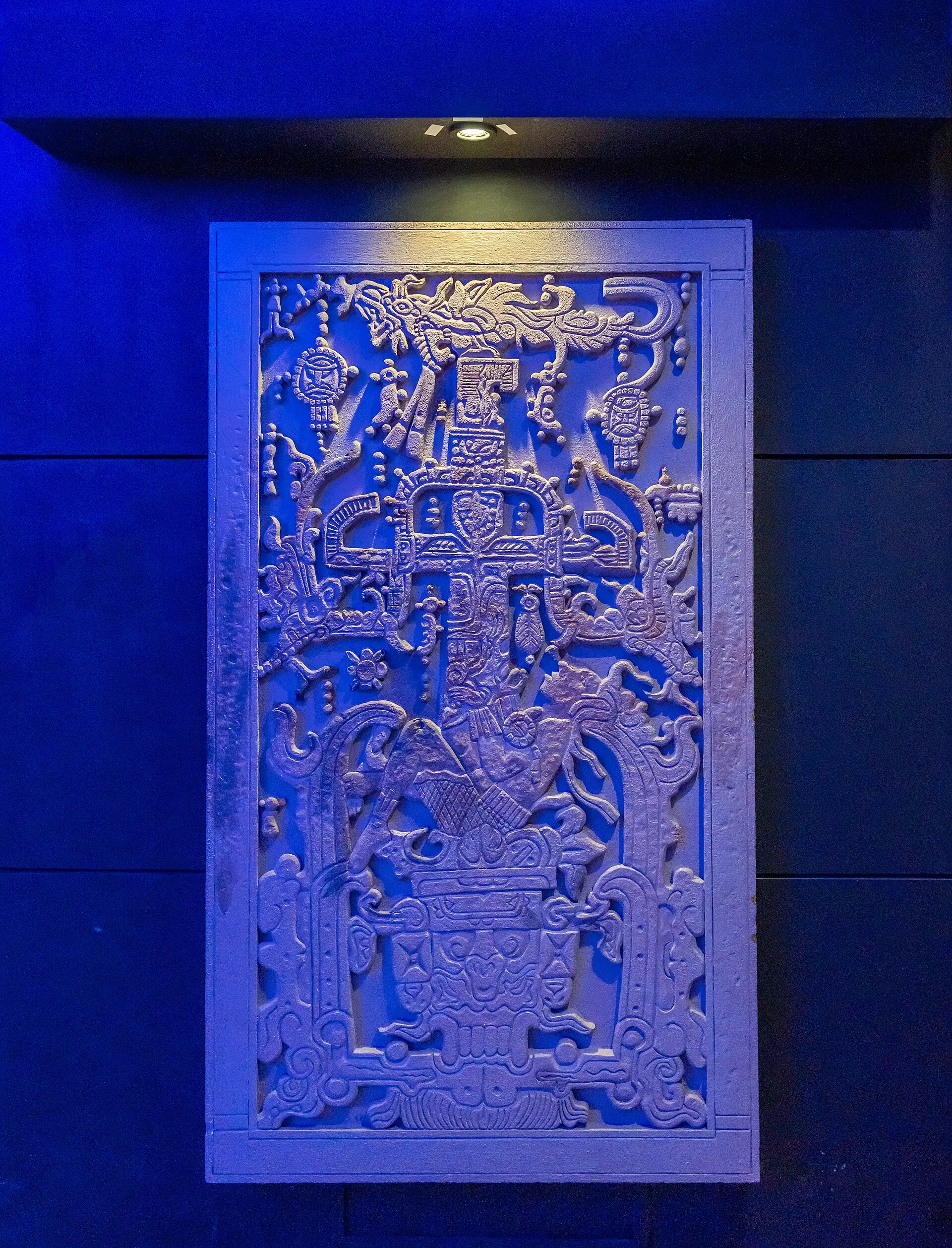
Deep inside the Temple of the Inscriptions at Palenque, Mexican archaeologist Alberto Ruz Lhuillier spent years in the early 1950s clearing a rubble-choked stairway that modern looters and earlier excavators had missed. In 1952 his persistence paid off: a sealed crypt, untouched since the 7th century, containing the remains of King K'inich Janaab' Pakal I beneath an enormous carved limestone lid - one of the defining discoveries in 20th-century Maya archaeology.
The lid's central image is dense with meaning once read against the broader corpus of Classic Maya art. Pakal is shown at the moment of death, falling backward at the base of a cruciform World Tree into the open jaws of the underworld, flanked by a celestial bird above and serpent and ancestral imagery along the borders. It's a scene about cosmic cycling - death feeding into rebirth - that epigraphers have matched to comparable funerary and dynastic iconography found on other Palenque monuments and across the wider Maya world. INAH's own published description of the lid walks through this reading in detail, situating the carving firmly within documented religious conventions rather than treating it as an isolated puzzle.
That didn't stop a very different reading from taking hold in popular culture. Erich von Däniken's 1968 bestseller "Chariots of the Gods?" recast the same composition as an astronaut hunched over the controls of a rocket-like vehicle, flames and machinery replacing the World Tree and underworld jaws. The image became one of the most reproduced "proofs" in ancient-astronaut media, endlessly recirculated on documentary franchises and internet forums decades after Maya specialists had already explained what the carving actually depicts and why.
The tomb's authenticity has never been the issue - its excavation context, dating, and iconographic parallels are about as solid as Mesoamerican archaeology gets. What divides the astronaut reading from the scholarly one isn't missing evidence; it's whether you interpret a 7th-century Maya king's death scene on its own cultural terms or project a 20th-century technological vocabulary onto imagery that was never meant to represent either.
Art-history seminars that walk glyph by glyph around the lid leave less oxygen for cockpit jokes. That is a feature. When the last glyph lands, Pakal is a king again, and the stone can be extraordinary without being mechanical.

