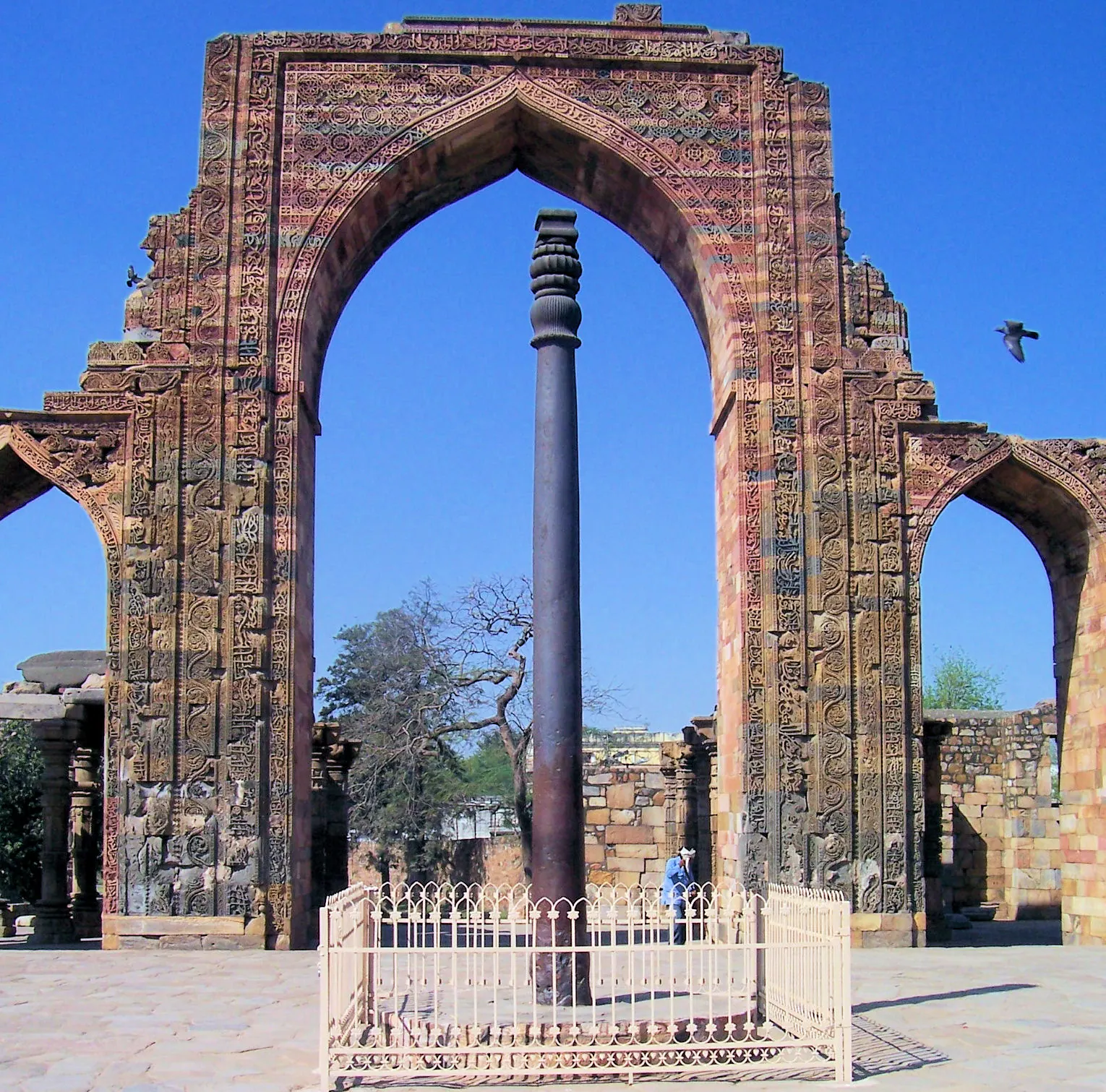
A little over seven meters of solid wrought iron has stood in the open air at Delhi's Qutb complex since roughly the 5th century CE, and for most of that time it has done something iron isn't supposed to do: it hasn't rusted away. Visitors walking through the ruined arches of the Quwwat-ul-Islam mosque find the pillar framed almost theatrically by carved sandstone, its dark surface smooth and largely intact after more than one and a half millennia of monsoons, heat, and exposure.
The pillar isn't anonymous. A Sanskrit inscription running down its shaft commemorates a king called Chandra, translated by colonial scholar James Prinsep in 1838 and generally matched by historians to Chandragupta II, one of the most powerful rulers of the Gupta Empire. That places the pillar's creation firmly within a documented, literate civilization with sophisticated administrative and artistic traditions - not a mysterious predecessor culture, and certainly not an object that fell from the sky.
Its durability is real, and real science explains it. A team led by metallurgist R. Balasubramaniam at the Indian Institute of Technology Kanpur spent years analyzing the pillar's composition and surface chemistry, publishing results in the early 2000s. The iron contains unusually high phosphorus and very low sulfur and manganese, a profile tied to the specific ores and forging methods available to Gupta-era smiths. Under Delhi's dry climate, that chemistry encourages a thin, adherent layer of iron hydrogen phosphate hydrate - sometimes called misawite - to form on the surface and continually regenerate itself, slowing oxidation to a crawl rather than halting it by magic. The pillar does show some surface pitting, particularly near its base where an old iron railing once touched it, so "it has literally never rusted" overstates the case even as the broader resistance remains genuinely remarkable.
None of this requires lost ancient technology, alien manufacturing, or a chronology-breaking age. It requires skilled Gupta-period ironworkers who, whether by deliberate recipe or by the ore sources available to them, produced a batch of iron with an unusually favorable chemistry - and a climate dry enough to let that chemistry do its slow, self-protecting work for sixteen centuries and counting.
