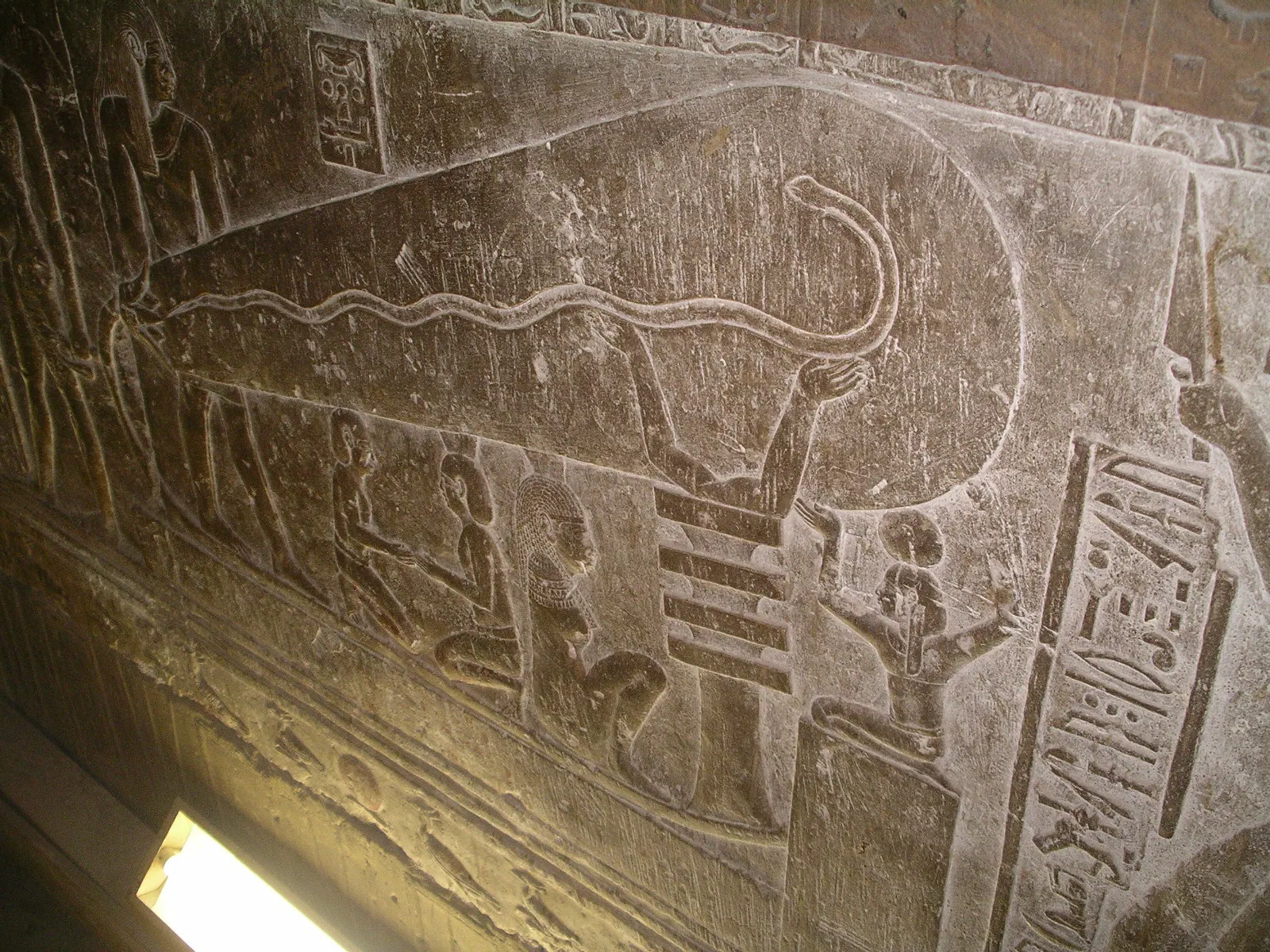
Deep in the crypts beneath the Hathor Temple at Dendera, carved reliefs show an elongated oval shape with a snake coiled inside it, resting atop a stylized pillar flanked by figures. To modern eyes primed by incandescent bulbs, the oval reads as glass, the snake as a glowing filament, and the pillar as a cable or support - and since the 1990s, that reading has powered a steady stream of documentaries arguing that ancient Egyptians (or some earlier, unnamed civilization) had working electric lighting.
Egyptology had already explained the image more than a century earlier. French archaeologist Auguste Mariette published the first full survey of Dendera in 1870, describing the crypt reliefs within the temple's broader religious program. The "bulb" is a lotus flower - a standard Egyptian symbol of creation and rebirth - giving rise to a serpent, a form associated with the god Harsomtus in Dendera's own temple texts. The "cable" beneath it is a djed pillar, one of the most common symbols in Egyptian religious art, representing stability and the backbone of Osiris. None of this is exotic or unique to this one scene: variations on the same lotus-serpent-djed grouping appear in other chambers at Dendera and in Ptolemaic temple decoration more broadly.
What the light-bulb reading requires - and never produces - is physical evidence. No wiring, no glass vessel, no battery, and no power source of any kind has ever turned up at Dendera or any comparable Egyptian site. The claim typically travels paired with the Baghdad Battery, another object reinterpreted decades after its original, far more mundane identification (in that case, likely a container for scroll storage or a reaction vessel). Stacking two separately debunked claims together doesn't produce a stronger case; it just produces a more popular one.
None of this makes Dendera less remarkable. The temple is one of the best-preserved religious complexes from Ptolemaic Egypt, its crypts decorated with an extraordinarily rich visual theology that took Egyptologists decades to map in full. The real story - a creation myth rendered in careful relief, readable today because Mariette and his successors did the patient work of publishing and translating it - is arguably more interesting than a prop for a lamp nobody has ever found the rest of.

