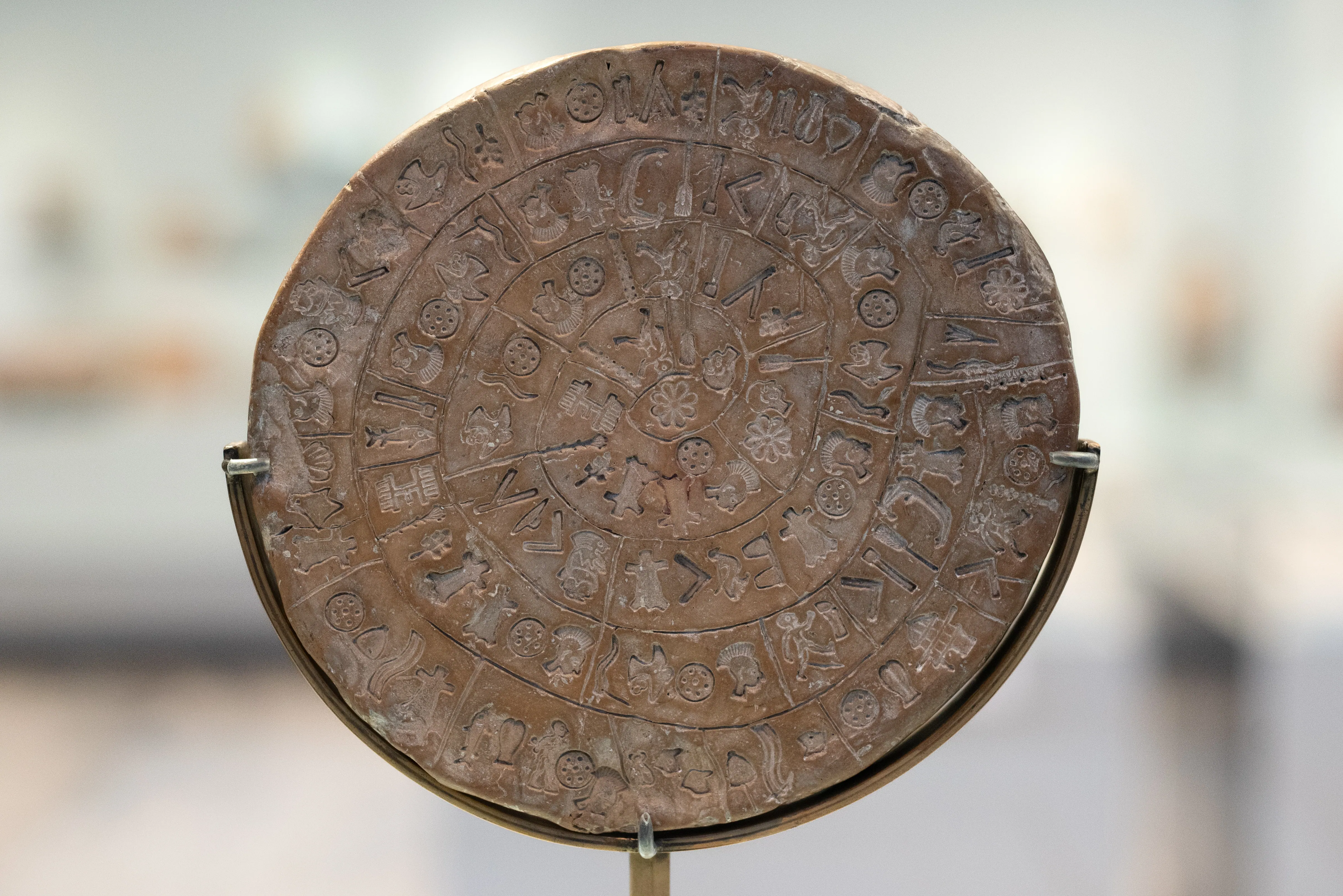
The Phaistos Disc looks like a puzzle someone already solved - until you ask specialists which solution. Recovered in 1908 at the Minoan palace of Phaistos, the clay circle carries stamped signs winding in spirals on both faces. That manufacturing trick is part of the fascination: someone owned a set of stamps and used them deliberately. What the sequence meant - language, ritual, inventory, something else - remains open.
Because the corpus is essentially one object, decipherment attempts have a hard time proving themselves. Viral “cracked!” headlines recycle every decade. Linear A tablets at least form a larger set; the disc stands oddly alone. Museum photography of the real Heraklion piece beats any AI spiral fantasy for the public record.
Peers include Linear A, the Voynich Manuscript, and the Indus script.
Aegean epigraphy thrives on comparison. Linear A and Linear B tablets form sets; the Phaistos Disc barely forms a set of one. That isolation is why stamp technology and spiral layout get so much attention: production method is clearer than semantics. Museum lighting on the real clay beats CGI glyphs because the object’s heft and firing are part of the argument for authenticity.
Readers should expect more “solved!” headlines. They should also expect specialists to ask for method, not vibes. Until a reproducible reading survives peer scrutiny, the disc remains a brilliant, stubborn Minoan outlier - and that is already enough wonder.
Side A and Side B spiral with stamped signs nobody has securely matched to Linear A inventories. That uniqueness is catnip for decipherers and a caution for anyone selling a finished translation.
The Phaistos Disc remains a one-of-a-kind Cretan puzzle: stamped signs, unclear language, endless decipherment bids. Wonder stays honest when the clay stays unique.
Casts and photographs circulate widely; the unique original stays in Heraklion. Treat every confident translation as a hypothesis until another stamped disc appears - and none has.
