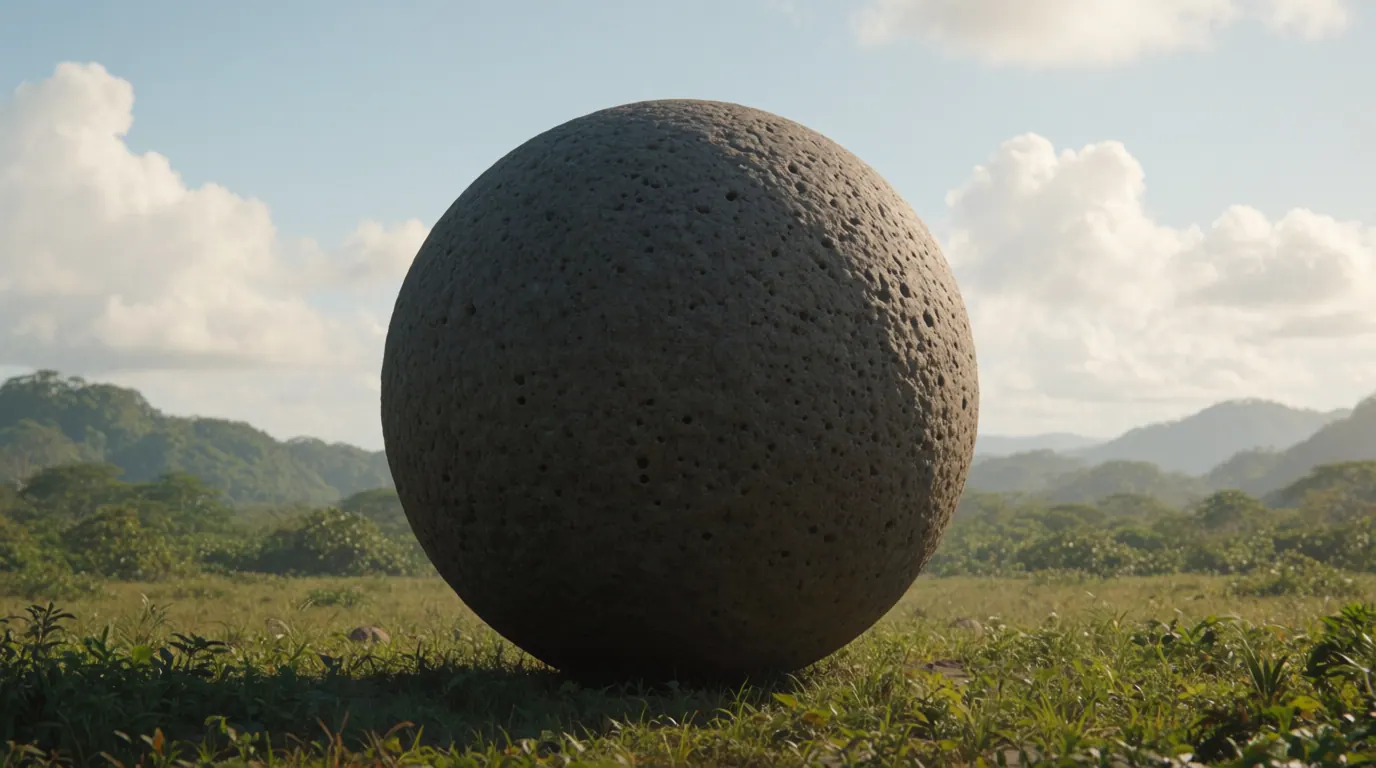
Nearly perfect stone balls sound like a sci-fi prop until you stand them back in a Costa Rican chiefdom plaza. The Diquís spheres of the southern Pacific lowlands range from pocket-sized to more than two meters across. UNESCO’s 2014 listing treats them as part of pre-Columbian settlement landscapes, not as leftover bolts from a spaceship factory.
Roundness without a lathe from Orion
Pecking, grinding, and patient abrasion on local igneous stone can yield startling roundness. Agricultural clearing in the twentieth century scattered and damaged many spheres, which ironically fed collector myths while erasing context. Archaeology rebuilds that context with site maps, not alien tooling catalogs.
What the spheres marked
Researchers read larger spheres as status and spatial markers inside Diquís settlements - aligned along ridges, plazas, and elite compounds. That social reading is less cinematic than Atlantis workshops and much better supported by settlement archaeology. Small spheres may have circulated differently than the plaza giants.
Identification that survives tourism
Lock gabbro-like gray stone, near-spherical geometry, and southern Costa Rica / Diquís association. Garden-center replicas and CGI glowing orbs are lookalikes. When photographs erase scale, a human figure or meter stick matters more than a dramatic sunset crop.
Keeping wonder honest
A culture that invested tons of labor into geometric stone still deserves wonder. It does not need a spaceship to stay strange. Put UNESCO site reports on one shelf and late-night lathe theories on another, then walk the plaza story first.
Labor, not lasers
Moving multi-ton spheres across soft delta ground is a human logistics story - ropes, rollers, community labor, elite demand. That story is strenuous and impressive. It does not require orbiting machine shops to stay impressive.
Delta plazas before star maps
Walk the Diquís settlement story first - elite compounds, alignments, human transport - before any documentary about orbital machine shops. The spheres stay astonishing when they stay local.
Looting scars and surviving giants
Twentieth-century clearing and collecting scarred the corpus, which is why in-situ UNESCO sites matter so much. A sphere on a plaza still teaches more than a sphere in a rumor. Preservation is part of the identification story, not a footnote.