Location and access
Baalbek sits in Lebanon's Bekaa Valley at about 1,150 meters elevation, roughly 85 km northeast of Beirut, at approximately 34.0069° N, 36.2039° E. UNESCO lists the inscribed property at 17.35 hectares within the city and district of Baalbek.
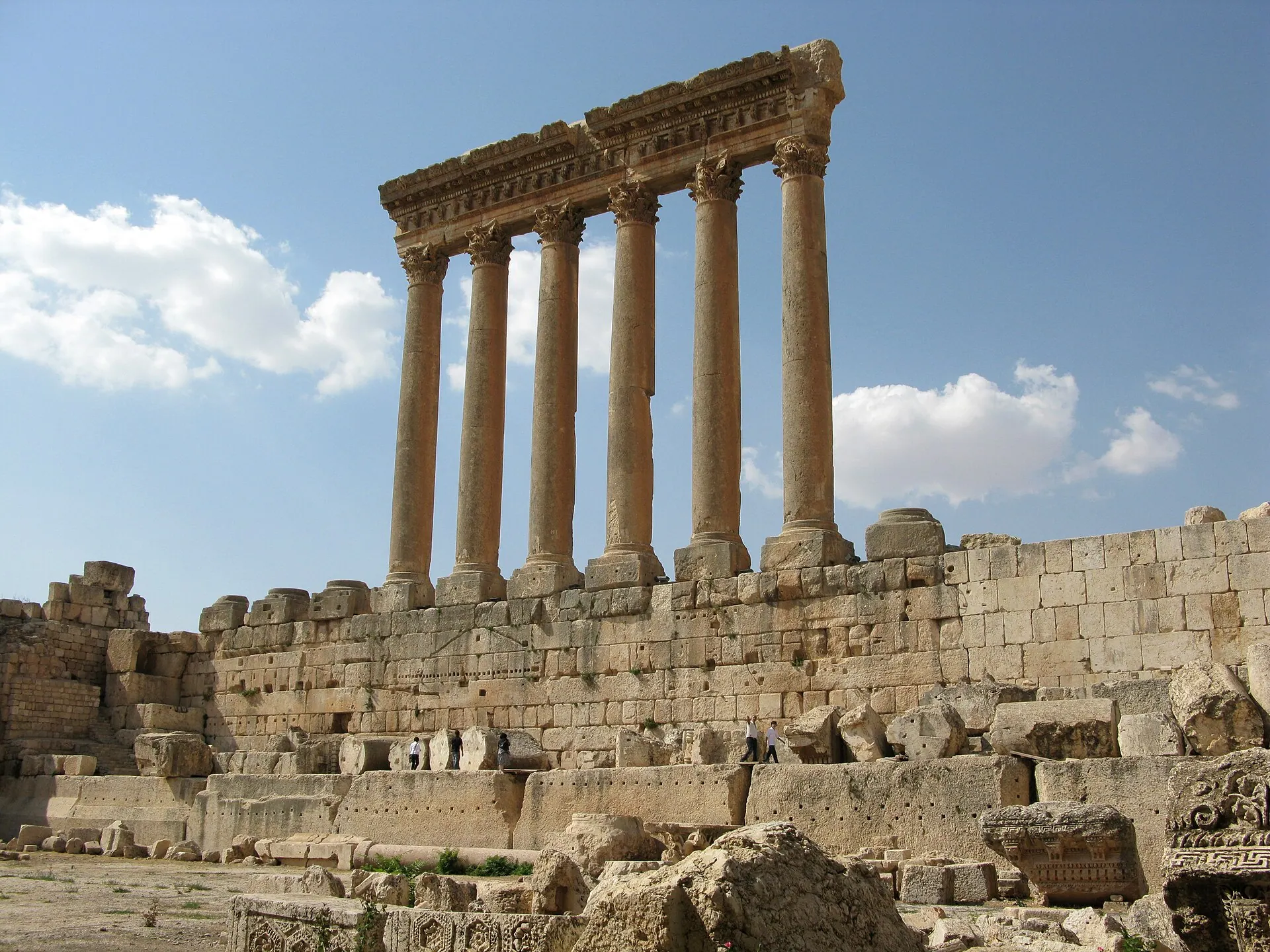
The archaeological park is ticketed and managed by Lebanon's Directorate General of Antiquities. Visitors walk among the Temple of Jupiter's surviving columns, the well-preserved Temple of Bacchus, and the smaller Temple of Venus. Because the Bekaa Valley is a region where security conditions can shift, confirm current official travel guidance and local opening hours before a trip rather than relying on older trip reports.
History and legend
Documented history: A Phoenician cult center dedicated to Baal stood on this tell before the Hellenistic and Roman periods, when the site became known as Heliopolis. Roman builders raised the sanctuary of Heliopolitan Jupiter over more than two centuries, producing the Temple of Jupiter's megalithic podium, the Trilithon's three 750-800 tonne blocks, and nearby quarry stones that were never moved, including the roughly 1,000-tonne "Stone of the Pregnant Woman" and the 1,650-tonne "Forgotten Stone" documented in 2014. Robert Wood and James Dawkins' 1757 survey, "The Ruins of Balbec," first brought detailed drawings of the site to a European audience and influenced Neoclassical architecture; German excavations began in 1900, and a German-Lebanese research project has studied the quarries since 2002.
Legend and alternative overlay: Popular writers starting with Zecharia Sitchin in 1976 recast the platform as the Anunnaki's "Landing Place," a launch and recovery site for alien spacecraft supposedly described in the Epic of Gilgamesh. Researchers who checked Sitchin's sources found no such passage in the Gilgamesh text and traced the claim to a mistranslated Sumerian word and a misattributed footnote in an earlier travelogue. Local Maronite legend separately told of giants raising the platform before a great flood, a folk memory the ancient-astronaut writers borrowed rather than discovered.
Related places and beings
Baalbek belongs to the same megalithic storytelling cluster as Göbekli Tepe, Stonehenge, and the Pyramids of Giza - real monumental sites that fringe writers repeatedly nominate as evidence for lost civilizations or outside intervention. Its closest thematic cross-category cousin is the Baghdad Battery, another Near Eastern find that genuine archaeology explains far more modestly than popular retellings do.
In popular culture
Baalbek appears constantly in ancient-astronaut television specials, conspiracy podcasts, and alternative-history books that lean on its Trilithon as a centerpiece image. Erich von Däniken and Zecharia Sitchin both built chapters around it well before the 2014 excavation that actually explained why the largest stones were left in the quarry. Mainstream travel and heritage media instead frame Baalbek as a showcase of Roman provincial engineering layered onto a much older Phoenician holy place.


