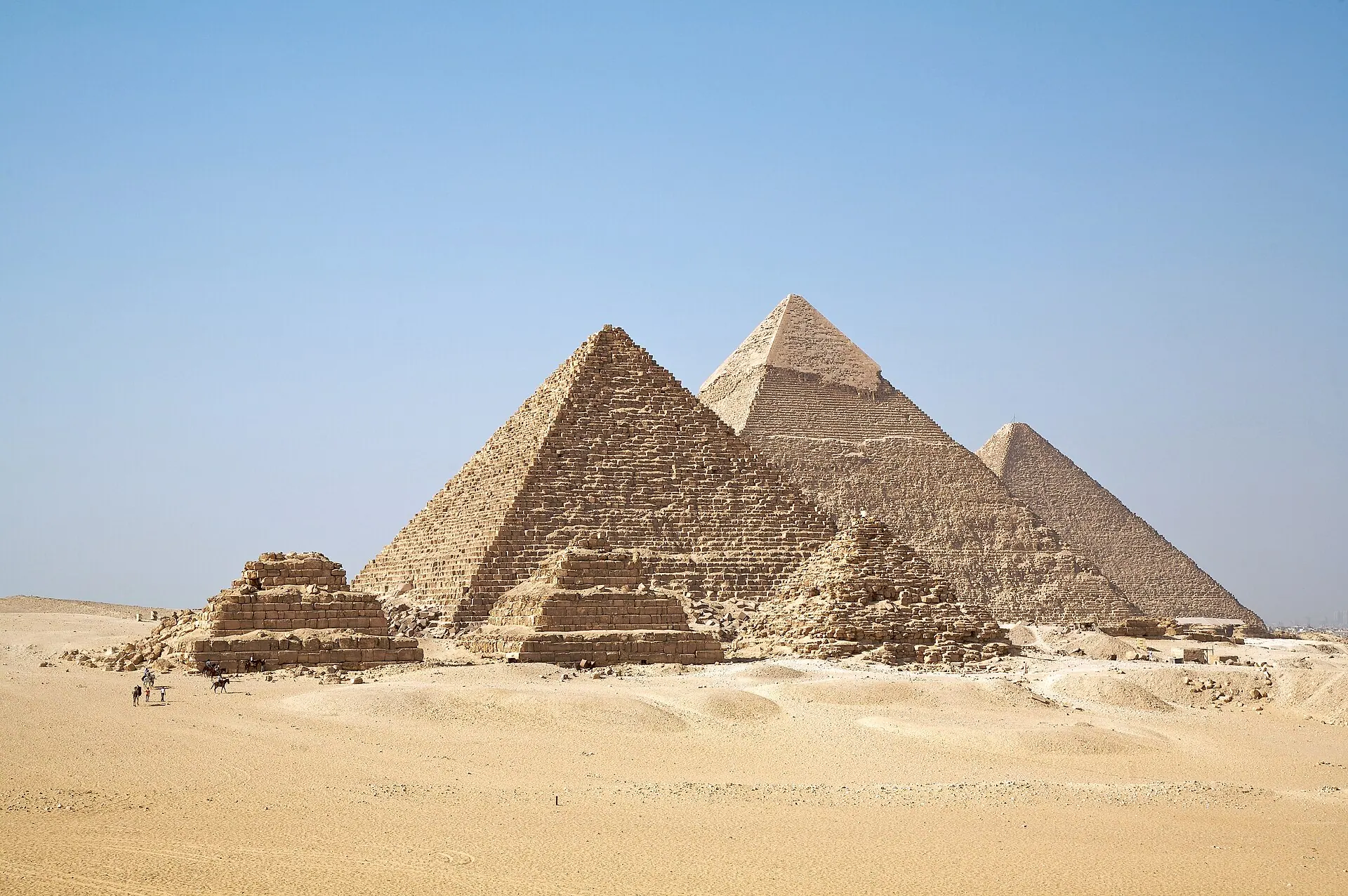
The three main pyramids of Giza and smaller queens' pyramids in the desert under a clear sky
RICARDO LIBERATO / WIKIMEDIA COMMONS / CC BY-SA 2.0

Pyramids of Giza

Great Pyramids · Giza Necropolis · Pyramids of Cheops, Khafre and Menkaure
HISTORICAL SITE

Mainstream consensus: The Giza pyramids are verified Fourth Dynasty royal monuments built by a documented, organized Egyptian labor force; ongoing scientific scanning keeps revealing real internal structure, not evidence for slave labor, alien builders, or a lost pre-dynastic civilization.

Share this page
Short answer

The Great Pyramid of Giza was built for Pharaoh Khufu around 2560 BCE by paid, rotating labor crews, not slaves or aliens, as excavated workers' barracks and bakeries confirm. A 2023 muon-scanning survey revealed a hidden corridor still sealed behind its north face. Alternative writers keep hunting for a lost civilization inside stones archaeologists have mapped for two centuries.

Location and access

The Giza Plateau sits on Cairo's western outskirts at approximately 29.9792° N, 31.1342° E, within UNESCO's "Memphis and its Necropolis - the Pyramid Fields from Giza to Dahshur" World Heritage property, which covers more than 16,000 hectares of pyramid fields stretching south toward Saqqara and Dahshur.

Egypt's Ministry of Tourism and Antiquities manages Giza as a ticketed archaeological zone, with separate tickets for plateau entry, interior pyramid access, and the Great Sphinx. Interior visits to the Great Pyramid are capped daily and occasionally suspended for conservation work, so confirming current rules before a trip saves disappointment. The plateau sits close enough to central Cairo that many visitors combine it with a single-day trip, though crowds and heat both peak around midday.

History and legend

Documented history: The Great Pyramid was built for Khufu around 2560 BCE, during Egypt's Fourth Dynasty, following an architectural progression visible at earlier Old Kingdom sites like Djoser's Step Pyramid at Saqqara. Khafre's slightly smaller pyramid and, by most Egyptological dating, the Great Sphinx followed around 2500 BCE. Flinders Petrie's meticulous 1880s survey established precise measurements that still anchor later research. Starting in 1988, Mark Lehner's excavation of the Heit el-Ghurab settlement south of the Sphinx uncovered a planned 4th Dynasty town of more than 7 hectares, complete with barracks, bakeries, breweries, craft workshops, and administrative buildings built by the crown specifically to house and feed the pyramid-building workforce. Non-invasive scanning has continued refining the picture: the ScanPyramids project first detected a void behind the Great Pyramid's north-face Chevron structure by muon imaging in 2016, then confirmed it in 2023 as a roughly 9-meter corridor using radar, ultrasound, and a 6mm endoscope camera threaded through a tiny gap between stones.

Legend and alternative overlay: Popular film and literature, most famously Cecil B. DeMille-style depictions tied loosely to the biblical Exodus narrative, have long portrayed the pyramids as built by whipped slaves, an image the excavated workers' settlement does not support. Separately, Robert Bauval's 1983 "Orion Correlation Theory" argues the three Giza pyramids mirror the stars of Orion's Belt, a reading Egyptologists treat as a disputed, non-consensus interpretation rather than an accepted finding. Graham Hancock's books and the Netflix series "Ancient Apocalypse" push further, proposing a forgotten ice-age civilization taught early Egyptians to build; geologist Robert Schoch's related water-erosion hypothesis, which reads the Sphinx enclosure's weathering as evidence of a pre-10,500 BCE date, likewise remains outside mainstream geological and Egyptological consensus, which attributes the pattern to wind-driven sand and limited rainfall episodes consistent with the accepted Fourth Dynasty date.

Related places and beings

Giza belongs to the same "massive stones invite outside-help theories" cluster as Göbekli Tepe, Baalbek, Stonehenge, Sacsayhuamán, and Teotihuacan. Its closest thematic cross-category cousin is Nabta Playa, an Egyptian Neolithic megalithic and astronomical site that predates Giza and is sometimes folded into the same "advanced ancient Egypt" speculation.

In popular culture

Few monuments carry as much pop-culture weight as the Giza pyramids, appearing in everything from Indiana Jones-style adventure films to countless documentaries built around Erich von Däniken's and Graham Hancock's ideas. Mainstream Egyptology instead emphasizes the pyramids as the culmination of a traceable Old Kingdom architectural tradition, built and maintained by a named, organized state workforce whose settlement, diet, and daily routines archaeologists have now reconstructed in striking detail.

Photos and illustrations

Mix of rights-cleared documentary stills and AI illustrations (labeled).

The Giza pyramids: Khufu, Khafre, and Menkaure with the smaller queens' pyramidsCredit: Ricardo Liberato / Wikimedia Commons / CC BY-SA 2.0
The Giza plateau from the International Space Station, the city pressing up to the desert edgeCredit: NASA / Wikimedia Commons / Public domain
The pyramids photographed from a balloon by Eduard Spelterini around 1904Credit: Eduard Spelterini / Wikimedia Commons / Public domain
Illustrative scene for Pyramids of GizaAI illustration for reference only

Visiting

loading map…

The Giza Plateau is a ticketed archaeological zone managed by Egypt's Ministry of Tourism and Antiquities, on Cairo's western outskirts. Separate tickets cover plateau entry, interior pyramid access, and the Great Sphinx; interior visits to the Great Pyramid are limited and sometimes restricted for conservation reasons, so check current rules before planning a visit.

Legend vs history: Excavated workers' quarters, bakeries, and administrative buildings at Heit el-Ghurab, combined with inscriptions, quarry marks, and consistent Old Kingdom architectural development across earlier pyramid sites, place the Great Pyramid's construction firmly under Khufu around 2560 BCE using organized, fed, rotating labor crews. Claims of slave labor, alien assistance, or a pre-dynastic "lost civilization" origin are not supported by this excavated evidence.

Reports and stories

Attributed reports, haunt claims, and discovery narratives from named sources. Links open the originals; AnomalyWiki does not verify these claims.

Claims vs mainstream

The claim

Slaves built the pyramids under the whip, as popularized in film and literature.

Mainstream view

Excavations at the Heit el-Ghurab workers' settlement uncovered barracks, bakeries, and breweries for a large, fed, rotating labor force, consistent with paid or corvee-based work crews rather than chattel slavery.

The claim

The pyramids' layout mirrors Orion's Belt as proof of alien or nonhuman contact (Orion Correlation Theory).

Mainstream view

Egyptologists note the layout fits textual and architectural precedents from earlier Old Kingdom pyramid fields; the star-correlation reading remains a disputed, non-consensus interpretation rather than an accepted finding.

The claim

The Great Sphinx's weathering proves it predates Khafre by thousands of years (the water-erosion hypothesis).

Mainstream view

Mainstream geologists and Egyptologists attribute the Sphinx enclosure's weathering pattern to wind-driven sand and limited rainfall episodes consistent with the accepted Fourth Dynasty date, not a lost pre-10,500 BCE civilization.

Timeline

  1. c. 2560 BCEThe Great Pyramid is built for Pharaoh Khufu during Egypt's Fourth Dynasty.Source: Egyptological consensus; Mark Lehner, "The Complete Pyramids"
  2. c. 2500 BCEKhafre's pyramid and, by most dating, the Great Sphinx are constructed.Source: Dream Stele inscription and associated Egyptological dating
  3. late 1980s-1990sMark Lehner and Zahi Hawass excavate the Heit el-Ghurab workers' settlement south of the Sphinx, revealing barracks, bakeries, and administrative buildings for the pyramid-building labor force.Source: AERA (Ancient Egypt Research Associates) project documentation
  4. 1979The Giza pyramids are inscribed within UNESCO's "Memphis and its Necropolis" World Heritage listing.Source: UNESCO World Heritage Centre listing 86
  5. 2023The ScanPyramids muon-imaging team confirms a roughly 9-meter hidden corridor behind the Great Pyramid's north face, first detected in 2016.Source: Nature Communications (2023); Reuters and BBC coverage

FAQ

What are the Pyramids of Giza?

Three monumental Fourth Dynasty royal tombs on the Giza Plateau outside Cairo, built for the pharaohs Khufu, Khafre, and Menkaure around 2600-2500 BCE, alongside the Great Sphinx.

Who built the Great Pyramid, and were they slaves?

Excavations at the nearby Heit el-Ghurab workers' settlement found barracks, bakeries, and breweries for a large, organized, fed labor force, evidence of paid or corvee-based work crews rather than chattel slavery.

How old is the Great Pyramid?

Egyptologists date its construction to around 2560 BCE, during the reign of Pharaoh Khufu in Egypt's Fourth Dynasty.

What did the 2023 pyramid scan find?

The ScanPyramids project confirmed a roughly 9-meter hidden corridor behind the Great Pyramid's north face, first detected by muon imaging in 2016 and verified with radar, ultrasound, and an endoscope camera in 2023.

Did aliens help build the pyramids?

No credible evidence supports that. The pyramids' construction fits a documented architectural progression from earlier Old Kingdom tombs, built by a real, excavated Egyptian labor force.

Is the Great Sphinx older than the pyramids?

Most Egyptologists date the Sphinx to around 2500 BCE under Khafre, based on the Dream Stele and stylistic evidence. A minority water-erosion hypothesis arguing for a much older date is not accepted by mainstream geologists or Egyptologists.