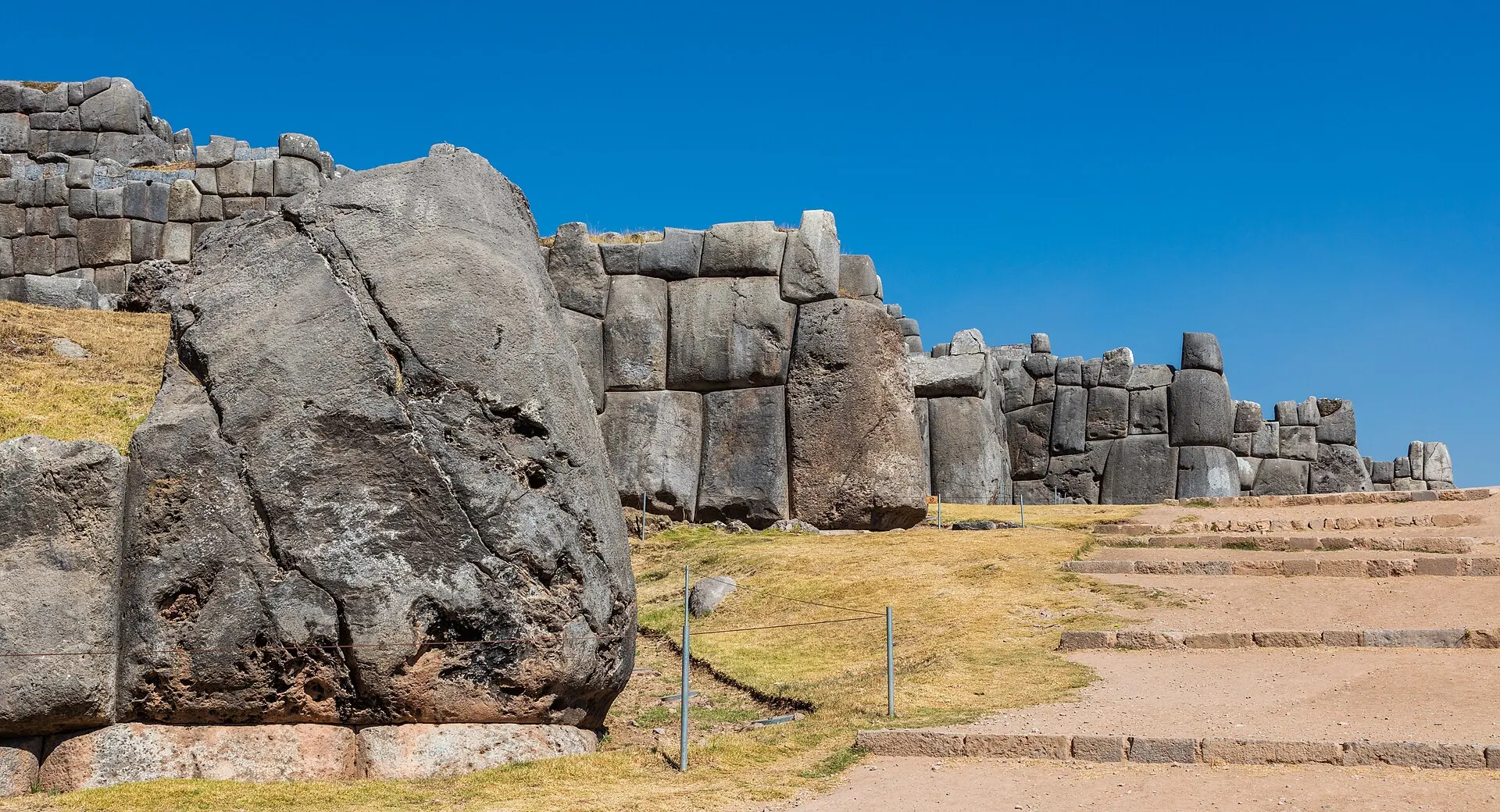
Location and access
Sacsayhuamán sits on a hilltop at the northern edge of Cusco at roughly 13.5091° S, 71.9821° W, in Peru's southern Andes at over 3,700 meters elevation, higher than the city center below it. It forms part of the UNESCO-protected "City of Cuzco" World Heritage property.
The site is included on Cusco's Boleto Turistico ticket circuit and is open daily with marked walking paths around the three great terrace walls and the ruined upper plateau. Because the altitude exceeds Cusco's already-high elevation, visitors coming from sea level benefit from a day or two of acclimatization first. Sacsayhuamán remains a living ceremonial space: the Inti Raymi festival, a modern reenactment of the Inca winter solstice celebration, is staged there every June 24.
History and legend
Documented history: Spanish chronicler Pedro Cieza de León, writing in 1553 within a generation of the conquest, recorded Inca oral tradition crediting the fortress to the reign of Pachacuti, continuing under his successors Topa Inca Yupanqui and Huayna Capac through the 1490s. Later writer Garcilaso de la Vega, himself half-Inca and raised in Cusco, preserved further detail about the project's scale. The Inca mit'a rotational labor system supplied the workforce, with some accounts describing roughly 20,000 laborers cycling through quarrying, hauling, and foundation work. In 1536, Manco Inca used the fortress as a stronghold during his siege of Spanish-held Cusco, one of the conquest period's fiercest battles; Spanish forces afterward dismantled much of the upper structures for colonial building stone, leaving the massive lower terraces that were too heavy to move easily.
Legend and alternative overlay: Erich von Däniken's 1968 "Chariots of the Gods" first popularized the idea that Sacsayhuamán's tight-fitting joints were beyond pre-industrial capability, implying outside or extraterrestrial help. Graham Hancock later picked up a related thread in "Fingerprints of the Gods" and the Netflix series "Ancient Apocalypse," pointing to the contrast between the finest lower stonework and cruder work elsewhere as evidence of an older, lost civilization that the Inca merely inherited and later claimed as their own.
Related places and beings
Sacsayhuamán sits alongside Teotihuacan, Easter Island, and the Pyramids of Giza as a real megalithic site frequently nominated by alternative-history writers as proof of lost technology. Its closest thematic cross-category cousin is the Nazca Lines, another Peruvian Andean mystery that draws the same "ancient engineers had outside help" framing.
In popular culture
Sacsayhuamán appears constantly in documentaries and books built around Erich von Däniken's and Graham Hancock's work, usually filmed from angles that emphasize the largest, most precisely fitted blocks. Peruvian tourism and heritage media instead frame it as a centerpiece of Inca imperial engineering and a living ceremonial site, still central to the annual Inti Raymi celebration rather than a monument abandoned to mystery.


