Location and access
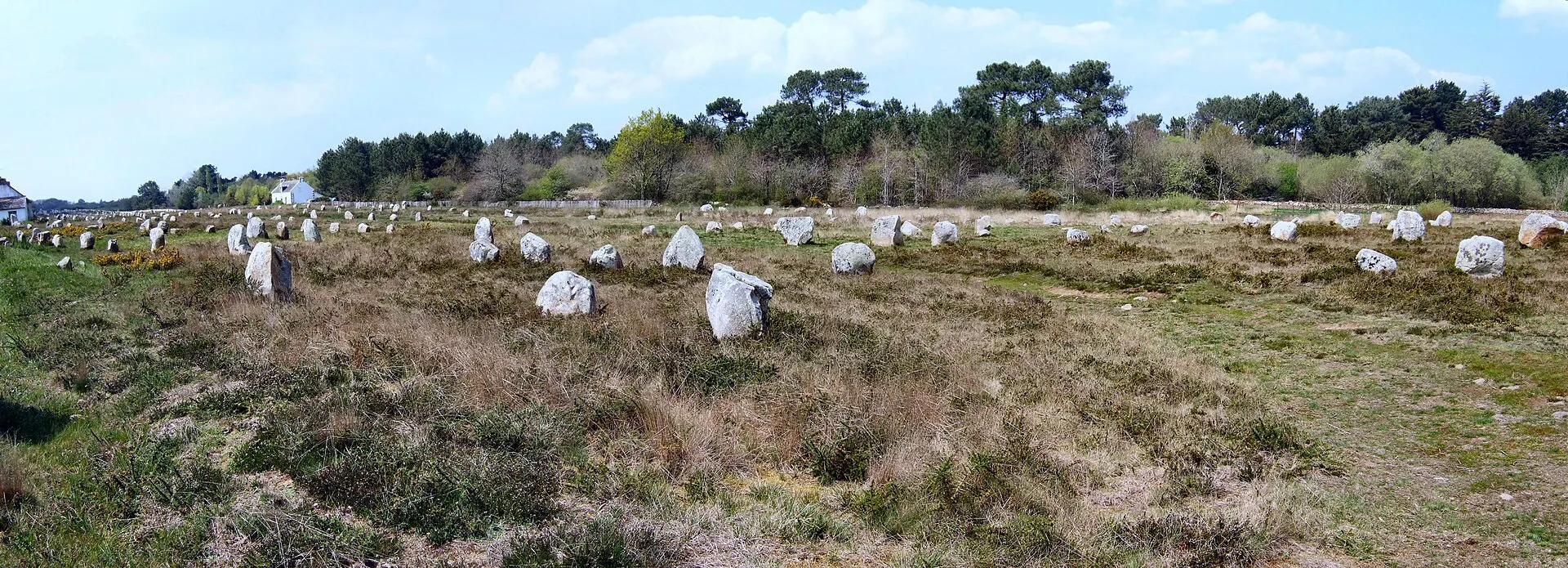
Carnac's alignments run along the south coast of Brittany in the Morbihan department, centered on Le Ménec at roughly 47.60° N, 3.06° W, and continuing northeast through Kermario to Kerlescan. The wider megalithic landscape stretches more than 10 km along the coast toward Erdeven, forming one of the densest concentrations of standing stones anywhere in the world.
Access changes with the season to protect the fragile ground: from October to March, visitors can walk freely among the stones on self-guided routes. From April to September, entry inside the fenced alignments requires a paid guided tour, though a free perimeter trail lets anyone view the rows up close year-round. The Maison des Mégalithes, opposite Le Ménec, offers free maps, exhibitions, and tour bookings every day of the year.
History and legend
The dense megalithic landscape around Carnac was built in phases across more than two millennia, with UNESCO's 2025 World Heritage listing framing construction roughly between 5000 and 2300 BCE. A 2025 excavation at Le Plasker in nearby Plouharnel, led by archaeologist Bettina Schulz Paulsson, used 49 radiocarbon dates to place a newly found section of standing stones at 4600-4300 cal BCE - among the earliest megalithic construction documented anywhere in Europe. Written interest in the stones came far later: A.F. Boureau-Deslandes made the probable first mention in 1721, and after the French state acquired the land in the 1880s, curators Félix Gaillard, Daniel Beaupré, and especially Zacharie Le Rouzic restored and re-erected fallen or buried menhirs, marking each restoration with a small red cement dot still visible today.
By the time anyone was writing seriously about the stones, their original purpose and builders had been forgotten for thousands of years, leaving room for Breton Christian tradition to supply its own explanation: Saint Cornély, fleeing a pursuing Roman legion, turned his enemies to stone when he reached the shore. The alignments predate the Roman Empire by roughly three millennia, making the legend a later folk invention rather than any record of the true builders.
Related places and beings
Carnac sits alongside Avebury, Stonehenge, Newgrange, and the Callanish Stones as one of Atlantic Europe's defining Neolithic megalithic landscapes, and the 2025 Le Plasker dating now places it among the earliest of that group. English-language media regularly nickname Carnac "France's Stonehenge" for its scale, even though the two monuments differ sharply in form - rows of thousands of modest stones at Carnac versus a single engineered circle at Stonehenge. Petrification legends like Saint Cornély's echo similar "turned to stone" folklore attached to other European megaliths, including figures mythologically linked to Medusa's gaze.
In popular culture
Carnac draws roughly 350,000 visitors a year and anchors Brittany's tourism identity, appearing on everything from regional branding to French school field trips. The comic series "Astérix" has twice played on the mystery for laughs: Obelix is a professional menhir carver and deliverer by trade, and the 1983 album "Astérix and Son" jokes that a local farmer planted leftover menhirs in his rocky field, inventing the alignments by accident. Documentaries about European prehistory routinely pair Carnac with Stonehenge as twin icons of a question archaeology still cannot fully answer: why anyone needed thousands of standing stones in one place.


