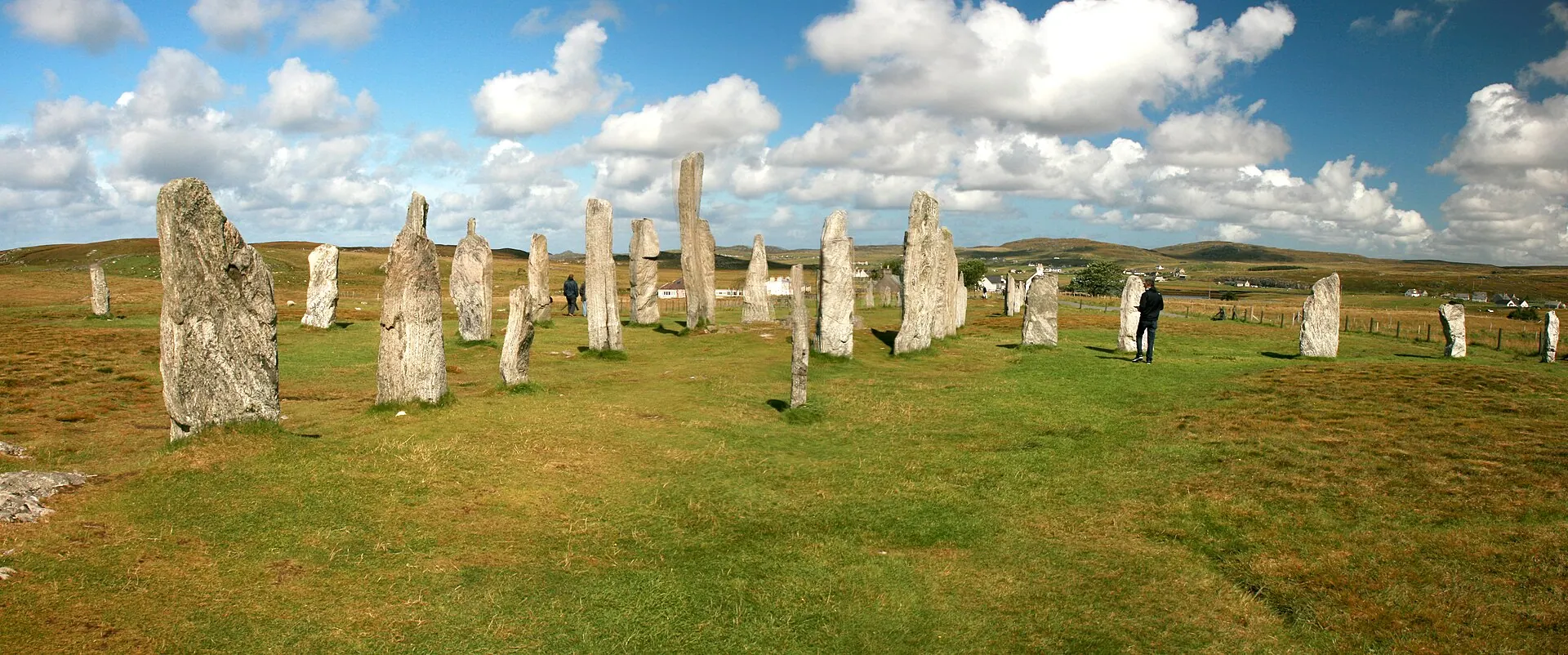
Panorama of the Callanish Stones with the central circle and stone rows on the Isle of Lewis
NACHOSAN / WIKIMEDIA COMMONS / CC BY-SA 3.0

Callanish Stones

Calanais · Clachan Chalanais · Tursachan Chalanais · Fir Bhrèige
HISTORICAL SITE

Mainstream consensus: Callanish is a professionally excavated Neolithic ceremonial site with a securely dated construction sequence. Its "false men" legend and lunar-observatory theories are folklore and interpretation, not findings that overturn the archaeological record.

Share this page
Short answer

The Callanish Stones are a Neolithic circle and avenue on Scotland's Isle of Lewis, raised around 2900-2600 BCE. Hebridean folklore calls them Fir Bhrèige, petrified giants who refused Christian conversion. Researchers argue the layout tracks the moon's horizon cycle across nearby hills. Historic Environment Scotland confirms the dates but says who built it, and why, remains unknown.

Location and access

Callanish (Gaelic: Calanais) stands on a low ridge on the west coast of the Isle of Lewis, about 58.20° N, 6.75° W, roughly 17 miles from Stornoway along the A858. The main circle is the centerpiece of a wider ritual landscape that includes at least fifteen related stone settings scattered across the surrounding moorland.

The stones themselves are free to visit year-round, and a redeveloped visitor centre with café, shop, and exhibition space sits beside the site. Reaching Lewis means flying in or taking the Caledonian MacBrayne ferry from Ullapool to Stornoway, then driving or busing the final stretch to Calanais village.

History and legend

Historic Environment Scotland excavations in 1980-81 dated the main circle's construction to roughly 2900-2600 BCE, erected on land local farmers were already cultivating - contemporary with the earliest phase of Stonehenge and the settlement at Skara Brae in Orkney. A small chambered cairn was added at the circle's center after 2500 BCE for burial use, and ritual activity likely continued into the Bronze Age before the site began disappearing under growing peat from around 1000 BCE. By 1857, nearly two meters of peat covered the lower stones until landowner Sir James Matheson had it cleared.

Local legend reached back further than any excavation. Writing around 1680, Lewis native John Morisone described the stones as men "converted into stone by ane Inchanter," the earliest written trace of what islanders by then called Fir Bhrèige, "false men." Traveller Martin Martin, visiting around 1695, was told the circle marked a place of pre-Christian worship where a chief druid once addressed the gathered people. A separate tradition holds that a "Shining One" walks the avenue every midsummer morning, heralded by a cuckoo's call.

Related places and beings

Callanish belongs to the same broad megalithic horizon as England's Stonehenge and Avebury, Ireland's Newgrange, and Brittany's Carnac alignments, even though its stone forms and ritual details developed independently in the Hebrides. Within Scotland, Loch Ness lies on the mainland to the east, and both sites anchor Highland and Hebridean folklore traditions about transformed or supernatural beings tied to the landscape. Researchers studying Callanish's lunar alignments often cross-reference Stonehenge's solar alignments as a comparative case for how Neolithic Britain tracked the sky.

In popular culture

Callanish's wind-scoured silhouette has made it a magnet for photographers, dowsers, and solstice and lunar-standstill pilgrims, and tourism boards from Caledonian MacBrayne Ferries to Logan Air have long used its image to promote travel to the Western Isles. The site is frequently named, alongside Castlerigg in the Lake District, as visual inspiration for the fictional stone circle Craigh na Dun in the "Outlander" novels and television series. Its remote setting and documented lunar-alignment research keep it a recurring stop in archaeoastronomy documentaries.

Photos and illustrations

Mix of rights-cleared documentary stills and AI illustrations (labeled).

The Callanish Stones on their ridge above Loch Roag, Isle of LewisCredit: Nachosan / Wikimedia Commons / CC BY-SA 3.0
The central ring of Callanish, with its tall monolith at the heartCredit: Andrew Gray / Wikimedia Commons / CC BY-SA 4.0
Standing stones at Callanish looking out over the waterCredit: Andrew Gray / Wikimedia Commons / CC BY-SA 4.0
Illustrative scene for Callanish StonesAI illustration for reference only

Visiting

loading map…

Open year-round with free access to the stones themselves. A redeveloped visitor centre with café, shop, and exhibition sits beside the site. Calanais is about 17 miles (27 km) from Stornoway via the A858; reach Lewis by air or Caledonian MacBrayne ferry from Ullapool.

Legend vs history: The stone circle's construction around 2900-2600 BCE, its later chambered cairn, and continued ritual use into the Bronze Age are documented by excavation. The "false men" petrification legend, the midsummer "Shining One," and lunar-observatory interpretations are folklore and later antiquarian theory layered onto that excavated record.

Reports and stories

Attributed reports, haunt claims, and discovery narratives from named sources. Links open the originals; AnomalyWiki does not verify these claims.

Claims vs mainstream

The claim

The stones are petrified giants who refused to convert to Christianity or build a church, as Hebridean folklore holds.

Mainstream view

Historic Environment Scotland notes this origin myth reflects a cultural tradition that postdates the Neolithic construction by millennia. There is no archaeological trace of any conversion-refusal event behind the legend.

The claim

Callanish was deliberately sited as a "lunar observatory," built to track the moon's 18.6-year declination cycle across specific hills on the horizon.

Mainstream view

Researchers Margaret and Gerald Ponting, later joined by Ron Curtis, developed this reading from decades of horizon observation. Historic Environment Scotland says the balance of evidence supports some lunar alignment, but who made the observations, and why, remains unknown and the full archive is still unpublished.

The claim

An entity called the "Shining One" still walks the stone avenue every midsummer morning, heralded by a cuckoo's call.

Mainstream view

Folklorists record this as a local legend tied to seasonal custom; families once visited the stones at May Day and midsummer. It is treated as traditional belief passed down orally, not a documented phenomenon.

Timeline

  1. c. 2900-2600 BCEThe main stone circle is erected on already-cultivated land, roughly contemporary with the first phase of Stonehenge and the settlement at Skara Brae.Source: Historic Environment Scotland, Calanais scheduling description
  2. after 2500 BCEA small chambered cairn is inserted at the circle's center and used for burial.Source: Historic Environment Scotland, Calanais Standing Stones Setting Document
  3. c. 1200-800 BCERitual activity at the site likely continues into the Bronze Age before the area begins sealing under peat.Source: Historic Environment Scotland scheduling description
  4. 1857Landowner Sir James Matheson has peat, nearly two meters deep in places, cleared from around the stones.Source: Visit Outer Hebrides, Calanais Standing Stones
  5. 1980-1981Historic Environment Scotland excavations establish the circle's construction sequence and recover Beaker-period burial evidence.Source: Historic Environment Scotland, "Calanais Survey and Excavation, 1979-88"

FAQ

What are the Callanish Stones?

The Callanish Stones are a Neolithic stone circle and avenue on the Isle of Lewis in Scotland's Outer Hebrides, with at least fifteen related stone settings in the surrounding landscape.

How old are the Callanish Stones?

Excavation dates the main circle's construction to roughly 2900-2600 BCE, with ritual use possibly continuing into the Bronze Age before peat began covering the site.

What is the "false men" legend?

Hebridean tradition recorded from the late 17th century holds that the stones are giants, or "Fir Bhrèige," turned to stone for refusing to convert to Christianity.

Is Callanish a lunar observatory?

Researchers have shown moonrise and moonset align with specific hills visible from the site at certain points in the moon's 18.6-year cycle. Historic Environment Scotland finds this persuasive but says the purpose and observers remain undocumented.

Can you visit the Callanish Stones?

Yes, the site is open year-round and free to visit, with a visitor centre offering exhibitions, a café, and a shop beside the stones.

What inspired Outlander's Craigh na Dun?

Outlander's fictional stone circle draws on several real Scottish sites, with Callanish frequently cited alongside Castlerigg as visual inspiration for the show's time-travel circle.