Location and access
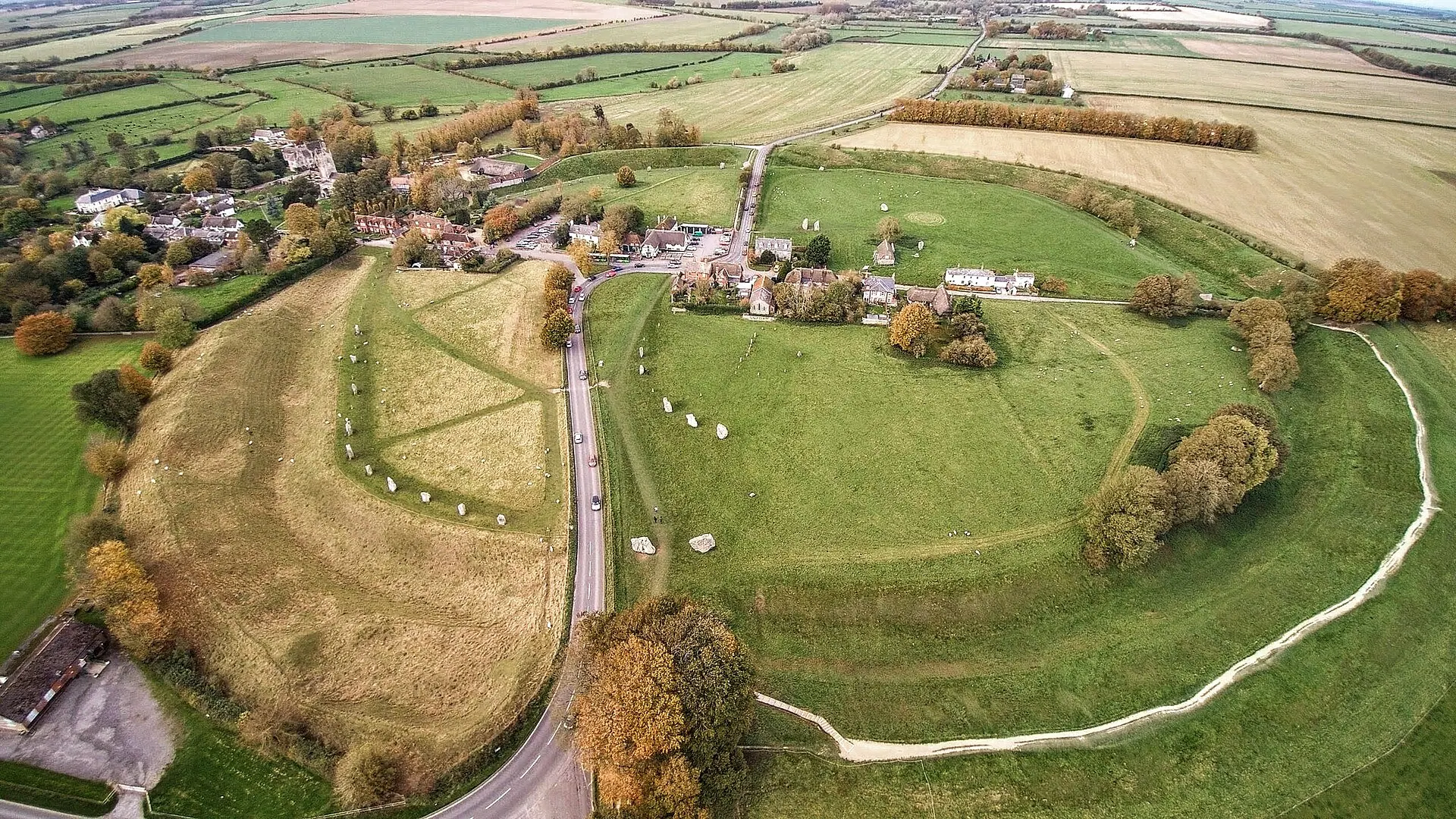
Avebury sits on a low chalk ridge in the Upper Kennet Valley, Wiltshire, at about 51.43° N, 1.85° W, roughly 10 km from Marlborough. The henge is part of the wider Stonehenge, Avebury and Associated Sites World Heritage property, which also includes West Kennet Avenue, West Kennet Long Barrow, and Silbury Hill, all reachable on foot from the village.
Unlike its more famous neighbor Stonehenge, Avebury has free, open access year-round, with no ticket required to walk among the stones, since a public road and part of the modern village sit directly inside the henge. The National Trust manages the site on behalf of English Heritage, and the on-site Alexander Keiller Museum charges separate admission for its collection of prehistoric finds.
History and legend
Avebury's bank, ditch, and three stone circles were built and reshaped over several centuries, roughly 2850 to 2200 BCE. Antiquarian John Aubrey first recorded the monument in January 1649 after stumbling onto it during a fox hunt, producing its earliest known survey plan. William Stukeley documented the site in detailed sketches during the 1720s, capturing stones that local villagers were actively breaking up and burying - a destructive habit that continued for generations. Marmalade heir and archaeologist Alexander Keiller began excavating the West Kennet Avenue in 1934 and continued through 1939, re-erecting buried stones and marking the locations of those lost for good, work that still defines Avebury's modern appearance.
Twentieth-century earth-mysteries writers added a second, interpretive layer onto that documented history. Alfred Watkins' 1920s "ley line" idea, later recast by John Michell as channels of earth energy, places Avebury at a key junction of lines running across Britain. Michael Dames went further in the 1970s, reading Silbury Hill and the surrounding monuments as a deliberately shaped goddess landscape. Neither claim rests on excavated evidence; archaeologists treat them as modern folklore built on top of a real Neolithic monument.
Related places and beings
Avebury belongs to the same Wiltshire ceremonial landscape as Stonehenge, 40 km to the south, and the pair are jointly inscribed as one UNESCO World Heritage property. Writers chasing continent-spanning megalith theories regularly link Avebury to Ireland's Newgrange, Brittany's Carnac alignments, and Scotland's Callanish Stones as evidence of a shared prehistoric tradition, even though each site's stone forms, dates, and local purposes differ. Nearby Silbury Hill, Windmill Hill, and the Sanctuary are treated as satellite sites within the same ritual landscape rather than separate mysteries.
In popular culture
Avebury's eerie village-among-the-stones setting made it the filming location for the 1977 British children's serial "Children of the Stones," still cited as a touchstone of folk horror. The site's ley-line reputation keeps it a fixture of earth-mysteries tourism, dowsing tours, and solstice gatherings alongside Stonehenge, and Michael Dames' goddess-landscape books remain in print as alternative readings of the valley. Documentary crews return regularly to contrast Keiller's excavation record with the site's broader reputation as one of Britain's great "mystery" landscapes.


