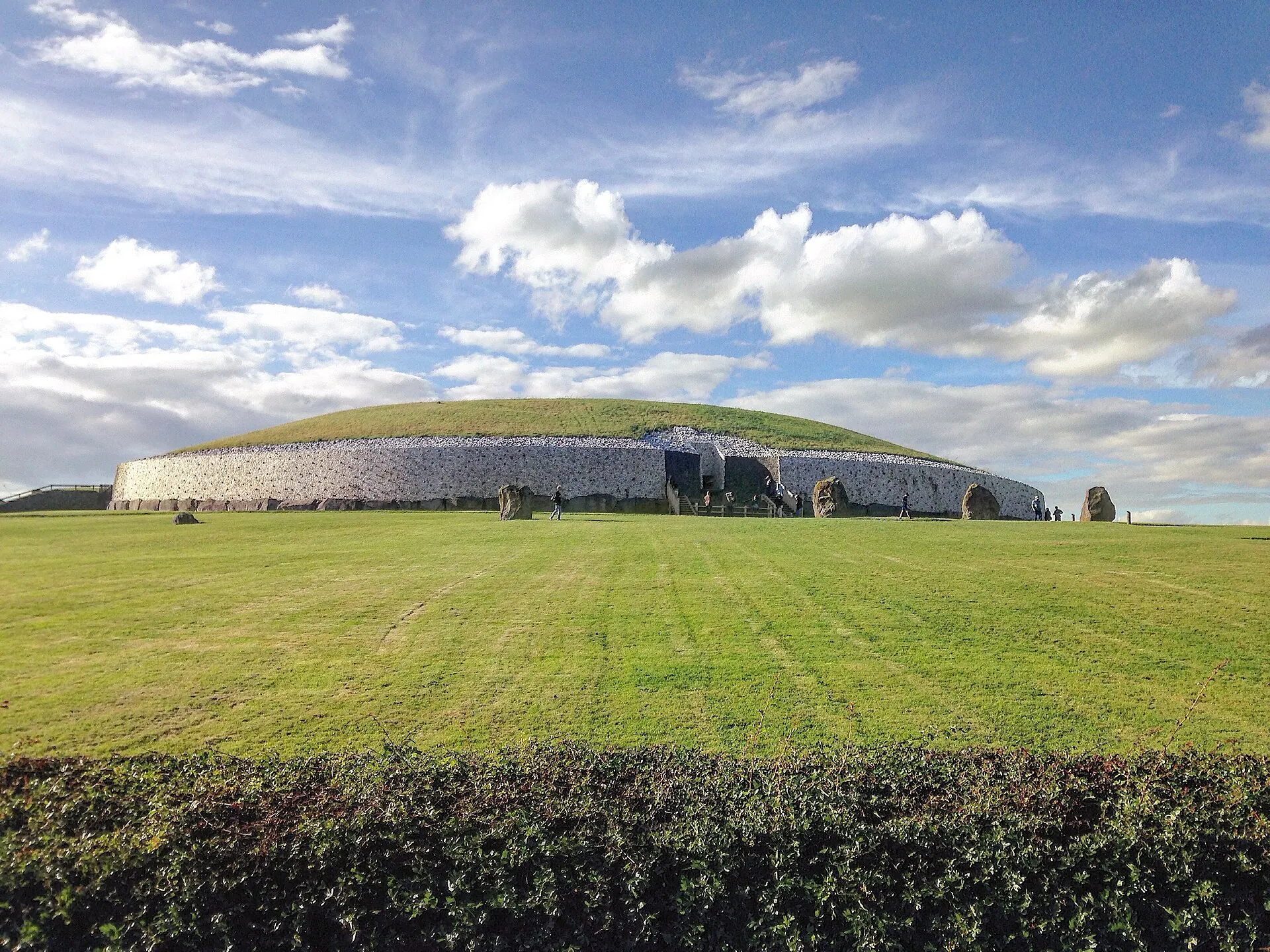
Location and access
Newgrange rises from the Boyne Valley in County Meath, roughly 53.69° N, 6.48° W, within the Brú na Bóinne World Heritage landscape alongside the passage tombs of Knowth and Dowth. The mound is the largest and most visited of the three, with a reconstructed white quartz facade that greets visitors from the car park across the river.
There is no direct public access to the monument itself. Every visit begins at the Brú na Bóinne Visitor Centre, where a shuttle bus carries small guided-tour groups to the mound and inside the chamber. Tickets must be pre-booked online - 30 days ahead from April to November, 7 days ahead in winter - because places on each tour are strictly limited to protect the fragile interior.
History and legend
Newgrange was built around 3200 BCE from layered stone and turf over a decorated passage leading to a cruciform chamber. Welsh antiquarian Edward Lhwyd first recorded it in 1699, after workmen quarrying stone for a road broke into the entrance. Twentieth-century scholars examined only the exterior kerb and stone circle until Michael J. O'Kelly's Office of Public Works excavation, running from 1962 to 1975, opened the passage, uncovered a collapsed stone feature he named the roof-box, and restored the mound's facade.
Local tradition had long held that the tomb filled with sunlight at winter sunrise, though no one had verified it directly. Suspecting a deliberate solar alignment from the tomb's south-east orientation, O'Kelly watched the chamber at dawn on December 21, 1967, and became the first person in the modern era to see the sunbeam cross the floor. He timed and documented the full seventeen-minute effect on December 21, 1969. Brú na Bóinne was inscribed as a UNESCO World Heritage Site in 1993.
Related places and beings
Newgrange sits in a dense cluster with Knowth and Dowth, its sister passage tombs along the same bend of the River Boyne, and is frequently compared with Britain's Stonehenge and Avebury as a flagship of Atlantic European Neolithic monument-building. Scotland's Callanish Stones and Brittany's Carnac alignments share the same broad 4th-3rd millennium BCE megalithic horizon, even though each tradition developed its own stone forms and purposes. Irish folklore ties the wider Boyne landscape to the Tuatha Dé Danann and figures like the Dagda, giving the valley a mythic frame that predates serious archaeology by centuries.
In popular culture
Newgrange's solstice illumination draws international media coverage every December, including live-streamed broadcasts of the sunrise event since 2020, and the monument appears regularly in documentaries about prehistoric astronomy. Irish band Clannad's 1983 instrumental "Newgrange" put the site's name on record shelves well beyond archaeology circles, while tourism campaigns use the mound's quartz facade as a signature image for Ireland's Ancient East. Popular retellings sometimes stretch the solstice alignment into claims about lost technology or extraterrestrial contact that the excavation record does not support.


