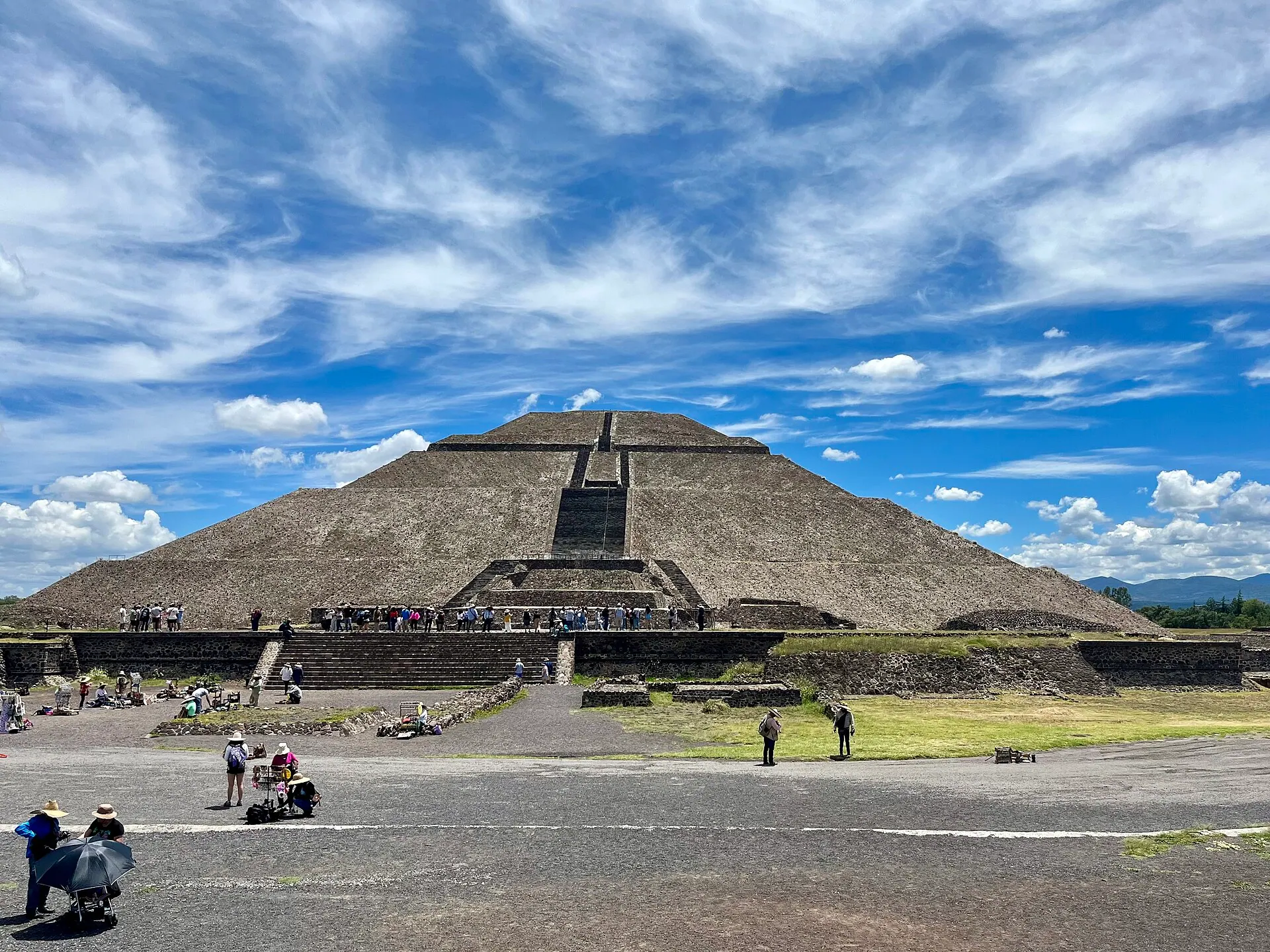
Location and access
Teotihuacan sits in the State of Mexico roughly 50 km northeast of Mexico City, at approximately 19.6925° N, 98.8438° W. UNESCO's inscribed property covers 250 hectares around the ceremonial core, with a much larger buffer zone protecting the surrounding valley.
Mexico's National Institute of Anthropology and History (INAH) manages the site as a ticketed archaeological zone. Visitors can climb the Pyramid of the Sun and walk the roughly 2-km Avenue of the Dead connecting it to the Pyramid of the Moon and the Ciudadela complex. The site offers little shade across its open plazas, so an early start and sun protection make a real difference, especially during the dry season when the area draws heavy tourist traffic.
History and legend
Documented history: Human occupation of the Teotihuacan Valley predates the Christian era, but the settlement grew into one of the Americas' largest ancient cities between the 1st and 7th centuries CE, eventually housing at least 25,000 people according to UNESCO's assessment. Revised radiocarbon dating from the Sun Pyramid Project's 2008-2011 excavations places the Pyramid of the Sun's main construction phase at roughly 170-310 CE, tied to a subterranean tunnel used for ritual activity. The ceremonial core burned around 550-650 CE, and the city's population dispersed in a decline whose exact cause, whether internal uprising, invasion, drought, or some combination, remains an open question among archaeologists. Centuries later, Aztec settlers in the Valley of Mexico found the ruins already ancient and gave the abandoned city its now-familiar name, Teotihuacan, commonly translated as "the place where the gods were created." Mexican government excavation began formally in 1905 under Leopoldo Batres, and research continues today, including Sergio Gómez's 2003-2015 excavation of a sealed tunnel beneath the Temple of the Feathered Serpent, which turned up jade statues, jaguar remains, and large quantities of liquid mercury.
Legend and alternative overlay: Popular television specials point to Teotihuacan's precise astronomical alignments and sheer scale as evidence that extraterrestrials guided its construction, sometimes citing mica sheets found inside the Pyramid of the Sun as alien radiation shielding. The deeper hook for these claims is real: even the Aztecs, who arrived centuries after the city's collapse, did not know who had built it. Archaeologists treat that as a genuine naming gap rather than proof of nonhuman involvement, since the city's layout fits a pattern of Mesoamerican urban planning refined over generations by real, if anonymous, builders.
Related places and beings
Teotihuacan shares its "scale implies outside help" storytelling pattern with Sacsayhuamán, Easter Island, and the Pyramids of Giza. Its closest thematic cross-category cousin is the Pacal Sarcophagus from Palenque, another Mesoamerican carving that popular media reads as depicting an astronaut rather than Maya cosmology.
In popular culture
Teotihuacan appears regularly in "Ancient Aliens"-style programming, which leans on the city's unknown builders and astronomically precise layout as a hook for extraterrestrial-contact claims. Mexican heritage media and academic documentaries instead present it as a showcase of Classic-era Mesoamerican urban planning, multi-ethnic neighborhoods, and long-distance trade, a real metropolis whose name for itself simply never survived into the historical record.


