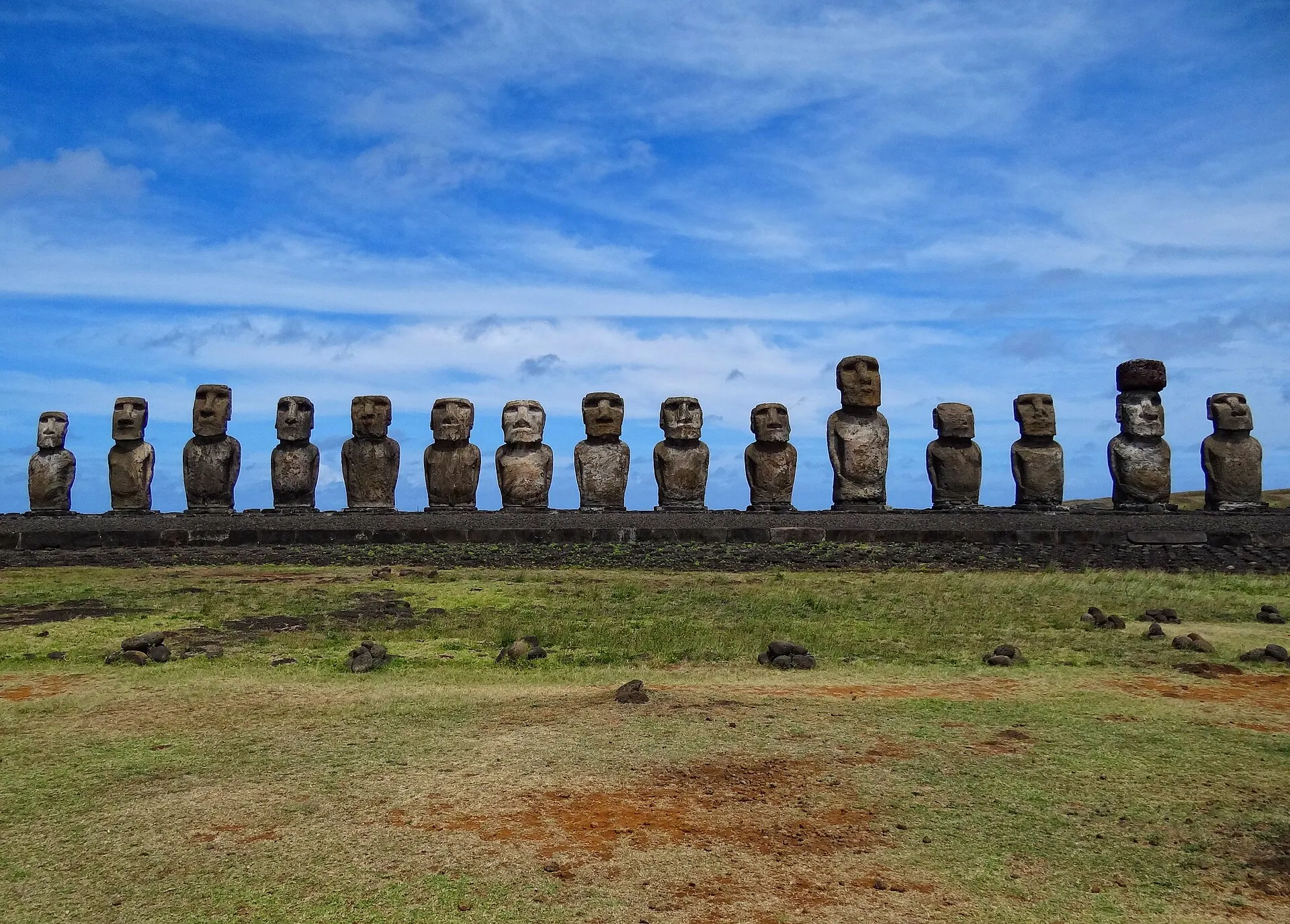
Fifteen moai standing in a row on the Ahu Tongariki platform on Easter Island
BJØRN CHRISTIAN TØRRISSEN / WIKIMEDIA COMMONS / CC BY-SA 3.0

Easter Island

Rapa Nui · Isla de Pascua
HISTORICAL SITE

Mainstream consensus: Rapa Nui is a verified Polynesian settlement with a well-documented monumental statue tradition; its moai are the work of human islanders, not extraterrestrials or a lost non-Polynesian civilization.

Share this page
Short answer

Easter Island's moai are nearly 900 carved ancestor figures raised by Polynesian settlers between roughly 1250 and 1500 CE, not by aliens, as Erich von Däniken once claimed. A 2012 "walking" experiment showed crews could rock a multi-ton replica upright with ropes alone. The island's real tragedy came later, from nineteenth-century slave raids and disease, not simple self-inflicted ecological collapse.

Location and access

Rapa Nui is a small volcanic island in the South Pacific at approximately 27.1127° S, 109.3497° W, administered by Chile as part of the Valparaiso Region despite sitting roughly 3,700 km from the mainland coast, making it one of the most isolated inhabited places on Earth. Rapa Nui National Park, covering about two-thirds of the island, protects the moai, ahu platforms, and the Rano Raraku quarry.

The island has a single airport, Mataveri, served by flights from mainland Chile and from Tahiti. A park entry ticket is required to visit the major sites, and tourism is managed jointly by Chile's national forest service (CONAF) and the local Rapa Nui community, whose cultural organizations have an increasing say in how the park operates.

History and legend

Documented history: Revised radiocarbon dating places Polynesian settlement of Rapa Nui at roughly 1200 CE, later than older estimates that assumed arrival as early as 300-800 CE. Over the following centuries, islanders developed the moai-carving tradition centered on the Rano Raraku quarry, where unfinished statues still show the carving sequence in progress, some left mid-extraction at well over 100 tons. Dutch admiral Jacob Roggeveen's expedition made the first recorded European contact in 1722, arriving on Easter Sunday and naming the island accordingly; some moai had already toppled from their platforms by then. The island's sharpest historical catastrophe came later and was entirely external: Peruvian slave raids in 1862-1863 removed roughly a third of the population, including chiefs and oral historians, and introduced disease further devastated the survivors in the following decades. Chile annexed Rapa Nui in 1888.

Legend and alternative overlay: Erich von Däniken's 1968 "Chariots of the Gods" argued that Rapa Nui's small Polynesian population could never have carved and transported statues weighing many tons without extraterrestrial help. That specific claim was tested directly in 2012, when researchers rocked a 4.35-tonne concrete replica upright and "walked" it 100 meters with ropes and about 18 people, matching Rapa Nui oral tradition that the moai walked to their platforms on their own. A separate, more mainstream legend, popularized by Jared Diamond's "Collapse," frames the islanders as the authors of their own ecological ruin through statue-building obsession; researchers Terry Hunt and Carl Lipo argue that version overstates deforestation's link to statue transport and understates the colonial-era slave raids and disease that caused the real demographic collapse. For the statues themselves and the carving and transport debate in more depth, see the moai entry; for the society-and-collapse debate specifically, see Rapa Nui Society.

Related places and beings

Easter Island belongs to the same "small population, massive monuments" storytelling cluster as Sacsayhuamán, Teotihuacan, and the Pacific's other great megalithic outlier, Nan Madol. Its closest companions within AnomalyWiki are the moai themselves and Rapa Nui Society, which cover the statues' carving and transport and the island's social history in more depth.

In popular culture

Easter Island's moai are instantly recognizable shorthand for ancient mystery, appearing everywhere from emoji sets to disaster films, often paired with Erich von Däniken-style claims that aliens must have been involved. More grounded popular treatments, including Jared Diamond's widely read "Collapse," use the island as a case study in environmental and social fragility, though archaeologists like Terry Hunt and Carl Lipo argue that version still oversimplifies a history whose worst chapter was colonial violence rather than self-inflicted ecological ruin.

Photos and illustrations

Mix of rights-cleared documentary stills and AI illustrations (labeled).

Ahu Tongariki, the largest ceremonial platform on Rapa Nui, with all fifteen moai re-erectedCredit: Bjørn Christian Tørrissen / Wikimedia Commons / CC BY-SA 3.0
Partly buried moai on the slopes of Rano Raraku, the quarry where nearly all the statues were carvedCredit: Aurbina / Wikimedia Commons / Public domain
Rano Raraku's quarry slope, still scattered with unfinished and abandoned moaiCredit: Dropus / Wikimedia Commons / CC BY-SA 4.0
Illustrative scene for Easter IslandAI illustration for reference only

Visiting

loading map…

Rapa Nui National Park covers about two-thirds of the island and is reached by flights to the island's single airport, Mataveri, from mainland Chile or Tahiti. A park entry ticket is required to visit sites like Rano Raraku and Ahu Tongariki, and the local Rapa Nui community manages tourism alongside Chile's national forest service (CONAF).

Legend vs history: Archaeological, genetic, and linguistic evidence ties the moai firmly to Polynesian settlers who reached Rapa Nui roughly 1200 CE and developed statue carving at the Rano Raraku quarry over several centuries. Claims that only extraterrestrials or a vanished non-Polynesian culture could have carved and moved the statues ignore both the Rano Raraku quarry's clear developmental sequence and field experiments showing human crews could move them with ropes alone.

Reports and stories

Attributed reports, haunt claims, and discovery narratives from named sources. Links open the originals; AnomalyWiki does not verify these claims.

Claims vs mainstream

The claim

Only extraterrestrial or lost-continent engineers could have carved and moved moai weighing many tons.

Mainstream view

A 2012 field experiment showed 18 people could "walk" a 4.35-tonne replica moai upright roughly 100 meters in under an hour using only three ropes, matching Rapa Nui oral tradition that the statues walked to their platforms.

The claim

The moai and ahu platforms were built by a vanished non-Polynesian culture before the Rapa Nui arrived.

Mainstream view

Archaeological, linguistic, and genetic evidence ties moai carving to Polynesian settlers who reached the island roughly 1200 CE, with a clear stylistic development sequence visible in the Rano Raraku quarry.

The claim

Rapa Nui islanders single-handedly destroyed their own environment through reckless statue-building ("ecocide").

Mainstream view

Researchers Terry Hunt and Carl Lipo argue deforestation involved introduced Polynesian rats and land clearing for agriculture, and that the island's sharpest population collapse followed 19th-century slave raids and introduced disease, not statue transport.

Timeline

  1. c. 1200 CEPolynesian settlers reach Rapa Nui, per revised radiocarbon dating of early occupation layers.Source: Hunt and Lipo research, summarized in Nature news coverage
  2. c. 1250-1500 CEPeak moai carving period at the Rano Raraku quarry, producing most of the island's statues.Source: Rapa Nui National Park UNESCO documentation
  3. 1722Dutch admiral Jacob Roggeveen's expedition makes the first recorded European contact, naming the island after the holiday on which his ships arrived.Source: Standard Rapa Nui historical accounts
  4. 1862-1863Peruvian slave raids remove roughly a third of the island's population, including chiefs and knowledge-holders, a demographic catastrophe later compounded by introduced disease.Source: Standard Rapa Nui historical accounts
  5. 2012Terry Hunt, Carl Lipo, and Sergio Rapu Haoa demonstrate "walking" a 4.35-tonne replica moai upright using ropes and a small rotating crew.Source: Nature news coverage; The Guardian

FAQ

Where is Easter Island?

Rapa Nui is one of the most isolated inhabited places on Earth, a Chilean-administered volcanic island in the South Pacific roughly 3,700 km from mainland Chile, reached mainly by flights to its single airport, Mataveri.

How many moai are there?

Archaeologists count nearly 900 moai across the island, ranging from a few tons to statues left unfinished in the Rano Raraku quarry that would have weighed well over 100 tons.

Did aliens carve or move the moai?

No credible evidence supports that. A 2012 field experiment showed a small crew could "walk" a multi-ton replica moai upright using ropes alone, matching Rapa Nui oral tradition.

Did the Rapa Nui destroy their own island through overpopulation?

That "ecocide" narrative is contested. Researchers Terry Hunt and Carl Lipo argue introduced rats and land clearing drove deforestation, and that the island's worst population collapse came later, from 19th-century slave raids and disease.

Can you visit the moai?

Yes, most of the famous statue sites sit within Rapa Nui National Park, which requires an entry ticket and is reached by flights to the island from mainland Chile or Tahiti.

When did people first settle Easter Island?

Revised radiocarbon dating points to Polynesian settlement around 1200 CE, somewhat later than older estimates that put first arrival closer to 300-800 CE.