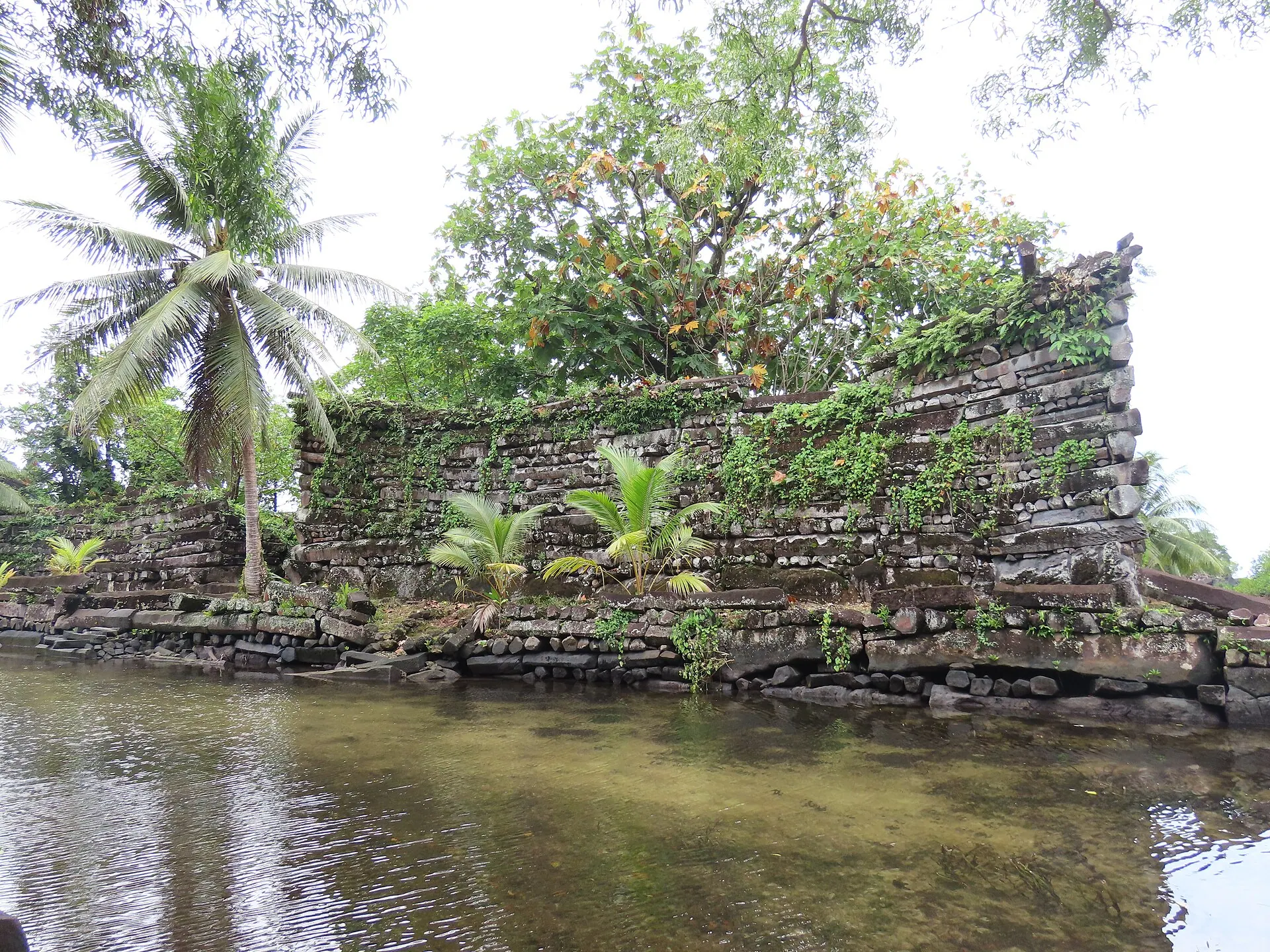
Stacked basalt-column walls of Nan Madol rising from a tidal channel among palms
UHOOEP / WIKIMEDIA COMMONS / CC BY-SA 4.0

Nan Madol

Nan Matal · Venice of the Pacific
HISTORICAL SITE

Mainstream consensus: Nan Madol is a UNESCO World Heritage-listed megalithic city built by the Saudeleur dynasty beginning around 1180 CE using locally quarried basalt moved by canoe raft. Theories of a sunken "Mu" civilization or outside advanced builders are pseudoarchaeology and colonial-era myth, not findings supported by excavation.

Share this page
Short answer

Nan Madol is a megalithic stone city of nearly 100 artificial islets off Pohnpei, Micronesia, built from giant basalt columns starting around 1180 CE as the Saudeleur dynasty's capital. Local legend credits twin sorcerers with raising the stones by magic. Coral dating confirms a real, locally built chronology; claims tying it to a sunken "Mu" civilization are discredited pseudoscience.

Location and access

Nan Madol sits in a shallow lagoon off the southeast coast of Pohnpei in the Federated States of Micronesia, near Madolenihmw municipality at roughly 6.84° N, 158.33° E. The ruins cover about 100 artificial islets built from stacked columnar basalt, laced together by a network of tidal canals, which is why early European visitors nicknamed it the "Venice of the Pacific."

There is no road to Nan Madol. Visitors reach it by guided boat tour through the canals, and because the site sits within traditional Pohnpeian land, access requires permission from the local Nahnmwarki, or paramount chief. Mangrove growth and tidal flooding have reclaimed parts of the ruins, so independent exploration without a local guide is both difficult and discouraged.

History and legend

Uranium-series (230Th/U) dating of coral used as structural fill, carried out by archaeologist J. Stephen Athens, places the start of monumental construction at Nan Madol around 1180-1200 CE. Over the following centuries the site grew into roughly 100 islets serving as the political and ceremonial capital of the Saudeleur dynasty, Pohnpei's first centralized ruling line. Oral history records that the dynasty eventually fell to the warrior Isokelekel, who overthrew the last Saudeleur ruler and established the Nahnmwarki chiefdom system still in use across Pohnpei today. German-Polish ethnographer Jan Kubary produced some of the first detailed Western documentation of the ruins during the 1870s-80s German colonial period.

Pohnpeian tradition explains the city's origin differently: twin sorcerers named Olisihpa and Olosohpa arrived by canoe seeking a place to raise an altar to the agricultural deity Nahnisohn Sahpw, and used magic, in some versions assisted by a flying dragon, to levitate the massive basalt columns into place. In the 20th century, writer James Churchward layered a second myth onto the ruins, claiming in 1926 that Nan Madol was a surviving fragment of a sunken Pacific super-civilization he called Mu, built on fabricated "Naacal tablets" he said he alone could translate. No geological or archaeological evidence has ever supported a sunken Pacific continent.

Related places and beings

Nan Madol belongs to a global class of megalithic ceremonial centers alongside Peru's Sacsayhuamán, Mexico's Teotihuacan, and Chile's Easter Island, each built by complex local societies without outside help, despite recurring fringe claims to the contrary. Within the megalith tradition more broadly, it is often compared to Göbekli Tepe and Stonehenge as evidence that monumental stone construction arose independently in multiple parts of the world. The debunked "lost continent of Mu" theory that attached itself to Nan Madol parallels similar lost-civilization myths layered onto other real archaeological sites.

In popular culture

Netflix's 2022 series "Ancient Apocalypse," hosted by Graham Hancock, featured Nan Madol in an episode arguing the site reflects contact with a lost advanced civilization. Pacific archaeologists and Indigenous scholars responded publicly and sharply, calling the framing both factually wrong and insulting, since it echoes colonial-era assumptions that Pacific Islanders were incapable of building their own monuments. Earlier in the 20th century, James Churchward's "Mu" books popularized Nan Madol in pulp adventure and pseudoarchaeological writing, a legacy that still surfaces in alternative-history media today.

Photos and illustrations

Mix of rights-cleared documentary stills and AI illustrations (labeled).

Basalt walls of Nan Madol rising from the tidal channels off PohnpeiCredit: Uhooep / Wikimedia Commons / CC BY-SA 4.0
An islet of Nan Madol with its log-stacked basalt wallsCredit: CT Snow / Wikimedia Commons / CC BY 2.0
The towering stacked-basalt walls of Nan MadolCredit: NOAA / Wikimedia Commons / Public domain
Illustrative scene for Nan MadolAI illustration for reference only

Visiting

loading map…

Nan Madol has no road access; reaching it requires a guided boat tour through its canals from nearby Madolenihmw, and visitors must obtain permission from the local Nahnmwarki (traditional chief) before entering. Reef-reinforced vegetation and tidal mangrove growth make independent exploration both difficult and discouraged.

Legend vs history: Nan Madol's construction by the Saudeleur dynasty beginning around 1180-1200 CE, confirmed by uranium-series coral dating, is documented archaeology. The Pohnpeian legend of twin sorcerers Olisihpa and Olosohpa raising the basalt with magic, sometimes aided by a flying dragon, is oral tradition explaining the monument's origin, not an engineering record.

Reports and stories

Attributed reports, haunt claims, and discovery narratives from named sources. Links open the originals; AnomalyWiki does not verify these claims.

Claims vs mainstream

The claim

Nan Madol was founded by twin sorcerer-brothers, Olisihpa and Olosohpa, who used magic, in some tellings a flying dragon, to levitate the massive basalt columns into place.

Mainstream view

Pohnpeian oral history credits the twins as founders of the Saudeleur dynasty; archaeologists treat this as the island's own origin narrative for its ruling line and monument, not a construction method. Engineering studies instead point to canoe-rafted transport of columnar basalt from quarries elsewhere on Pohnpei.

The claim

James Churchward's 1926 "Lost Continent of Mu" theory holds that Nan Madol is a surviving fragment of a sunken Pacific super-civilization, more advanced than Egypt, destroyed in a cataclysm.

Mainstream view

Churchward's Mu theory relied on fabricated "Naacal tablets" he claimed to have translated. No geological, genetic, or archaeological evidence supports a sunken Pacific continent, and mainstream scholars classify Mu as pseudoscience.

The claim

Nan Madol's scale and precision imply contact with, or construction by, an outside advanced culture rather than the local Pohnpeian population, as suggested in Netflix's "Ancient Apocalypse."

Mainstream view

Pacific archaeologists and Indigenous scholars have publicly rejected this framing as both factually wrong and insulting, since it echoes colonial-era assumptions that Pacific Islanders were incapable of their own monumental architecture. Excavation shows local chiefly societies organized the labor using locally available basalt.

Timeline

  1. c. 1180-1200 CEMegalithic construction at Nan Madol begins, per uranium-series (230Th/U) coral dating of foundational fill, marking the rise of the Saudeleur dynasty.Source: J. Stephen Athens, Quaternary Research
  2. c. 1200-1500 CENan Madol expands into roughly 100 artificial islets separated by canals, serving as the Saudeleur dynasty's political and ceremonial capital.Source: UNESCO World Heritage nomination documentation
  3. c. 1600sThe Saudeleur dynasty falls to the invading warrior Isokelekel, who overthrows the last Saudeleur ruler and establishes the Nahnmwarki chiefdom system still used on Pohnpei today, per oral tradition.Source: Pohnpeian oral history, as recorded by ethnographers
  4. 1870s-1880sGerman-Polish ethnographer Jan Kubary conducts some of the first systematic Western surveys of the ruins.Source: Kubary ethnographic reports, cited in Athens research
  5. 2016UNESCO inscribes Nan Madol as a World Heritage Site, simultaneously listing it as a World Heritage Site in Danger.Source: UNESCO World Heritage Centre, Nan Madol listing

FAQ

What is Nan Madol?

Nan Madol is a megalithic stone city built on nearly 100 artificial islets off the coast of Pohnpei in Micronesia, constructed from massive basalt columns as the capital of the Saudeleur dynasty.

How old is Nan Madol?

Uranium-series coral dating places the start of monumental construction around 1180-1200 CE, with the city expanding over the following centuries.

Who built Nan Madol?

Pohnpeian chiefly society built it under the Saudeleur dynasty, moving columnar basalt by canoe raft from quarries elsewhere on the island; oral tradition credits twin sorcerer-founders with the city's origin.

Can you visit Nan Madol?

Yes, but only by guided boat tour through the canals, and visitors need permission from the local Nahnmwarki, since the ruins sit on land under traditional Pohnpeian authority.

Is Nan Madol connected to the lost continent of Mu?

No. James Churchward's 1926 "Mu" theory relied on fabricated source material, and no geological or archaeological evidence supports a sunken Pacific continent.

Why is Nan Madol a World Heritage Site in Danger?

UNESCO listed it as endangered in 2016 because encroaching mangrove roots, tidal erosion, and limited conservation resources threaten the stability of its basalt structures.