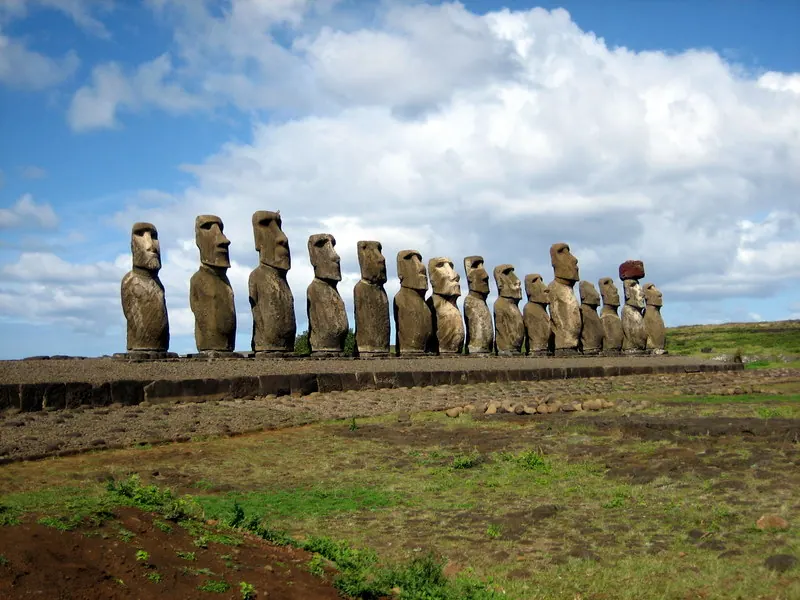
Fifteen restored moai statues standing on the Ahu Tongariki platform at Rapa Nui (Easter Island).
WIKIMEDIA COMMONS CONTRIBUTOR

Rapa Nui Society

Easter Island · Rapa Nui
ARCHAEOLOGICAL

Mainstream consensus: Well-studied Polynesian settlement with ongoing archaeological debate over deforestation causes; the severe population decline is now substantially attributed to post-contact disease and slave-raiding, not solely pre-contact self-destruction.

Share this page
Short answer

Rapa Nui society carved nearly 1,000 moai after Polynesian settlers arrived roughly 800 years ago, managing a small island for centuries before European contact in 1722. Disease and slave raids drove the real crash; the popular ecocide story oversimplifies what recent research ties more to colonial violence.

Mainstream view

Rapa Nui's Polynesian settlers developed sophisticated statue-carving and resource-management practices over centuries on a remote, resource-limited island; deforestation had multiple drivers, and the population crash long blamed on pre-contact "ecocide" is increasingly linked to European-introduced disease and 19th-century slave raids after 1722 contact.

Alternative claim

A widely repeated "ecocide" narrative holds that Rapa Nui islanders destroyed their own forests and triggered societal collapse entirely through their own mismanagement before Europeans arrived.

Rapa Nui's moai are the kind of achievement that invites overexplanation, and for a long time they got it. Polynesian voyagers who reached this remote Pacific speck around 1200 CE eventually carved close to 1,000 monumental statues, the bulk of them between roughly 1250 and 1500 CE, using stone tools and organized labor on an island with no metal and precious little timber to spare.

The island's deforestation is real, documented in pollen cores and charcoal layers, and debated in its causes: introduced Polynesian rats eating palm seeds, human land-clearing for agriculture, and wood use for statue transport likely all contributed in proportions researchers are still arguing over. What has not held up as well is the popular "ecocide" story - the idea that islanders single-handedly wrecked their environment and collapsed into societal catastrophe entirely on their own, before any outsider showed up.

Rock-mulch agriculture studies and population-timing research increasingly argue islanders adapted to a changing landscape rather than collapsing under it. The population crash that genuinely devastated Rapa Nui society arrived with history's outsiders: Dutch explorer Jacob Roggeveen's 1722 first contact introduced the island to European disease, and 1860s Peruvian slave raids abducted roughly a third of the remaining population - a documented atrocity, not an abstraction.

Even the moai-moving mystery has a tested, unglamorous answer. Researchers Terry Hunt and Carl Lipo demonstrated in 2012 that upright statues could be "walked" short distances using ropes and coordinated rocking by modest teams, matching Rapa Nui oral tradition and requiring no outside intervention. Unfinished statues still sitting at the Rano Raraku quarry are best read as ordinary halted production, not a frozen snapshot of sudden collapse.

Peers facing their own revised-collapse-narrative scrutiny include the Khmer Empire at Angkor and the Classic Maya, both cases where multi-causal, slower stories have displaced single-dramatic-event myths. The licensed Ahu Tongariki photo belongs here because those fifteen restored moai, standing again after 20th-century restoration, are the clearest living argument for what Rapa Nui's carvers actually accomplished.

Documentary photos

Rights-cleared documentary stills and serious reference images. These are not AI illustrations.

Ahu Tongariki, Rapa NuiCredit: Wikimedia Commons contributor

Key debates and stories

Attributed discovery narratives, debates, and claim histories from named sources. Links open the originals; AnomalyWiki does not verify these claims.

Claims vs mainstream

The claim

Rapa Nui islanders caused total societal collapse purely through environmental mismanagement before Europeans ever arrived.

Mainstream view

Settlement and population studies show communities adapting to deforestation with agricultural innovations like rock mulching; the sharpest population decline followed 1722 European contact, disease, and 19th-century slave raids.

The claim

The moai were abandoned mid-carving because the society collapsed suddenly.

Mainstream view

Unfinished moai at the Rano Raraku quarry likely reflect normal halted production (resource allocation, changing priorities) rather than evidence of sudden catastrophic collapse.

The claim

Only rats, not people, caused the island's deforestation.

Mainstream view

Researchers debate relative contributions of introduced Polynesian rats eating palm seeds versus human land-clearing for agriculture and statue transport; both likely played a role.

The claim

Rapa Nui society required outside (non-Polynesian) help to carve and move the moai.

Mainstream view

Experimental archaeology, including a 2012 "walking" demonstration, shows moai could be transported upright using ropes and coordinated teams, consistent with Polynesian technology.

Timeline

  1. c. 1200 CEPolynesian voyagers settle Rapa Nui, one of the most remote inhabited islands in the Pacific.Source: Rapa Nui settlement chronology studies
  2. c. 1250–1500 CEIslanders carve and transport the majority of the island's nearly 1,000 moai statues.Source: Rapa Nui moai archaeological surveys
  3. 1722Dutch explorer Jacob Roggeveen's expedition makes the first recorded European contact.Source: Roggeveen expedition accounts
  4. 1860sPeruvian slave raids abduct roughly a third of the island's population, devastating Rapa Nui society.Source: 19th-century Rapa Nui historical records
  5. 1888Chile annexes Rapa Nui, incorporating it into Chilean territory.Source: Chilean national historical records
  6. 1995UNESCO inscribes Rapa Nui National Park as a World Heritage Site.Source: UNESCO World Heritage Centre listing

FAQ

What is Rapa Nui society known for?

Carving and transporting nearly 1,000 moai statues after Polynesian settlers arrived around 1200 CE on one of the Pacific's most remote islands.

Did Rapa Nui islanders destroy their own civilization through ecocide?

That older narrative is increasingly contested; research on agricultural adaptation and population timing points instead to disease and slave raids after 1722 European contact as the main cause of the population crash.

How were the moai moved without modern machinery?

A 2012 experiment showed teams could "walk" upright moai short distances using ropes and coordinated rocking, consistent with Polynesian oral tradition and technology.

Who made first contact with Rapa Nui?

Dutch explorer Jacob Roggeveen's expedition in 1722, arriving on Easter Sunday, which gave the island its European name.

What happened to the population after European contact?

Introduced disease and devastating 1860s Peruvian slave raids, which abducted roughly a third of the population, caused severe decline.

Why are some moai unfinished at Rano Raraku?

Hundreds remain in various carving stages at the quarry, likely reflecting normal halted production rather than evidence of sudden societal collapse.