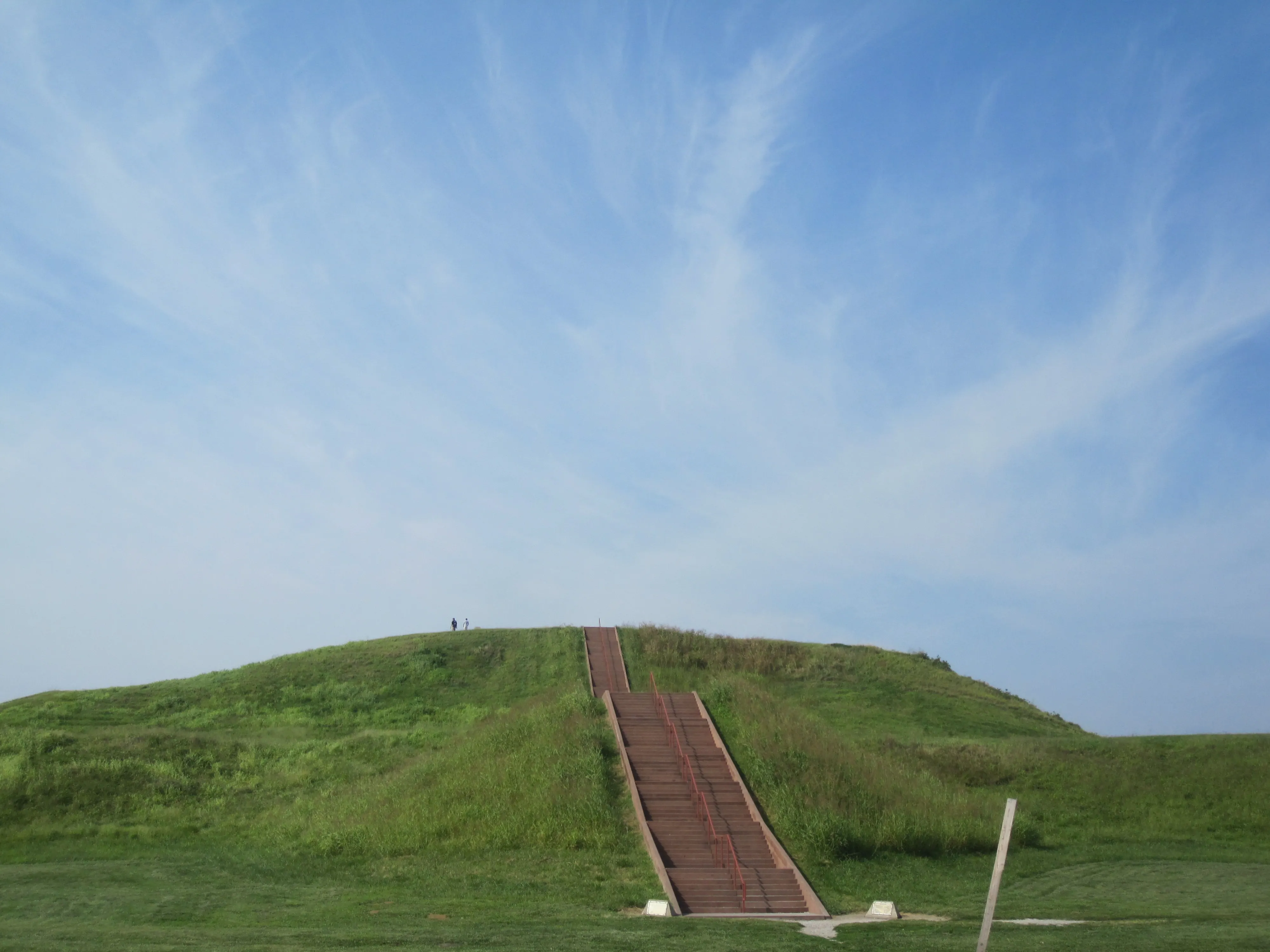
Monks Mound at Cahokia Mounds, Illinois - the largest prehistoric earthen mound north of Mesoamerica.
ETHAJEK / PUBLIC DOMAIN (WIKIVOYAGE)

Cahokia

Cahokia Mounds · Monks Mound site · Cahokia Mounds State Historic Site
ARCHAEOLOGICAL

Mainstream consensus: Verified Mississippian archaeological city with UNESCO recognition - Native-built, extensively studied.

Share this page
Short answer

Cahokia was a Mississippian megacity of earthen mounds near modern St. Louis, peaking around 1050–1200 CE with Monks Mound at its ceremonial core. Archaeology documents Native urban planning - not a lost white race or alien construction crew - even as popular myth still tries to hijack the skyline.

Mainstream view

Cahokia was a Native Mississippian urban and ceremonial center with monumental earthworks, plazas, and dense settlement. Decline involves social, environmental, and political factors debated by specialists - not lost races.

Alternative claim

Fringe narratives invent non-Native builders, extreme antiquity, or suppressed tech to explain Monks Mound’s scale.

Cahokia is what intentional earth and dense community look like when they scale into a city. On the floodplain east of today’s St. Louis, Mississippian builders raised plazas, neighborhoods, and Monks Mound - a terraced earthen summit large enough to rearrange how visitors think about “prehistoric” North America. Peak centuries around 1050–1200 CE made Cahokia a gravitational center for ritual, exchange, and power across a wide hinterland.

The digs are not ambiguous about authorship. Ceramics, house basins, burials, and chronologies sit inside Native Mississippian trajectories. Older mound-builder myths that stole credit for European or lost races collapse under that record; alien-labor talk collapses harder. Decline still invites debate - climate, conflict, political fragmentation - which is ordinary archaeology, not a cover-up.

Peers include other urban and monumental Native histories such as Ancestral Puebloans and cross-category monumental sites like Göbekli Tepe. Licensed photos of Monks Mound belong here because the grass-covered summit is the argument.

Walk the Grand Plaza today and the horizontal ambition is still obvious even under grass and reconstruction paths. Palisades, borrow pits, and neighborhood excavations show a city that ate labor and ceremony at scale. Specialists argue about how many people lived there at peak, how far its influence reached, and which stresses mattered most in decline - climate swings, conflict, political fragmentation, or all of the above.

What they do not argue is whether the builders were Mississippian Native peoples. That question was settled by ceramics, houses, and chronology against older mound-builder myths. Cahokia’s drama is human urban history in the American Bottom, not a missing chapter of Egypt or Orion.

Woodhenge posts and plaza alignments show ritual astronomy embedded in an urban plan. The city's decline is climate, politics, and migration - not a single curse tablet.

Cahokia's mounds are still on the Illinois skyline. Walk Monks Mound with excavation reports in mind - Indigenous urban engineering needs no Atlantis upgrade.

Mississippian peers from the American Bottom to the Southeast shared mound vocabulary without needing a single lost empire template. Cahokia is the loudest chapter, not the only one.

Documentary photos

Rights-cleared documentary stills and serious reference images. These are not AI illustrations.

Monks Mound, CahokiaCredit: Ethajek / public domain (Wikivoyage)

Key debates and stories

Attributed discovery narratives, debates, and claim histories from named sources. Links open the originals; AnomalyWiki does not verify these claims.

Claims vs mainstream

The claim

Cahokia’s mounds were built by a lost non-Native race.

Mainstream view

Excavation, chronology, and material culture place Cahokia firmly in Mississippian Native history.

The claim

Monks Mound requires alien or lost high technology.

Mainstream view

Earthmoving at scale is documented across Mississippian societies; extraordinary volume does not require non-human labor.

The claim

Cahokia is mythical rather than archaeological.

Mainstream view

The site is excavated, dated, and protected as a UNESCO World Heritage property.

Timeline

  1. c. 800–1050 CEEmergent Mississippian settlement intensifies in the American Bottom.Source: Cahokia archaeological chronologies
  2. c. 1050–1200 CEUrban peak - Monks Mound expansion, Grand Plaza, dense neighborhoods, regional influence.Source: Mississippian archaeology syntheses; Cahokia site literature
  3. c. 1200–1350 CEPopulation and monumental programs reorganize and decline; causes debated.Source: Cahokia decline research
  4. 1982UNESCO lists Cahokia Mounds as a World Heritage Site.Source: UNESCO World Heritage listing

FAQ

What was Cahokia?

A major Mississippian urban and ceremonial center in Illinois, famous for Monks Mound and a dense planned landscape.

Who built Cahokia?

Native Mississippian peoples. Archaeology rejects lost-race and alien-builder claims.

When did Cahokia peak?

Specialists often place the urban florescence around the eleventh and twelfth centuries CE.

Why did Cahokia decline?

Researchers debate climate stress, social conflict, resource pressure, and political reorganization - not a single mystical catastrophe.

Can I visit Cahokia?

Yes - Cahokia Mounds State Historic Site interprets the UNESCO-listed landscape.