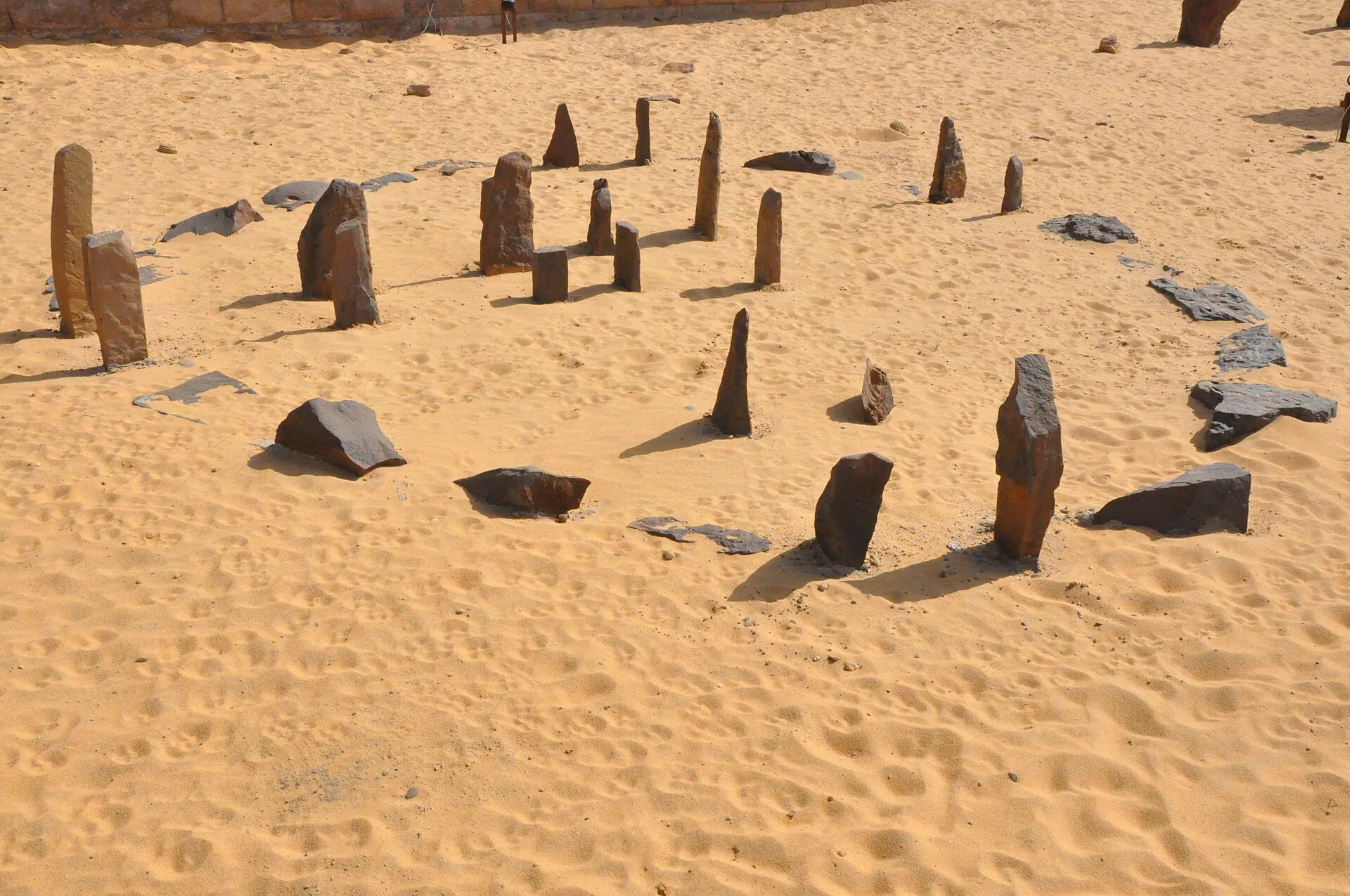
Nabta Playa sits in a basin that used to catch rain. During the African Humid Period, Saharan herders returned here seasonally for thousands of years, long before the dunes closed in on what is now one of the driest stretches of Egypt's Western Desert. What they left behind - cattle burial mounds, standing stones, and a modest circle of rough megaliths - makes the site one of the oldest known ceremonial complexes anywhere.
Fred Wendorf's Combined Prehistoric Expedition spent nearly three decades, from 1973 to 2002, mapping that legacy. The cattle burials are hard to misread as anything but ritual: articulated skeletons placed deliberately under stone mounds, evidence of sacrifice tied to a pastoralist cosmology where cattle clearly mattered beyond the dinner table.
The stone circle is where interpretation gets more contested, in useful ways. Wendorf, working with astronomer J. McKim Malville, proposed that sightlines through its upright slabs tracked the summer solstice sunrise - a practical calendar for herders who needed to know when monsoon rains, and the grazing that followed them, were about to arrive. That is a testable, published hypothesis grounded in surveyed stone positions, not a leap.
The leap comes later, in documentaries that stretch the solstice reading into a claim that the circle precisely maps Orion's Belt or encodes impossible ancient astronomy. Mainstream archaeoastronomers who have examined the alignment data have not replicated that specific match, and the jump from "tracks one solstice" to "encodes a constellation" skips the statistical work real archaeoastronomy requires.
Comparisons worth making sit with other early ritual-stone landscapes: Çatalhöyük for dense Neolithic community life elsewhere, and Stonehenge for the closest Old World parallel in solstice-tracking megaliths built by people with no need of outside help. The generated illustration here is labeled as such because no licensed photograph of the remote basin was available for this draft - the cattle mounds and alignments are the real story regardless of the image.
By around 4,800 years ago, the rains that made seasonal life here possible had stopped coming reliably. The Sahara that swallowed the basin's green years is the same desert that preserved its stones well enough for Wendorf's team to find them intact millennia later.

