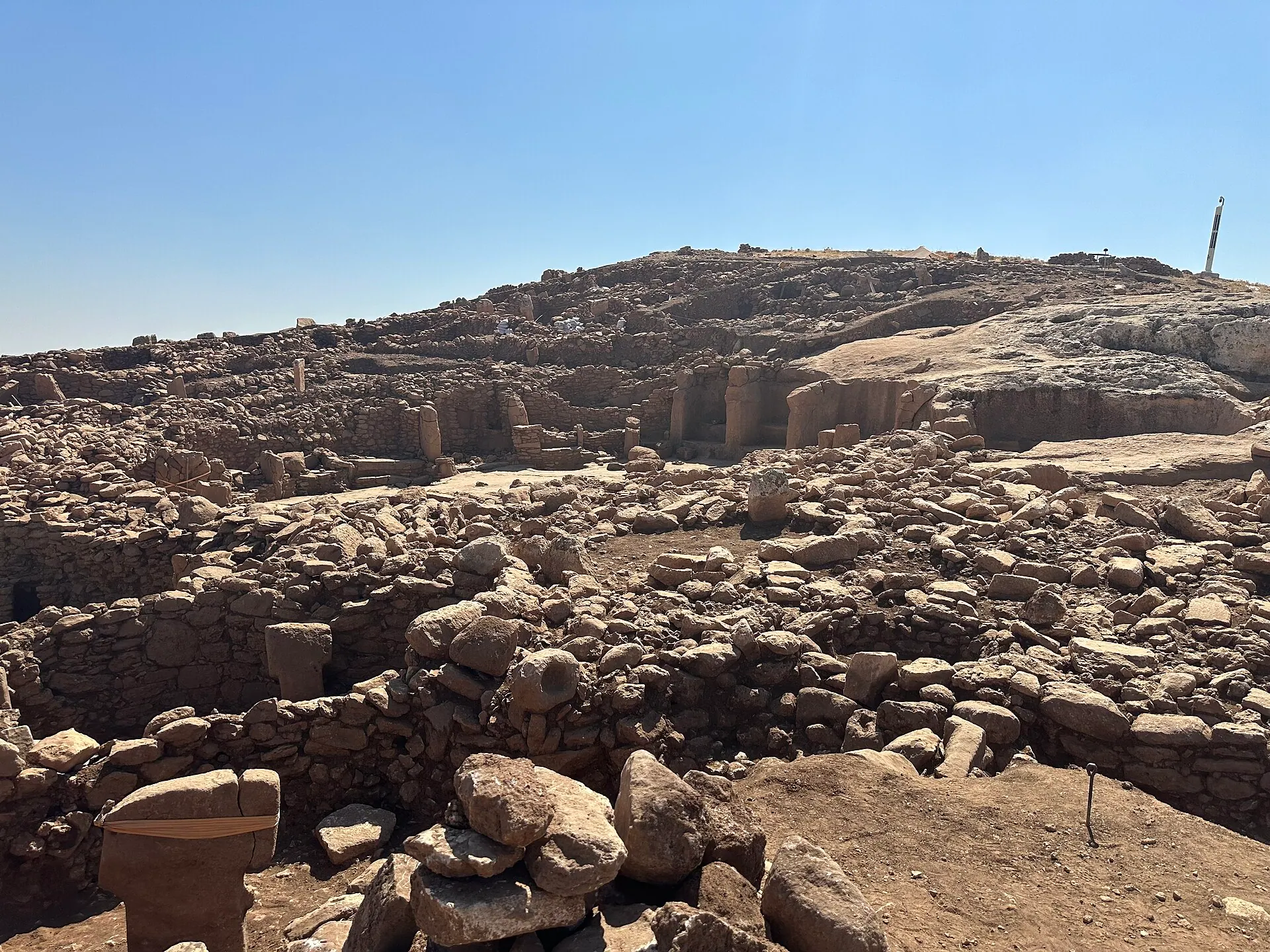
Excavated stone walls and enclosures at Karahan Tepe on a dry hillside in Şanlıurfa
VINCENT VEGA / WIKIMEDIA COMMONS / CC BY-SA 4.0

Karahan Tepe

Karahantepe · Keçili Tepe
HISTORICAL SITE

Mainstream consensus: Karahan Tepe is a professionally excavated Pre-Pottery Neolithic site inside an active Turkish-led research project. Its early date is real and remarkable; there is no excavated evidence of a lost high-tech civilization behind it.

Share this page
Short answer

Karahan Tepe is a Pre-Pottery Neolithic site in southeastern Turkey where hunter-gatherers carved T-shaped pillars, benches, and statues into bedrock starting around 10,000 years ago. Excavations led by Necmi Karul found a 2023 seated statue and a 2025 human-faced pillar. Archaeologists reject Graham Hancock's lost-civilization reading; they see skilled Stone Age builders, not survivors of a vanished advanced culture.

Location and access

Karahan Tepe sits in the Tek Tek Mountains National Park, roughly 60 km east of Şanlıurfa in southeastern Turkey, at about 37.09° N, 39.30° E - part of the same Taş Tepeler ("Stone Hills") cluster as its better-known neighbor Göbekli Tepe. The hill overlooks the arid Harran Plain; local residents once called it Keçili Tepe before the modern name stuck.

The site is open to visitors as part of Turkey's Taş Tepeler open-air network, but excavation trenches, bedrock-cut rooms, and newly found sculptures are often fenced off while digs are active. Confirm current visitor rules with Turkey's Ministry of Culture and Tourism before travel, since open sections shift as the Istanbul University team expands its work season by season.

History and legend

Harran University archaeologist Bahattin Çelik recorded about 266 T-shaped pillars still standing on the surface during a 1997 regional survey, but systematic excavation did not begin until 2019 under Necmi Karul of Istanbul University. Digging revealed rock-cut benches, pools, and rooms carved directly into limestone bedrock rather than built from freestanding blocks - a construction style distinct from Göbekli Tepe. In September 2023 the Ministry of Culture and Tourism announced a 2.3-meter seated statue with carved ribs and spine, fixed into a bench beside a vulture sculpture. In October 2025 the team found the first T-pillar carved with a human face, inside a domestic structure with grinding stones, which Karul called direct evidence that the region's T-pillars stood for people.

Because the site predates farming and pottery, some popular writers treat it as proof of a vanished, technologically advanced civilization destroyed by prehistoric catastrophe. Graham Hancock has featured Karahan Tepe in that argument on his website and in Netflix's Ancient Apocalypse. Karul and other excavators have publicly disputed the reading, pointing to Stone Age tools and a building style that developed locally over centuries rather than arriving with outside help.

Related places and beings

Karahan Tepe is routinely paired with Göbekli Tepe, 46 km to the west, as twin flagships of the Taş Tepeler Neolithic culture - both share T-shaped pillars, animal carvings, and a habit of deliberately burying earlier structures. Çatalhöyük, a later Anatolian settlement, and Nabta Playa in Egypt's Western Desert turn up in the same "early monumental ritual" conversations, though each site developed on its own. Writers chasing a global lost-civilization narrative often chain Karahan Tepe to Baalbek's giant foundation blocks or Stonehenge's solstice alignments, even though the sites sit thousands of years and thousands of kilometers apart.

In popular culture

Karahan Tepe gained wide attention after Turkish state media released images of the 2023 seated statue and the 2025 human-faced pillar, both widely reshared online as "oldest human face" stories. Graham Hancock's Netflix series Ancient Apocalypse and his companion website use the site, alongside Göbekli Tepe, to argue for a lost Ice Age civilization, pulling a working Turkish excavation into mainstream ancient-aliens and lost-civilization discourse well beyond archaeology circles. Turkish tourism campaigns for the wider Taş Tepeler project now promote Karahan Tepe as a rival draw to Göbekli Tepe itself.

Photos and illustrations

Mix of rights-cleared documentary stills and AI illustrations (labeled).

Excavated enclosures at Karahan Tepe in the Tektek Mountains of southeastern TürkiyeCredit: Vincent Vega / Wikimedia Commons / CC BY-SA 4.0
The carved human head and phallic pillars cut from bedrock in Karahan Tepe's main enclosureCredit: Vincent Vega / Wikimedia Commons / CC BY-SA 4.0
T-shaped and stub pillars inside one of Karahan Tepe's enclosuresCredit: Vincent Vega / Wikimedia Commons / CC BY-SA 4.0
Illustrative scene for Karahan TepeAI illustration for reference only

Visiting

loading map…

Open as part of Turkey's Taş Tepeler visitor network, but excavation trenches and newly found sculptures are often fenced while digs are active. Confirm current rules with Turkey's Ministry of Culture and Tourism before travel; opened sections change as excavation expands.

Legend vs history: Documented excavation shows a Pre-Pottery Neolithic settlement of rock-cut benches, pillars, and sculpture built and used by hunter-gatherers across the 10th-9th millennia BCE. Claims that the site proves a lost advanced Ice Age civilization are a popular overlay the excavation team explicitly disputes, not a conclusion from the dig itself.

Reports and stories

Attributed reports, haunt claims, and discovery narratives from named sources. Links open the originals; AnomalyWiki does not verify these claims.

Claims vs mainstream

The claim

Karahan Tepe and Göbekli Tepe prove a lost advanced Ice Age civilization destroyed in a Younger Dryas catastrophe, as argued in Graham Hancock's "Ancient Apocalypse."

Mainstream view

Excavators report only hunter-gatherer tools and wild plant and animal remains, with a building style that developed locally over generations. Dig director Necmi Karul says this supports increasingly capable Neolithic communities, not a surviving high-tech culture.

The claim

The 2025 human-faced T-pillar and the 2023 giant seated statue prove every T-pillar in the region was carved as a portrait of an advanced "ancestor race."

Mainstream view

Karul frames the face as confirmation that T-pillars were stylized human figures in general, a long-suspected reading now backed by direct evidence. Most T-pillars remain unfaced and abstract; the find does not point to a separate builder species.

The claim

Carved animal, serpent, and vulture imagery at Karahan Tepe encodes forgotten astronomical or technical knowledge beyond Stone Age capability.

Mainstream view

Archaeologists read the imagery as shamanistic and cosmological symbolism tied to ritual use, comparable to carvings at Göbekli Tepe. No instrument, device, or technical artifact has been recovered to support a "lost science" reading.

Timeline

  1. c. 10th-9th millennia BCEHunter-gatherer builders cut benches, pillars, and sculpture into bedrock terraces as part of the wider Taş Tepeler Neolithic culture alongside Göbekli Tepe.Source: Taş Tepeler project settlement overview
  2. 1997Bahattin Çelik records roughly 266 surface pillars during a Şanlıurfa survey and names the site.Source: Çelik survey, cited by Taş Tepeler project and Wikipedia
  3. 2019Istanbul University, led by Necmi Karul, begins systematic excavation on the western slope as part of the Taş Tepeler project.Source: Taş Tepeler project; Hürriyet Daily News, September 2019
  4. September 2023Turkey's Ministry of Culture and Tourism announces a 2.3-meter seated male statue with carved ribs and spine, fixed into a bench beside a vulture sculpture.Source: Turkish Ministry of Culture and Tourism press announcement
  5. October 2025Excavators report the first T-shaped pillar carved with a human face, found inside a domestic structure, which Karul calls direct evidence that T-pillars represented people.Source: Smithsonian Magazine, October 10, 2025

FAQ

What is Karahan Tepe?

Karahan Tepe is a Pre-Pottery Neolithic site in Turkey's Tek Tek Mountains, where hunter-gatherers carved T-shaped pillars, benches, and statues directly into limestone bedrock. It is studied as part of the Taş Tepeler project alongside its better-known neighbor, Göbekli Tepe.

How old is Karahan Tepe?

Excavators date construction to roughly the 10th-9th millennia BCE, making it contemporary with Göbekli Tepe and among the oldest known monumental ritual architecture.

What was found at Karahan Tepe in 2025?

In October 2025, excavators found the first T-shaped pillar in the region carved with a human face, inside a domestic structure with grinding stones, which lead archaeologist Necmi Karul called direct evidence the pillars represented people.

Is Karahan Tepe proof of a lost civilization?

No. Graham Hancock has used the site to argue for a lost Ice Age civilization, but the dig team reports only Stone Age tools and locally developed building methods, and has publicly disputed that reading.

Can you visit Karahan Tepe?

Yes, it is open within the Taş Tepeler visitor network near Şanlıurfa, though some areas close while excavation continues. Check current Ministry of Culture and Tourism guidance before travel.

How is Karahan Tepe related to Göbekli Tepe?

The two sites sit about 46 km apart and share T-shaped pillars and animal carvings, but Karahan Tepe's rooms are cut directly into bedrock rather than built from freestanding blocks, and its excavation only began in 2019, decades after Göbekli Tepe's.