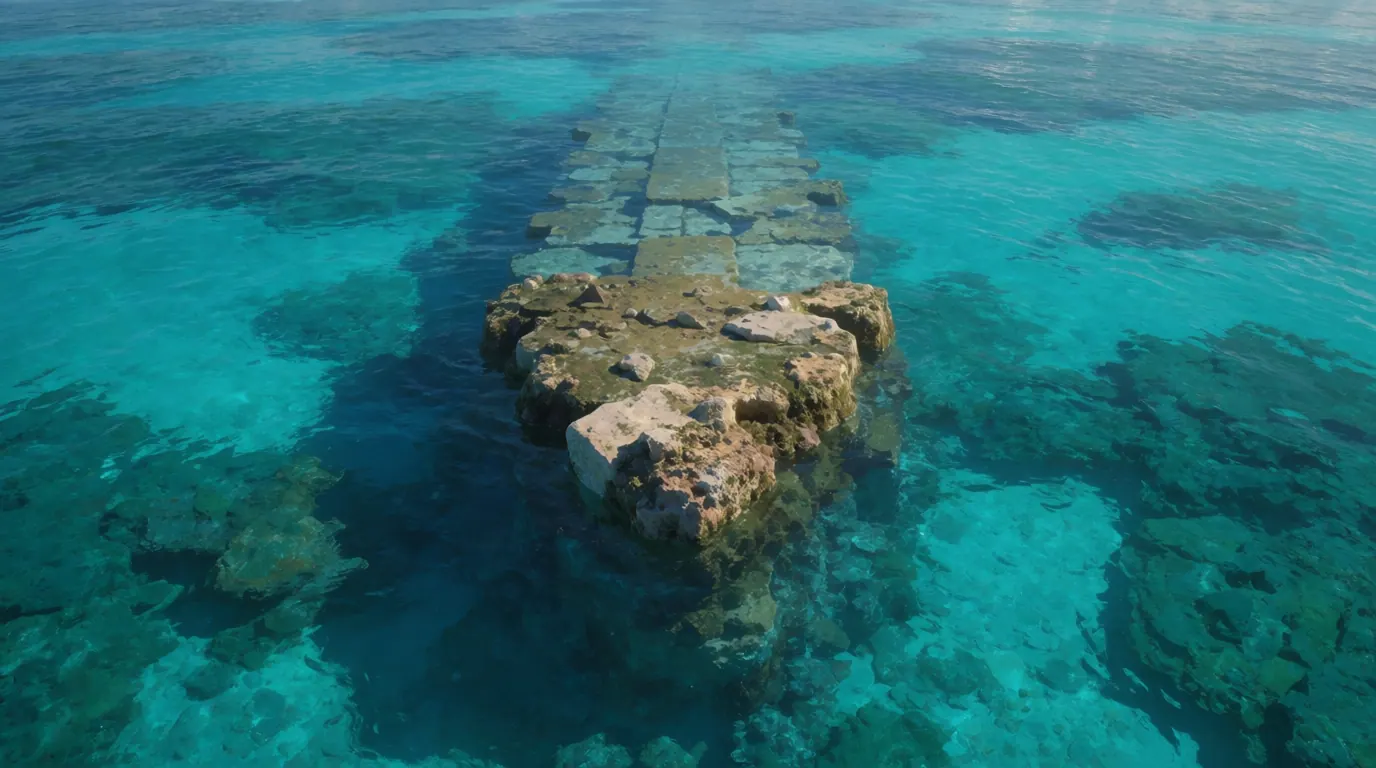
AI illustration (front view) for reference only.
AI ILLUSTRATION FOR REFERENCE ONLY

Bimini Road

Bimini Wall · Bimini pavement
MISIDENTIFICATION

Mainstream consensus: Natural beachrock fractured by joints and wave action; ages contradict an Atlantean road.

Share this page
Short answer

Bimini Road is a submerged limestone pavement off North Bimini that divers mapped in 1968 and Atlantis fans cast as a lost-city harbor wall. Geologists including McKusick and Shinn identify naturally jointed beachrock - radiocarbon ages of a few thousand years, far too young for Plato's Atlantis timeline.

On 2 September 1968, divers swam over a northeast-southwest line of large limestone blocks in about eighteen feet of water off North Bimini. From above, the jointed stones look enough like a roadbed that Atlantis paperbacks and Edgar Cayce tourism seized the nickname Bimini Road almost immediately.

Geologists who cored and dated the bed told a quieter story. Calcium-rich Bahamian seawater cements beach sand and shell hash into beachrock so quickly that modern litter can get trapped in the matrix. Joints then break that bed into tabular blocks with rounded edges - a natural pavement that McKusick and Shinn summarized for Nature in 1980. Radiocarbon ages in the few-thousand-year range undercut any claim that the stones are Plato-era Atlantean masonry.

The feature remains a wonderful dive and a stubborn meme. Compare the geology-first reading with Atlantis theories and with the Baghdad Battery, where a real object carries a rejected high-tech caption. AI plates are illustrative only. Rectangular does not equal quarried when a core sample and a radiocarbon date say beachrock.

Divers still photograph the pavement-like lines because the geometry is striking in clear Bahamian water. Geologists answer with bedding planes and beachrock fracture, not Atlantis city planning. The debate survives because underwater photography looks like architecture long after the petrography says otherwise.

Manson Valentine's 1968 dives and psychic Atlantis timelines still get reprinted beside sonar screenshots. Those retellings rarely quote thin-section petrography or tidal-cement models. A fair encyclopedia page keeps both the diver's pavement metaphor and the geologist's beachrock answer in the same paragraph so readers can see why the argument never dies. Bring a mask if you visit; bring a skepticism for city-grid overlays.

North Bimini charter boats still sell Atlantis snorkel runs across the block lines. Core samples and beachrock literature answer with cemented shoreline debris, not cyclopean masons. Hold the postcard and the petrography together: the seafloor pattern is real, the lost-city blueprint is the leap.

Sightings and object accounts

Attributed sightings, recoveries, and object histories from named sources. Links open the originals; AnomalyWiki does not verify these claims.

Claims vs mainstream

The claim

The pavement is a megalithic Atlantis harbor road.

Mainstream view

Surveys identify naturally cemented beachrock too young for a 10,000-year Atlantis reading.

The claim

Scientists ignore the site.

Mainstream view

USGS-linked geologists published Nature notes and coring studies specifically to test the claim.

The claim

Right-angle blocks prove quarrying.

Mainstream view

Beachrock commonly fractures into tabular polygons that look paved from above.

Timeline

  1. 1968-09-02Divers publicize the North Bimini pavement as an archaeological enigma.Source: Dive discovery summaries
  2. 1980McKusick and Shinn publish Bahamian Atlantis reconsidered in Nature.Source: USGS / Nature record
  3. 1980-09-24Christian Science Monitor summarizes the beachrock rebuttal for a general audience.Source: CSMonitor science reporting

FAQ

Is Bimini Road a real underwater structure?

Yes. Limestone blocks exist off North Bimini; the dispute is engineered versus natural beachrock.

Did geologists explain it?

The 1980 Nature note and later coring identify naturally cemented beachrock broken along joints.

Could it still be Atlantis?

Ages of a few thousand years are far too young for the popular 10,000-year Atlantis timeline.

Why do the blocks look rectangular?

Beachrock commonly develops orthogonal joints that separate into tabular polygons.

Can you still visit it?

Local dive operators still run trips; geology need not match the sales pitch.