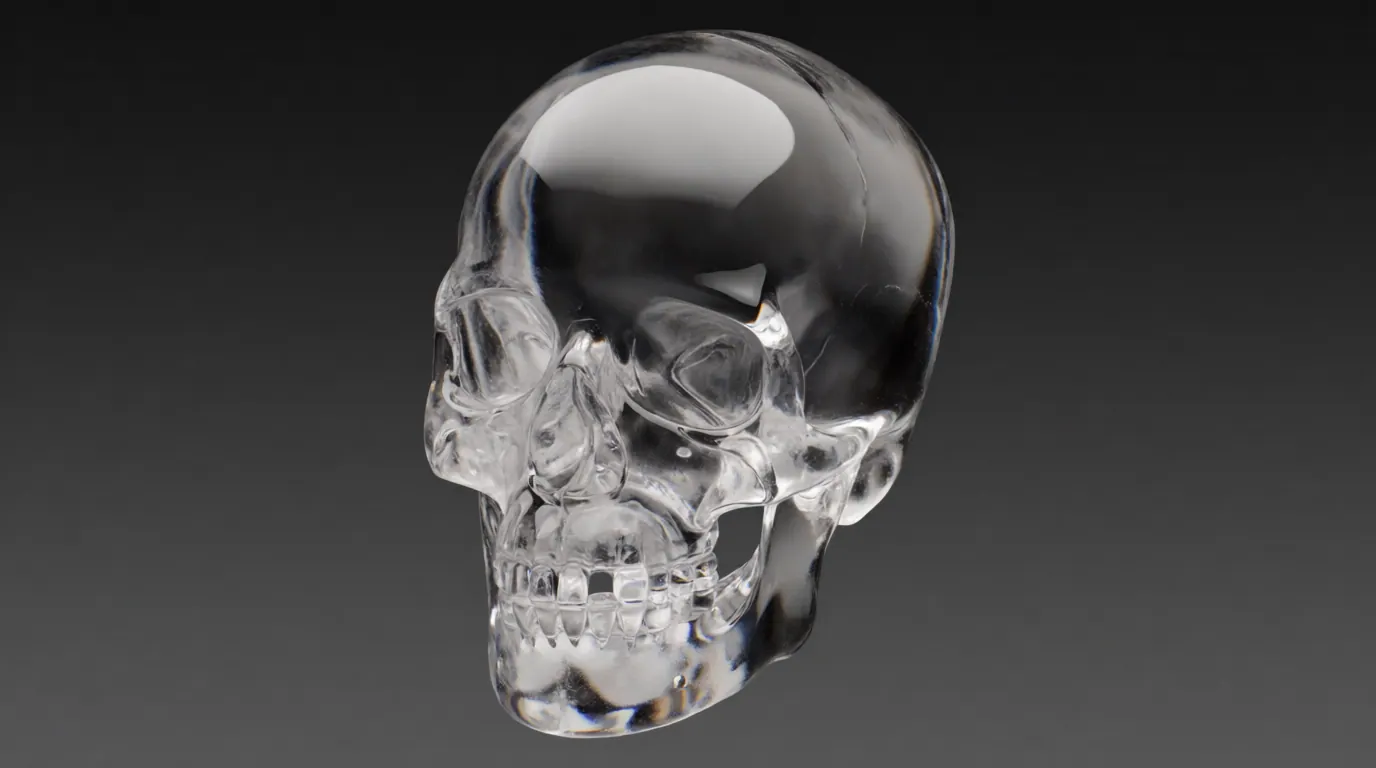
The crystal skull story runs on two timelines that rarely meet in the same sentence. One is Eugène Boban's antiquities trade, documented in sales ledgers and museum rejection letters. The other is a twentieth-century mystical narrative about ancient Maya knowledge sealed in quartz, kept alive mostly by retellings that never cite a lab result. The 2008 study finally put both timelines side by side.
A dealer's product line, not a temple relic
Boban sold carved rock-crystal skulls out of Mexico City and Paris starting in the 1880s, timed to a European fascination with Mexican antiquities after the fall of Maximilian's empire. Mexico's own national museum turned one down as a fake in 1885 - contemporary proof that doubts existed from the start, even as the British Museum bought its now-famous example from a different dealer in 1897 and displayed it as genuine for over a century.
What the electron microscope actually found
Margaret Sax and Jane MacLaren Walsh's team compared tool marks on the British Museum and Smithsonian skulls against securely dated Mesoamerican rock-crystal objects worked only with stone and wood tools charged with natural abrasives. The disputed skulls showed rotary lapidary-wheel grinding instead, a technology absent from the pre-Columbian record. The Smithsonian skull carried an even sharper tell: traces of carborundum, a synthetic abrasive that did not exist before the industrial era, embedded in a piece supposedly carved millennia earlier.
The Mitchell-Hedges detour
Anna Mitchell-Hedges spent decades telling audiences her father dug up his "Skull of Doom" at the Maya ruin of Lubaantun on her seventeenth birthday in 1924. Jane Walsh's archival work instead turned up a 1943 Sotheby's auction record showing F.A. Mitchell-Hedges simply bought the piece in London - a gap of nearly twenty years between the claimed find and the paper trail that actually exists. The excavation story did not disappear once the receipt surfaced; it just kept circulating in a different kind of literature.
Why the mystique outlasted the paperwork
Museum accession files and peer-reviewed tool-mark analysis settle the manufacture question cleanly, but neither document addresses the energy, prophecy, and telepathy claims that New Age writers layered onto the skulls starting in the 1970s. Those claims were never testable archaeology to begin with; they belong to a separate, parallel belief system that treats the objects as spiritual tools rather than museum specimens. Readers chasing provenance should start with the British Museum's own collection record and Walsh's archival research before any crystal-healing literature that skips the carbon-and-quartz facts entirely.