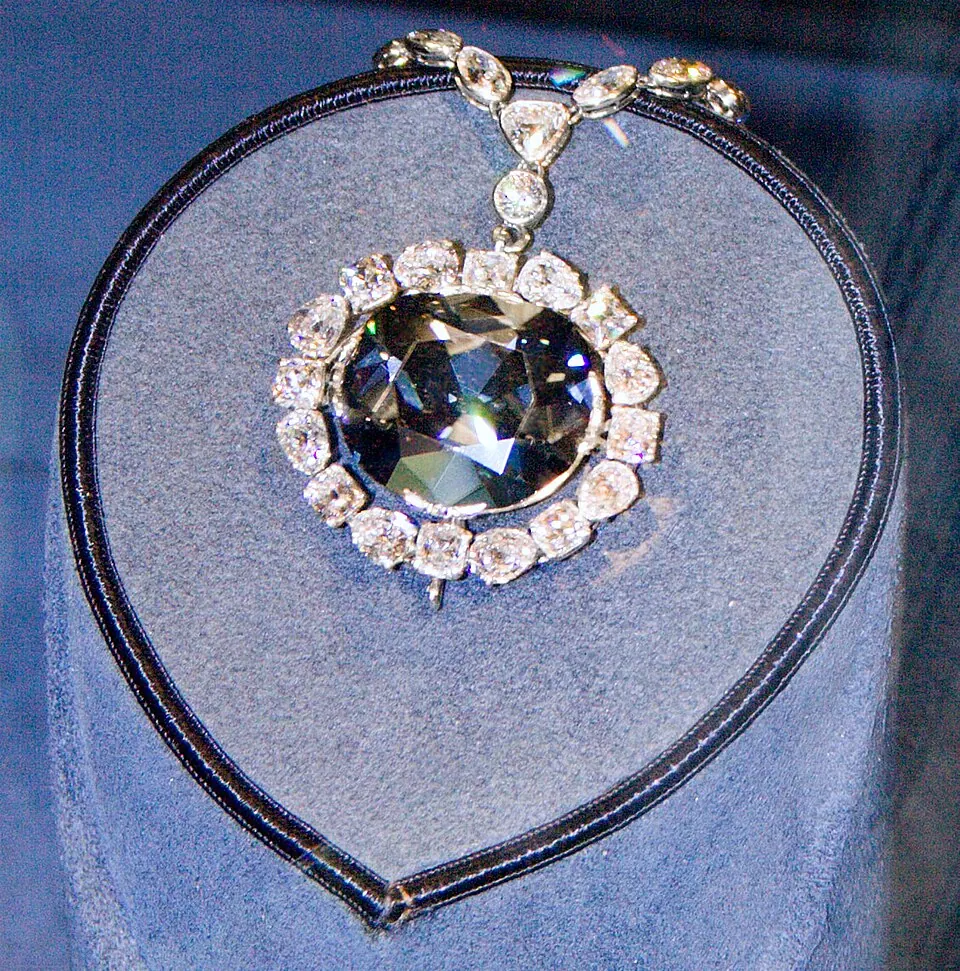
Visitors queue in Washington for a blue stone that glows red under ultraviolet light like a laboratory trick, yet still wears a hoodoo reputation from old newspapers. The Hope Diamond is real geology first: a boron-tinted type IIb crystal with measured weight, cut, and accession history at the National Museum of Natural History. The curse is a second layer, stitched from bankruptcies, wars, and family grief that happened near owners who also happened to own a famous gem.
From Golconda to the French Blue
Indian diamond trade routes fed European courts long before the modern name. Jean-Baptiste Tavernier's seventeenth-century purchase and Louis XIV's French Blue recut belong to archival gemology. When crown jewels were looted in 1792, the large blue stone vanished from official lists until a documented London appearance in 1812 tied the crystal to the Hope banking family. That lineage is contested detail by detail, but it is history on paper, not a séance claim.
Hoodoo headlines and Hollywood sparkle
The January 1908 Washington Post article calling the jewel a hoodoo turned vault gossip into a durable brand. Stage actress May Yohé later toured with curse songs; Evalyn Walsh McLean's flamboyant Washington life supplied fresh anecdotes for list writers. Each retelling ignored quiet decades when nothing dramatic occurred. Museums now treat the folklore as cultural color while publishing spectroscopy, phosphorescence timings, and cutting notes beside the case.
Reading the stone without the omen
Identification means the cushion brilliant face, the pendant frame of white diamonds, and the steel-sapphire body color in gallery photography. Glass replicas and unrelated listicle photos flood image search; the signature is the McLean-era mount and the Smithsonian display context. Pairing the Hope with the Koh-i-Noor shows how colonial-era transfers and royal drama invite omen talk around stones that remain physically ordinary crystals. Wonder at the color; keep bankruptcies in the economics column unless someone produces repeatable harm in a controlled test.
How Harry Winston mailed a celebrity
In November 1958, Harry Winston Inc. donated the stone and shipped it from New York to Washington by ordinary registered mail - a publicity flourish the Postal Museum still documents. Tour lore later hung a curse on carrier James Todd; the paperwork shows a package, not a hex. Once installed in the Harry Winston Gallery, the diamond became the museum's signature draw, with GIA visits and public UV demonstrations reinforcing the science story beside the gossip.
In popular culture
Period dramas, travel shows, and listicles still cut to the pendant whenever they need a shorthand for cursed wealth. Replicas and jewelry-store knockoffs blur search results, so the McLean-era mount and Smithsonian case remain the safest visual anchors. Enjoy the sparkle; read the accession notes when the hoodoo soundtrack swells.


