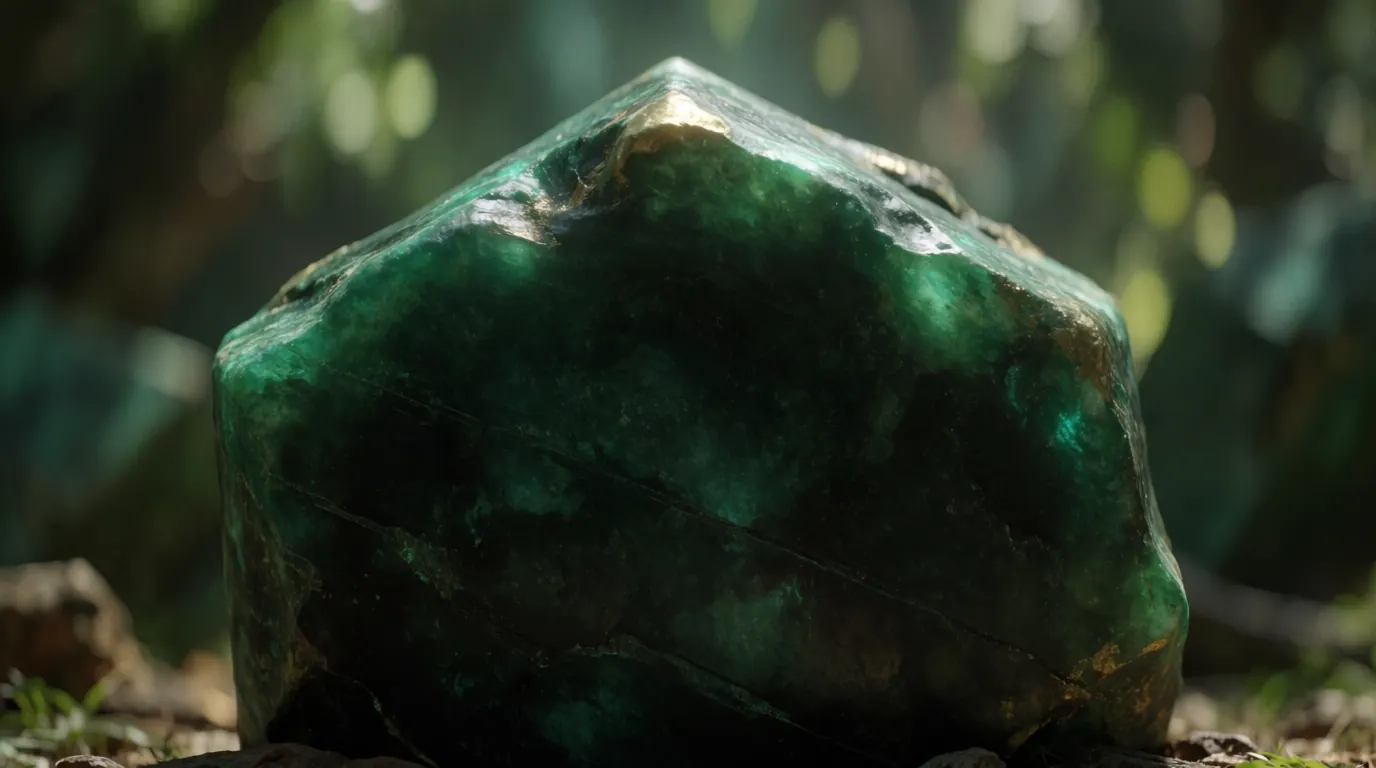
AI illustration for reference only, front view of the legendary Emerald Tablet.
AI ILLUSTRATION FOR REFERENCE ONLY

Emerald Tablet

Tabula Smaragdina · Smaragdine Table · Table of Emerald
FOLKLORE

Mainstream consensus: Historians of alchemy and manuscript scholars agree the Emerald Tablet is a real and well-documented text tradition with a verifiable Arabic-to-Latin transmission history, including Newton's own surviving translation manuscript. No museum, excavation report, or credible archive has ever produced a physical emerald or green-stone tablet matching the legendary description; the "tablet" label is understood academically as a literary device, not evidence of a lost physical artifact.

Share this page
Short answer

The Emerald Tablet, or Tabula Smaragdina, is a short Hermetic text - not a surviving physical slab - that circulated in Arabic manuscripts by the eighth century and reached medieval Europe in Latin translation, inspiring alchemists from Newton. No museum or excavation has ever produced the literal emerald tablet itself; the phrase describes a text tradition, not a found artifact.

Isaac Newton spent real time with the Emerald Tablet - just not the way popular retellings imply. His handwritten translation sits today in a Cambridge archive, catalogued and readable by any researcher. What he never touched, because it has never existed in any verifiable form, is a physical slab of green stone.

A text with a genuine paper trail

The Tabula Smaragdina's documented history runs through Arabic alchemical manuscripts of the sixth through eighth centuries, associated with the corpus attributed to Jabir ibn Hayyan, well before any European scholar encountered it. That transmission continued into Latin translations by the twelfth century, then into print across the following centuries of European alchemical literature. Every step of that chain is manuscript and printed-book history - the kind of evidence historians can actually examine, cross-reference, and date.

What Newton's manuscript actually proves

Keynes MS. 28, held at King's College, Cambridge, and catalogued by the Newton Project under record ALCH00017, is Newton's own handwritten English rendering of the Latin text. It documents his serious engagement with Hermetic alchemy during his years at Cambridge - a well-established part of his biography historians no longer treat as a footnote to his physics. It does not document contact with an actual stone tablet; it is ink on paper, translating ink on earlier paper.

Where the "lost artifact" framing comes from

The gap between "important historical text" and "lost ancient relic" opened widest in the early twentieth century, when occult writers began describing the tablet as a literal object rather than a transmitted document - echoing how cult retellings frequently upgrade a documented text or claim into a physical artifact nobody has ever produced. No excavation report, museum catalog, or credible archive has ever closed that gap with an actual stone.

Reading the legend against the manuscripts

The honest framing for any Emerald Tablet image is "illustration of a legendary object," not a photograph of a find. Readers interested in the real documented history should start with the Arabic-to-Latin transmission scholarship and Newton's own surviving translation rather than any retelling that treats the "tablet" in its name as proof a stone once sat somewhere waiting to be dug up.

Sightings and object accounts

Attributed sightings, recoveries, and object histories from named sources. Links open the originals; AnomalyWiki does not verify these claims.

Claims vs mainstream

The claim

A physical emerald tablet inscribed by Hermes Trismegistus exists or once existed and was later lost.

Mainstream view

No excavation, museum catalog, or credible historical record documents a physical tablet; every known version of the text survives as manuscript copies on paper or parchment.

The claim

Isaac Newton possessed or examined the actual Emerald Tablet artifact.

Mainstream view

Newton's surviving manuscript, Keynes MS. 28 at King's College, Cambridge, is his own handwritten translation of the text from a printed source - a scholarly working paper, not physical contact with a stone relic.

The claim

The text's authorship by "Hermes Trismegistus" proves a single ancient Egyptian author wrote it.

Mainstream view

Historians treat Hermes Trismegistus as a legendary composite figure used as an attribution device across many Hermetic texts written by different, unknown authors over centuries.

Timeline

  1. 6th-8th century CEEarliest known versions of the Emerald Tablet text appear in Arabic alchemical writing associated with the Jabir ibn Hayyan corpus.Source: Medievalists.net, "The Emerald Tablet: Alchemy's Most Mysterious Text"
  2. 12th centuryThe text reaches Latin Europe via translation from Arabic sources, entering the medieval alchemical canon as the Tabula Smaragdina.Source: Medievalists.net, "The Emerald Tablet: Alchemy's Most Mysterious Text"
  3. c. 1680sIsaac Newton handwrites his own English translation of the Latin text, now catalogued as Keynes MS. 28.Source: The Newton Project, Keynes MS. 28 (ALCH00017)
  4. 1920s onwardOccult and New Age writers increasingly describe the "tablet" as a literal lost physical artifact rather than a transmitted text.Source: Medievalists.net, "The Emerald Tablet: Alchemy's Most Mysterious Text"

FAQ

Does the actual Emerald Tablet exist in a museum?

No. Every surviving version is a manuscript or printed copy of the text; no physical emerald or stone tablet has ever been excavated or catalogued.

Did Isaac Newton own the real Emerald Tablet?

No. His surviving manuscript, Keynes MS. 28 at King's College, Cambridge, is his own handwritten English translation of the Latin text, not a physical relic.

Who wrote the Emerald Tablet?

Authorship is attributed to the legendary figure Hermes Trismegistus, a composite associated with Hermetic texts written by different, unidentified authors over centuries.

When does the text first appear in the historical record?

The earliest known versions date to the sixth through eighth centuries CE, embedded in Arabic alchemical writing associated with the Jabir ibn Hayyan tradition.

What is the tablet's most famous line?

"As above, so below" - a phrase condensing the text's core idea that patterns in the cosmos mirror patterns on Earth.

Is the Emerald Tablet connected to modern New Age "lost artifact" claims?

Yes, loosely - twentieth-century occult writers increasingly described the tablet as a literal lost physical object, a framing historians trace to retelling rather than to any new primary evidence.